Night Teeth Grinding (Bruxism) and Jaw Joint (TMJ) Pain
Do you wake up in the morning with jaw pain and fullness in your temples? Manual therapy support in temporomandibular joint (TMJ) dysfunction where a night guard alone is not enough.
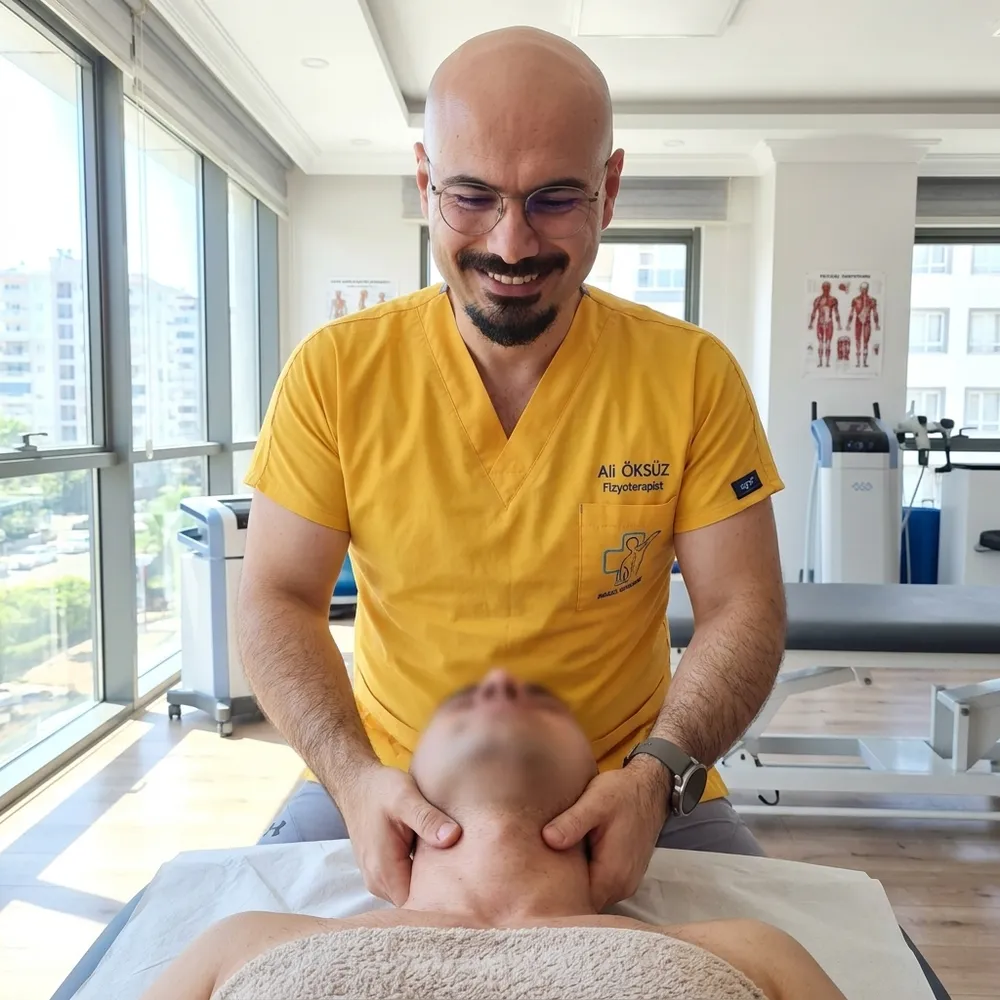
Physiotherapist Ali Oksuz | Private Health Profession Service Unit
Fizyoterapist
Hızlı Cevap
TMJ (jaw joint) dysfunction is directly related to neck mechanics and spasm in chewing muscles, not just dental occlusion. Intra-oral/extra-oral manual therapy and postural education applied after a dentist's diagnosis provide additional support to the night guard.
İçindekiler Tablosu
Night Teeth Grinding (Bruxism) and Jaw Joint (TMJ) Pain
A throbbing pain in your temples when you wake up in the morning, that annoying "click" sound you feel when opening your jaw, and feeling your jaw tire while eating... The habit of grinding teeth at night (bruxism) due to stress eventually disrupts the biomechanics of your jaw joint, called the Temporomandibular Joint (TMJ), turning into a chronic pain cycle. The night guard given by your dentist protects your tooth enamel wonderfully, but you need jaw joint physiotherapy to resolve that deep spasm in your muscles.
What Is Jaw Joint (TMJ) Physiotherapy?
Our jaw joint (TMJ) is an extremely complex structure that connects our skull with our lower jaw, which we use thousands of times a day to talk and chew. Bruxism (teeth grinding) causes very strong chewing muscles (Masseter and Temporal muscles) around this joint to overwork (hypertonus) and go into spasm.
- Mechanism: Constantly clenched muscles cause the cartilage disc inside the jaw joint to squeeze and slip forward. That "clicking" sound you hear when opening your jaw is the sound this disc makes when trying to snap back into place. In physiotherapy, we physically resolve this spasm in these muscles with specific manual therapy techniques performed both from the outside (cheek) and inside the mouth (intra-oral).
- Benefit: With the relaxation of the muscles, the abnormal load on the jaw is lifted. Restricted jaw opening (trismus) improves, headaches alleviate, and most importantly, that constant feeling of tension reflecting to the neck area disappears.
Who Performs It and How Is It Applied?
TMJ physiotherapy is applied by physiotherapists who work multidisciplinary with dentists and jaw surgeons (Maxillofacial surgery) and have received special training in this field.
- Biomechanical Assessment: Your mouth opening range (how many fingers you can open), whether the jaw deviates to the right or left when opening (deviation), and your neck posture are examined. The jaw and neck are directly connected to each other.
- Manual Intervention (Intra-oral and Extra-oral): Using clean gloves, ischemic compression and fascial release are performed by reaching the Masseter and Pterygoid muscles from inside the mouth. From the outside, the joint capsule is gently mobilized.
- Exercise Prescription: Special Rocabado exercises are given that will teach your brain to make the muscles work correctly and symmetrically again when opening and closing the jaw (motor control).
What Does Academic Evidence Say? (Literature)
The difference between using a night guard (splint) alone and supporting a night guard with physiotherapy is very clear in academic literature:
"According to controlled studies published in the Journal of Oral Rehabilitation in 2023, clinically much superior and permanent improvements in pain scores and jaw opening capacities were recorded in patients treated with a combination of 'Occlusal splint (night guard)' and 'Manual Therapy' for bruxism-related TMJ dysfunctions compared to those using a splint alone."
How Does the Physiotherapy and Rehabilitation Process Progress?
The TMJ process is usually a treatment that responds quickly but requires strict compliance with home exercises. Significant relief is achieved in an average of 4 to 6 sessions. The first sessions are heavy on intra-oral manual release and can be a bit sensitive, but the feeling of relief at the end of the session is very high. It has a very high success rate when progressed simultaneously with your dentist's treatment plan.
Safe Practices to Do at Home
- Correct Tongue Position: Your teeth should never touch each other when at rest. Correct jaw posture is: lips closed, teeth slightly separated from each other, tip of the tongue touching the palate just behind the upper teeth gently (N rest position).
- Soft Diet: In acute periods when your jaw is very painful, chewing gum, biting hard apples, or eating thick sandwiches will cause serious damage to the joint. Soft foods should be preferred for a short time.
- Warm Compress: Putting a hot water bag on your chewing muscles (the lower part of your cheeks) for 10-15 minutes twice a day speeds up blood flow and relieves spasms.
🚩 Red Flags (What NOT to Do!)
- When you hear a sound from your jaw, forcing the jaw to open and close to show that sound to friends saying "look how it makes sound" creates a dangerous destruction that can go as far as tearing the cartilage disc.
- The habit of constantly chewing gum causes the already overworked masseter (chewing) muscles to grow like a bodybuilder (hypertrophy), putting more pressure on the joint.
- Do not throw away your night guard (if your physician gave it to you) saying "it does not benefit me". That guard protects the tooth enamel; our job is to resolve the muscle spasm accompanying the guard. The two are a whole.
Need Biomechanical Support?
If you have been diagnosed by your physician, you can manage this problem, which reduces your quality of life, with evidence-based medical exercises under the guidance of a physiotherapist.
📍 Physiotherapist Ali Oksuz
Toros Mah. 801. Sok. No:4/4 Konyaalti / Antalya
👉 For consultation and appointments, reach us immediately on WhatsApp.
Legal Disclaimer
This page does not replace a physician's diagnosis or a definitive cure guarantee. It has been prepared based on physiotherapy science in accordance with the Health Advertising Regulation to increase health awareness.
Bu Konuyla İlgili Uygulamalarımız
Yazıda bahsedilen yöntemler aşağıdaki uygulamalarımız kapsamında yürütülür.
Sıkça Sorulan Sorular
Yazıyla ilgili en çok sorulan sorular. Cevabı bulamadığınız bir konu varsa doğrudan WhatsApp'tan yazabilirsiniz.
A night guard protects teeth from mechanical wear, but it does not resolve the chronic spasm in chewing muscles. Relaxing these muscles with manual therapy and postural correction supports the recovery.
Yes. Due to proximity to the trigeminal nerve, muscle tensions in the TMJ area can cause tension-type headaches in the temples.
The process begins with an evaluation by a dentist or oral-maxillofacial surgeon to clarify joint pathology, bite problems, or bruxism diagnosis. Following the physician's guidance, intra-oral/extra-oral manual therapy, chewing muscle release, and cervical posture training are planned individually. A physician evaluation should be prioritized before physiotherapy if severe locking, significant limitation in jaw opening, or a sudden change in bite has recently begun.
Şikayetinizi konuşmaya hazır mısınız?
Hekim teşhisi sonrası kişiye özel klinik fizyoterapi programı için bizi arayın veya WhatsApp'tan yazın. Sorularınız varsa cevaplamaktan memnuniyet duyarım.

About the Author
Physiotherapist Ali Oksuz
Expert physiotherapist providing clinical physiotherapy services in Konyaaltı, Antalya. Applies evidence-based approaches (Mulligan, Maitland, Vodder MLD) in manual therapy, lymphedema rehabilitation, clinical reformer pilates, and orthopedic rehabilitation. The articles convey the physiotherapy process after a physician's diagnosis for informational purposes; it does not replace medical treatment.