Jaw Pain After Dental Treatment: Post-Operative TMJ Physiotherapy
Jaw pain and difficulty opening your mouth after a long tooth extraction, implant or root canal treatment? Physiotherapy support for TMJ strain caused by keeping the mouth open for a long time.
Fzt. Ali Öksüz | Özel Sağlık Meslek Hizmet Birimi
Physiotherapist
Last updated: · Reviewed by: Fzt. Ali Öksüz
Quick Answer
Keeping the mouth forced open during long dental treatments can cause acute strain and micro-trauma in the chewing muscles around the jaw joint (TMJ). After a dental check, a program of manual therapy and home exercises, usually 2-4 sessions, is planned; duration varies from person to person.
Table of Contents
- What Happens Biomechanically in Your Jaw?
- Secondary Complaint Alert: Is It Only Your Jaw?
- How Does Manual Therapy Approach This Picture?
- How Does the Treatment Process Work and How Many Sessions Does It Take?
- Safe Practices at Home
- 🚩 Red Flags (What Not to Do!)
- Transparent Frequently Asked Questions (FAQ)
- 📚 Academic References and Evidence Base (EBM)
- Jaw Support After Dental Treatment in Antalya Konyaaltı
Jaw Pain After Dental Treatment: Post-Operative TMJ Physiotherapy
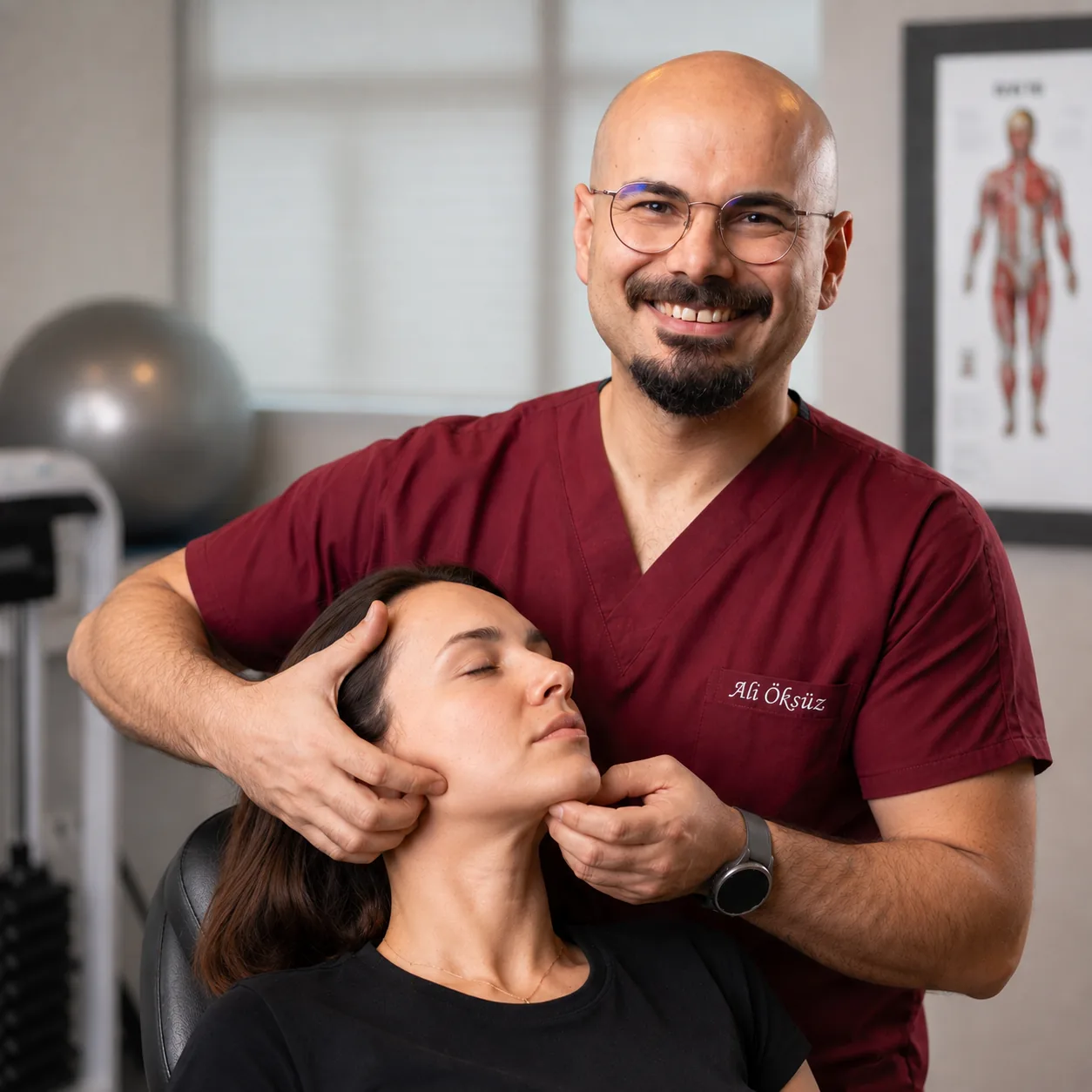 Physiotherapist Ali Öksüz applying manual therapy to the jaw joint (TMJ) area of a client at his clinic in Antalya Konyaaltı. The image was generated with artificial intelligence; it is not a real session photo.
If you have noticed unexpected pain, difficulty opening or a "locked" feeling in your jaw after a long tooth extraction, implant surgery or root canal treatment, you are not alone. Called "iatrogenic TMJ strain" in the dental literature, this is an acute overload of the chewing muscles and the jaw joint caused by keeping the mouth forced open for a long time. At our clinic in Antalya Konyaaltı, we manage this picture with gentle, drug-free manual therapy techniques, in coordination with dentists.
This article aims to explain clearly why jaw pain develops after dental treatment, which symptoms are within the normal limits of healing and how physiotherapy can support the process.
What Happens Biomechanically in Your Jaw?
A healthy jaw joint is rarely forced into excessive opening during everyday talking and chewing. In the dental chair, however, the mouth is held open statically and far beyond physiological comfort for 30-90 minutes.
- Static overload: In a jaw joint held open for a long time, blood flow to the chewing muscles (especially the lateral pterygoid and masseter) temporarily decreases. This triggers ischemic fatigue and protective spasm in the muscles.
- Joint capsule strain: When the joint capsule and surrounding connective tissue are held at an unusual opening for a long time, they may be mildly stretched (distension). This explains the feeling of "slipping" or "instability" in the first days after the procedure.
Secondary Complaint Alert: Is It Only Your Jaw?
Many clients who come to our clinic after dental treatment also describe the following secondary complaints:
- Complaint 1: A dull pain in front of the ear and at the temple that increases when chewing.
- Complaint 2: A sudden "catch" or restriction when trying to open the mouth wide.
- Complaint 3: Secondary tension in the neck and shoulder because the head was held still during the procedure.
- Complaint 4: A mild tension-type headache at the temple.
How Does Manual Therapy Approach This Picture?
Once your dentist has approved the treated area, the goal in physiotherapy is to relax the muscles and gently return the joint capsule to its normal physiological range. The classic "wait and hope it passes" approach can let the muscles stay in spasm and become chronic (turning into chronic TMJ dysfunction).
Our approach at the clinic:
- Gentle intra-oral/extra-oral soft tissue technique: Reducing acute spasm in the masseter and temporalis muscles with low-intensity ischemic compression techniques within pain-free limits.
- Controlled joint mobilization: Supporting the mild feeling of instability in the joint capsule with low-grade (Grade I-II) mobilization.
- Neurophysiological relief: Rhythmic touch applied to soft tissue activates natural mechanisms that reduce pain perception via the central nervous system.
For more comprehensive information on long-standing TMJ dysfunction and bruxism, see our TMJ (Jaw Joint) Problems treatment page.
How Does the Treatment Process Work and How Many Sessions Does It Take?
Acute TMJ strain after dental treatment can often respond in a shorter time than chronic cases:
- Session 1 (Assessment and relief): Measurement of mouth opening, deviation check and gentle soft tissue work aiming for relief.
- Sessions 2-3 (Mobility): Gradually increasing pain-free range of motion and reinforcing the home exercise program.
- Session 4 (Check): Re-assessment of functional chewing movements.
The program is usually planned as 2-4 sessions; progress is re-evaluated at every session and the duration varies from person to person. The process is safer when complaints are followed up together with your dentist.
Safe Practices at Home
- Soft diet: In the first days, avoid hard foods that require a wide bite (apples, thick sandwiches); cut food into small pieces.
- Warm compress: Applying a warm compress over the chewing muscles for 10 minutes twice a day can help reduce muscle tension.
- Controlled stretching: Opening and closing the mouth slowly and only a little, without pain, supports blood flow (your physiotherapist will recommend the angle and number of repetitions for you).
🚩 Red Flags (What Not to Do!)
- Testing by forcing your mouth open: Forcing the mouth fully open out of curiosity about "how far it opens" can further irritate the strained capsule.
- Chewing gum: It works the chewing muscles unnecessarily and delays recovery.
- Ignoring the pain and waiting: If acute spasm lasts for weeks without the right intervention, the risk of it turning into chronic TMJ dysfunction increases.
- Report suspicious signs in the treated area (swelling, fever, bleeding) to your dentist first, not the physiotherapist: Physiotherapy manages muscle and joint strain; the medical follow-up of the treated area is your dentist's responsibility.
Transparent Frequently Asked Questions (FAQ)
1. Do I need my dentist's approval before starting physiotherapy? Yes. The appropriate timing should be decided by your dentist based on how the treated area is healing. Physiotherapy for muscle and joint strain is applied after this approval.
2. Is a manual therapy session painful? No. Techniques used in the acute phase are applied at low intensity within pain-free limits.
3. Will this complaint come back? Acute strain related to a single dental treatment often does not recur. However, if frequent long dental procedures are planned, we can recommend simple warm-up exercises to relax the jaw muscles beforehand.
📚 Academic References and Evidence Base (EBM)
- Kim et al. Iatrogenic temporomandibular joint injury after prolonged mouth opening during dental treatment. Journal of Oral Rehabilitation.
- List T, Jensen RH. Temporomandibular disorders: Old ideas and new concepts. Cephalalgia, 2017.
- American Association of Oral and Maxillofacial Surgeons – Postoperative TMJ care guidelines.
Jaw Support After Dental Treatment in Antalya Konyaaltı
If you feel unexpected tension or pain in your jaw after dental treatment, with your dentist's approval we can plan a gentle, individual program at our clinic.
📍 Fzt. Ali Öksüz | Özel Sağlık Meslek Hizmet Birimi Toros Mah. 801. Sok. No:4/4 Konyaaltı / Antalya
👉 For a preliminary consultation and clinic appointment, contact us on WhatsApp.
Legal Disclaimer: This page does not replace a physician's diagnosis or a definitive cure promise. It has been prepared on the basis of physiotherapy science (articles and guidelines) to raise health awareness, in accordance with the Health Advertising Regulation.
Related Treatments
The methods described in this article are delivered within the following treatments.
Frequently Asked Questions
The most common questions about this topic. If you can't find your answer, message us directly on WhatsApp.
Mild muscle fatigue can last a few days, but if the pain lasts longer than 5-7 days, you have difficulty opening your mouth or your jaw deviates, this may mean a persistent spasm has developed in the chewing muscles; in that case a physiotherapy assessment is useful.
After your dentist approves the healing of the treated area, gentle manual therapy and stretching exercises can usually start within a few days to a week. The exact timing is set in coordination with your dentist.
In most cases, trismus due to prolonged mouth opening is temporary; the process can be supported with manual therapy. However, if opening does not improve on its own within weeks, a check by your dentist/oral surgeon is recommended to assess whether there is an underlying problem inside the joint.
Ready to talk about your complaint?
Call or message us on WhatsApp for a personalised clinical physiotherapy programme after your physician's diagnosis. I'm happy to answer your questions.
About the Author
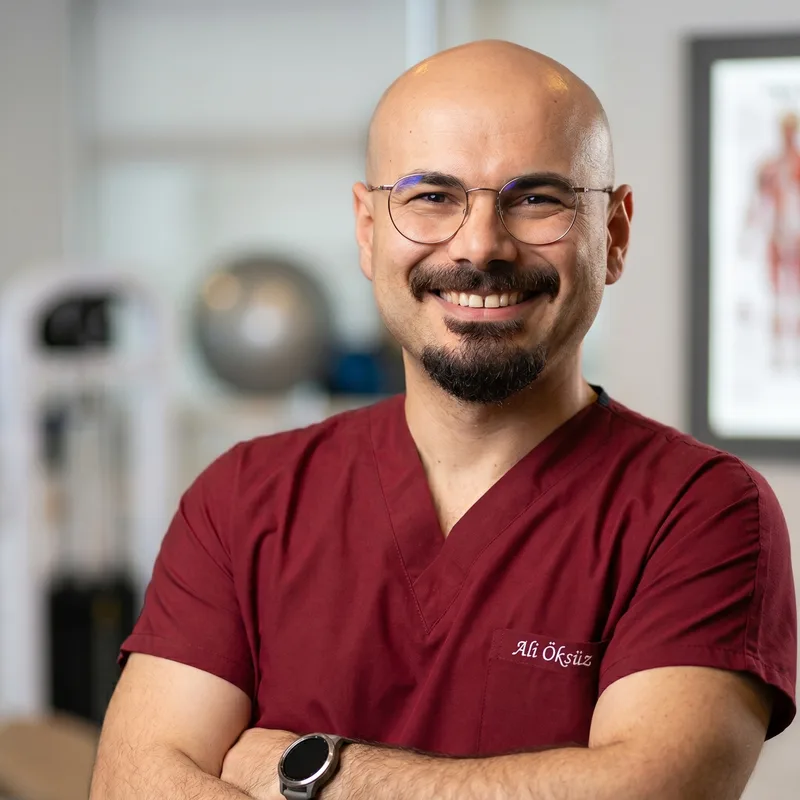
Physiotherapist Ali Oksuz
Physiotherapist providing clinical physiotherapy services in Konyaaltı, Antalya. Applies evidence-based approaches (Mulligan, Maitland, Vodder MLD) in manual therapy, lymphedema rehabilitation, clinical reformer pilates, and orthopedic rehabilitation. The articles convey the physiotherapy process after a physician's diagnosis for informational purposes; it does not replace medical treatment.