
Knee Osteoarthritis (Gonarthrosis) and Non-Surgical Physiotherapy
Do your knees creak, or do you struggle on the stairs? Learn about evidence-based physiotherapy approaches for knee osteoarthritis (gonarthrosis) after a physician's diagnosis.
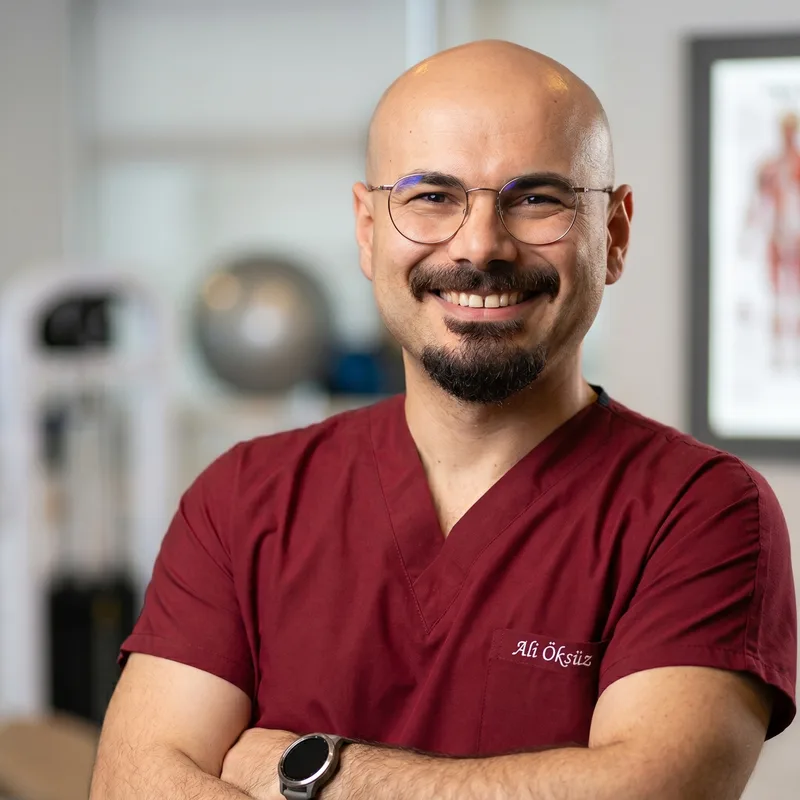
Fzt. Ali Öksüz | Özel Sağlık Meslek Hizmet Birimi
Physiotherapist
Last updated: · Reviewed by: Fzt. Ali Öksüz
Quick Answer
In knee osteoarthritis (gonarthrosis), a program of targeted quadriceps strengthening, controlled aerobic activity and manual mobilization applied after a physician's diagnosis is the first-line approach in international guidelines for managing pain and loss of function.
Table of Contents
Knee Osteoarthritis (Gonarthrosis) and Non-Surgical Physiotherapy
Do you feel stiffness and pain in your knees when you wake up in the morning or stand up after sitting for a long time? Are the stairs no longer as easy as they used to be? Often dismissed as a natural part of ageing, knee osteoarthritis (gonarthrosis) is in fact a biomechanical problem that can largely be managed with the right conservative approaches. You may be able to give your joint another chance before considering surgery.
What Is Knee Osteoarthritis and What Does Physiotherapy Do?
Knee osteoarthritis is the gradual wear, thinning and degeneration of the smooth cartilage covering the surfaces of the bones that form the knee joint. As the cartilage thins, the bones rub against each other more, leading to inflammation, pain and joint noises (crepitus).
- Mechanism: Weakness of the muscles around the knee (especially the front thigh muscles – quadriceps) causes the load on the knee joint to increase in an uncontrolled way. In physiotherapy we rebuild this disturbed biomechanics and strengthen the weakened muscles to take pressure off the joint.
- Benefit: Professional physiotherapy and manual therapy under physician follow-up cannot reverse cartilage wear, but by increasing the muscle strength around the joint they can help reduce pain. The aim is to improve circulation in the joint and range of motion.
Who Carries It Out and How?
Knee osteoarthritis rehabilitation should always be carried out by a licensed physiotherapist after diagnosis by an orthopaedic or physical medicine and rehabilitation (PM&R) physician. In the clinic, the process is planned entirely for you:
- Assessment: Your gait is analysed. Limitations in bending and straightening (flexion-extension) of your knee and muscle imbalances are identified.
- Manual Intervention: Using specific joint mobilization techniques (Mulligan or Maitland concepts), the physiotherapist aims to relax the knee joint capsule, release adhesions and prepare the joint for comfortable movement.
- Exercise Program: Clinical exercises that support maintaining the gains are given. Strengthening the quadriceps isometrically and isotonically at the angles allowed by the physician reduces the load on the kneecap (patella). Kinesiology taping can provide mechanical support to the joint.
What Does the Academic Evidence Say? (Literature)
The role of physiotherapy in knee osteoarthritis is supported by international guidelines:
"According to a recent meta-analysis published in the PubMed database in 2024, combining classic clinical exercise programs with 'manual therapy' (especially Mulligan mobilization techniques) was found to be effective in reducing pain and improving quality of daily life, not only in the short term but also in the medium and long term."
How Does the Rehabilitation Process Progress?
From the day the patient comes to the clinic, the process varies with the degree of damage (stage 1 to stage 4). A structured program of on average 6-12 sessions is planned. In the first sessions the goal is pain control and managing inflammation in the tissue. As pain eases, sessions turn into active clinical exercise focused on strengthening, balance (proprioception) and coordination (such as Clinical Pilates). The goal is not only to ease the current pain but to increase the joint's load-bearing capacity in the long term.
Safe Practices at Home
- Weight control: Every 1 kg lost reduces the load on your knees during walking by roughly 4 kg!
- Activity modification: During painful periods, avoid standing for long periods, squatting down and sitting cross-legged. Use your hands for support when getting up from a chair to reduce the load on your knees.
- Heat: If there is no acute condition (swelling, redness, warmth), a 15-20 minute warm compress (hot water bottle) around the knee can relax the muscles and provide relief in chronic pain.
🚩 Red Flags (What Not to Do!)
- Walking for hours on hard surfaces despite pain because "I have osteoarthritis, I must walk" can increase cartilage damage. Exercise should always be done within pain-free limits.
- Wearing a knee brace for months on a neighbour's advice without a physician's recommendation makes the muscles around the knee lazy and leads to atrophy (wasting).
- The basic approach in knee osteoarthritis is "strengthening the muscles". It is not possible to correct a biomechanical problem simply by applying cream or with hearsay remedies such as leeches or cupping.
Do You Need Biomechanical Support?
If your physician has made a diagnosis, you can manage this problem that lowers your quality of life with a physiotherapist, through medical exercise based on current literature.
📍 Fzt. Ali Öksüz
Toros Mah. 801. Sok. No:4/4 Konyaaltı / Antalya
👉 For a preliminary consultation and appointment, contact us on WhatsApp.
Legal Disclaimer
This page does not replace a physician's diagnosis or a definitive cure promise. It has been prepared on the basis of physiotherapy science to raise health awareness, in accordance with the Health Advertising Regulation.
Related Treatments
The methods described in this article are delivered within the following treatments.
Orthopedic Rehabilitation
Pre-operative (Pre-op) and Post-operative (Post-op) Process Management
Learn moreClinical Reformer Pilates in Antalya
Personalized Reformer Pilates with Physiotherapist Ali Öksüz · Konyaaltı
Learn moreManual Therapy & Joint Mobilization
International Evidence-Based (EBM) Joint and Spine Rehabilitation
Learn moreFrequently Asked Questions
The most common questions about this topic. If you can't find your answer, message us directly on WhatsApp.
The decision belongs to your physician. In early to moderate osteoarthritis, conservative physiotherapy can help delay surgery or reduce its necessity; in advanced stages a prosthesis may be considered.
Correctly dosed, individual, physician-approved exercise does not harm the knee; on the contrary, it supports the nourishment of the joint cartilage and muscular protection.
International guidelines such as OARSI and EULAR define quadriceps-focused strengthening, low-impact aerobic activity and patient education as first-line approaches in knee osteoarthritis. Manual mobilization and individual exercise programs can provide meaningful support for pain and function. The process is planned according to the physician's diagnosis and radiological staging; the level of improvement differs for each case and no standard recovery time can be promised.
Ready to talk about your complaint?
Call or message us on WhatsApp for a personalised clinical physiotherapy programme after your physician's diagnosis. I'm happy to answer your questions.
About the Author
Physiotherapist Ali Oksuz
Physiotherapist providing clinical physiotherapy services in Konyaaltı, Antalya. Applies evidence-based approaches (Mulligan, Maitland, Vodder MLD) in manual therapy, lymphedema rehabilitation, clinical reformer pilates, and orthopedic rehabilitation. The articles convey the physiotherapy process after a physician's diagnosis for informational purposes; it does not replace medical treatment.