Neuroplasticity and Gait Rehabilitation After Stroke
Regaining independence after a stroke builds on the brain's capacity to relearn. Evidence-based physiotherapy approaches in neurological rehabilitation.
Fzt. Ali Öksüz | Özel Sağlık Meslek Hizmet Birimi
Physiotherapist
Last updated: · Reviewed by: Fzt. Ali Öksüz
Quick Answer
The core principle of stroke rehabilitation is neuroplasticity: the brain's ability to form new neural connections. Task-oriented gait training, balance work and spasticity management, started early under physician follow-up, support functional independence.
Table of Contents
Neuroplasticity and Gait Rehabilitation After Stroke
A stroke, caused by a sudden interruption of blood flow to the brain or by a brain haemorrhage, is a serious event that changes the life not only of the patient but of the whole family in an instant. Weakness on one side of the body (hemiplegia), balance problems and difficulty walking may look frightening at first, but a proper "neurological rehabilitation" process starting right after the neurologist's acute treatment is one of the main scientific ways to support the recovery of lost abilities.
What Is Neuroplasticity and What Does Physiotherapy Do?
The medical world used to believe that "once brain cells die, they never regenerate and function never returns". Today's neuroscience, however, has shown that the brain has a capacity for reorganization called "neuroplasticity".
- Mechanism: Neuroplasticity is the capacity of the intact parts of the brain to take over the tasks of the damaged area by building new neural pathways ("highways"). In physiotherapy, a large number of repetitive, goal-directed movements support the brain in building these new pathways.
- Benefit: Muscle weakness (paresis) and excessive muscle tone (spasticity) are managed. The aim is for the patient to relearn rolling in bed, sitting without support, standing up and, where possible, walking safely. The main goal is to support the highest possible independence in activities of daily living.
Who Carries It Out and How?
Stroke rehabilitation is very different from ordinary exercise. It is programmed individually by physiotherapists trained in neurological physiotherapy concepts (Bobath, PNF).
- Assessment: The patient's bed mobility, trunk balance, degree of spasticity (muscle stiffness) and gait pattern are examined in detail.
- Postural Control and Weight Shifting: To send the right signals to the brain, the body first needs to be correctly aligned. Weight is safely shifted onto the affected side so that the brain can "feel" that side again.
- Task-Oriented Training: Simply lifting a leg in bed does not train the brain. Tasks that are meaningful in daily life, such as "reaching for a glass" or "picking up an object from the floor and putting it on the table", help reprogram the brain more effectively.
What Does the Academic Evidence Say? (Literature)
The World Health Organization (WHO) and international stroke guidelines emphasize the importance of early rehabilitation:
"American Heart Association / American Stroke Association (AHA/ASA) guidelines recommend starting rehabilitation early, at an appropriate dose, once the physician approves and the patient is medically stable. Very early, high-intensity mobilization within the first 24 hours, however, is not recommended. Neuroplasticity is usually most active in the first 3-6 months."
How Does the Rehabilitation Process Progress?
Stroke rehabilitation is not a sprint but a marathon that requires patience. Recovery is usually fastest in the first 3 to 6 months, but neuroplasticity can continue even years later. The process begins with passive joint movements and rolling in bed, then gradually progresses to sitting balance, standing in parallel bars and finally stepping (walking). Your physiotherapist works not only with the patient but also with relatives, teaching the positioning that needs to be done at home.
Safe Practices at Home
- Correct positioning: When the patient is lying down or sitting in a wheelchair, the shoulder and arm on the affected side must always be supported with a pillow. An arm left hanging can cause a painful partial dislocation of the shoulder (subluxation).
- Give constant stimulation: As a relative, always stand on the patient's affected side. Put the TV on that side and offer drinks from that side. Encourage the brain to use (and become aware of) the side it has "forgotten".
- Mental practice: Even if the patient cannot physically do it, ask them to "close their eyes and imagine" performing a movement with the affected side that they can do with the healthy side. Mental practice activates the motor cortex much as if the movement had actually been performed.
🚩 Red Flags (What Not to Do!)
- When helping the patient stand up or into a wheelchair, never pull on the affected arm! Because the muscles around the shoulder are weak, partial shoulder dislocation and long-lasting severe shoulder pain can develop.
- Don't do everything for the patient out of pity. Doing tasks for them undermines the brain's relearning of those movements. Support only as much as needed.
- Instead of alternative practices with weak scientific support, it is recommended to dedicate the first 6 months (the neuroplasticity window) to a regular rehabilitation program under medical guidance.
Do You Need Biomechanical Support?
If your physician has made a diagnosis, you can manage this problem that lowers your quality of life with a physiotherapist, through medical exercise based on current literature.
📍 Fzt. Ali Öksüz
Toros Mah. 801. Sok. No:4/4 Konyaaltı / Antalya
👉 For a preliminary consultation and appointment, contact us on WhatsApp.
Legal Disclaimer
This page does not replace a physician's diagnosis or a definitive cure promise. It has been prepared on the basis of physiotherapy science to raise health awareness, in accordance with the Health Advertising Regulation.
Related Treatments
The methods described in this article are delivered within the following treatments.
Frequently Asked Questions
The most common questions about this topic. If you can't find your answer, message us directly on WhatsApp.
It is preferable to start as early as possible once the physician approves and the patient is haemodynamically stable. Early mobilization supports the recovery potential.
Neuroplasticity continues for years. Physiotherapy in the later stages can also support functional gains; goals are set individually.
Following the principle of task-oriented repetition, reinforcing the movement patterns learned in the clinic throughout the day supports neuroplasticity. Family members are taught by the physiotherapist about transfers, safe walking, fall prevention and correct assistance techniques in daily activities. When adapting the home environment and choosing the necessary assistive devices are considered together with the individual program, in line with the guidance of the neurologist and the rehabilitation team, functional independence goals can be supported more sustainably.
Ready to talk about your complaint?
Call or message us on WhatsApp for a personalised clinical physiotherapy programme after your physician's diagnosis. I'm happy to answer your questions.
About the Author
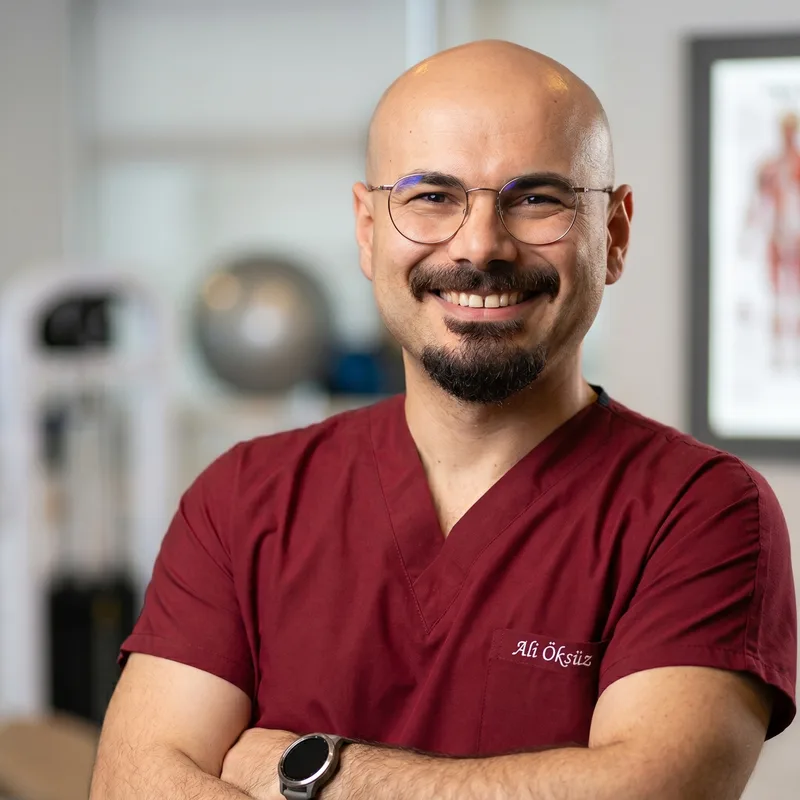
Physiotherapist Ali Oksuz
Physiotherapist providing clinical physiotherapy services in Konyaaltı, Antalya. Applies evidence-based approaches (Mulligan, Maitland, Vodder MLD) in manual therapy, lymphedema rehabilitation, clinical reformer pilates, and orthopedic rehabilitation. The articles convey the physiotherapy process after a physician's diagnosis for informational purposes; it does not replace medical treatment.