
Why Should People With a Herniated Disc Do Clinical Pilates?
Diagnosed with a herniated disc and afraid to exercise? Strengthen your spine safely with Clinical Reformer Pilates guided by a physiotherapist.
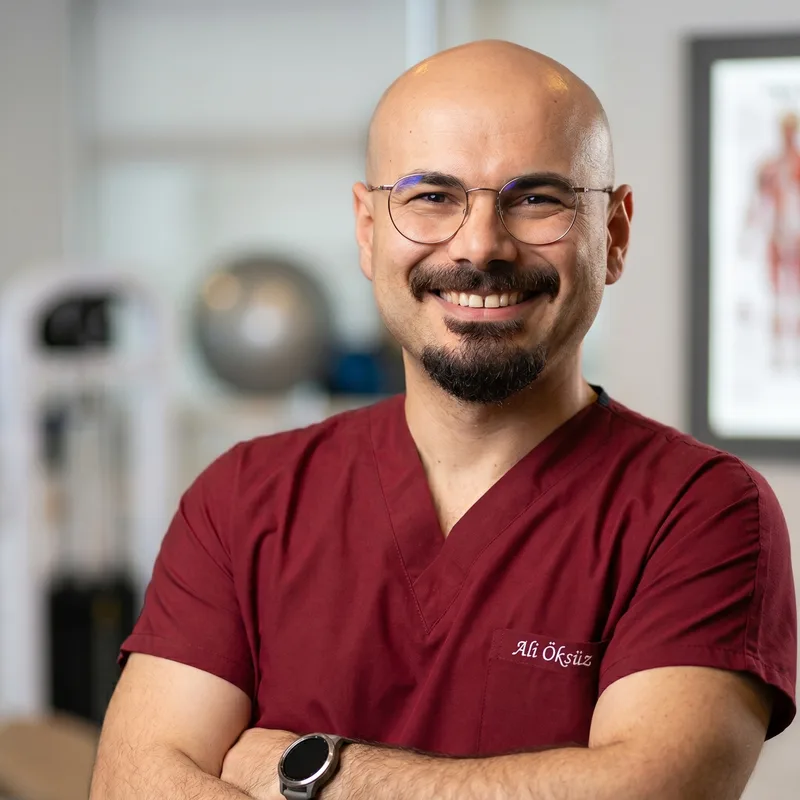
Fzt. Ali Öksüz | Özel Sağlık Meslek Hizmet Birimi
Physiotherapist
Last updated: · Reviewed by: Fzt. Ali Öksüz
Quick Answer
In lumbar or cervical disc herniations diagnosed by a physician, clinical reformer pilates applied under physiotherapist supervision with the neutral spine principle supports the rehabilitation process by safely strengthening the deep spinal stabilizers.
Table of Contents
Why Should People With a Herniated Disc Do Clinical Pilates?
You had an MRI of your lower back or neck and your physician said, "you have a herniated disc." From that moment you started restricting your life, being afraid to bend and worrying with every small movement: "will my disc burst?" Once the acute pain has eased with physiotherapy and manual therapy, the real question is: How can I prevent this herniation from coming back? One of the recommended approaches is to strengthen the muscles that surround your spine – in other words, physician-approved "Clinical Reformer Pilates" guided by a physiotherapist.
What Is Clinical Pilates and How Is It Different From Studio Pilates?
Many people confuse group pilates classes at the gym with clinical pilates. Studio pilates is taught by instructors to help "healthy" people tone up and stretch. Clinical Pilates, on the other hand, is a medical exercise program applied in a clinical setting entirely by "physiotherapists" to people with MRI findings and a physician's diagnosis (herniated disc, scoliosis, meniscus problems, etc.).
- Mechanism: Our lower back and neck are supported from within by deep muscles known as the "core" muscles. When these muscles weaken, the load of gravity falls on the spinal discs (the herniation). Using the spring system of the reformer, clinical pilates reduces the load on the spine (counterbalancing gravity) and trains those deep supporting muscles in a targeted way.
- Benefit: The aim is for stronger core muscles to help reduce the mechanical pressure on your discs, ease morning stiffness, support your posture and reduce the risk of injury from sudden movements in daily life.
Who Carries It Out and How?
Only licensed physiotherapists, who have studied anatomy, kinesiology and the pathophysiology of diseases in detail over 4 years at university, can deliver clinical pilates.
- Physical Assessment: Based on your physician's diagnosis, we analyse which movements could harm you and which will relieve your spine (flexion vs. extension principles). For example, forward-bending movements are risky with a lumbar disc herniation, while backward-bending movements can increase pain with spinal stenosis.
- Modified Exercises: Classic pilates movements are "modified" by the physiotherapist so that they do not harm your condition. Special spring resistances are set according to joint range.
- Motor Control: The aim is not only to tire the muscle but to teach your brain "how" to use that muscle at the right time (motor control).
What Does the Academic Evidence Say? (Literature)
The effect of clinical exercise on lumbar disc herniation has been examined in many academic studies:
"Evidence-based (PEDro) studies in the physical medicine and rehabilitation literature report positive effects on pain and function, and a contribution to reducing recurrent pain episodes, in patients with a history of lumbar disc herniation who perform specific 'core stabilization' (clinical pilates) exercises under physiotherapist supervision."
How Does the Rehabilitation Process Progress?
If you have severe numbness in the leg, loss of strength and very sharp pain (the acute phase), clinical pilates is not started. First, inflammation and pain are reduced with your physician's medical treatment or the physiotherapist's manual therapy. Once the pain is at a tolerable level, one-to-one reformer pilates sessions start twice a week. The program is usually planned over 2-3 months; duration and results vary from person to person.
Safe Practices at Home
- Daily walking: Inactivity is one of the biggest enemies of a herniated disc. Brisk 30-40 minute walks in proper shoes on soft ground or a running track help nourish the spinal discs.
- Correct bending (hip hinge): When picking something up from the floor, instead of bending at the waist with straight knees, push your hips back and bend your knees slightly (squat) to transfer the weight to your leg muscles.
🚩 Red Flags (What Not to Do!)
- Trying "one-size-fits-all" pilates movements from online videos, by people who know nothing about your spinal health, with a herniated disc is asking for trouble.
- Don't remove lifting and sport from your life completely because "I have a herniated disc". A weak back can be injured by even a small cough. What matters is not "how much" you lift, but "how" you manage that load biomechanically.
Do You Need Biomechanical Support?
If your physician has made a diagnosis, you can manage this problem that lowers your quality of life with a physiotherapist, through medical exercise based on current literature.
📍 Fzt. Ali Öksüz
Toros Mah. 801. Sok. No:4/4 Konyaaltı / Antalya
👉 For a preliminary consultation and appointment, contact us on WhatsApp.
Legal Disclaimer
This page does not replace a physician's diagnosis or a definitive cure promise. It has been prepared on the basis of physiotherapy science to raise health awareness, in accordance with the Health Advertising Regulation.
Related Treatments
The methods described in this article are delivered within the following treatments.
Frequently Asked Questions
The most common questions about this topic. If you can't find your answer, message us directly on WhatsApp.
Studio pilates can carry risks; clinical pilates, however, is modified by the physiotherapist for your case. After physician approval, it can be applied under physiotherapist supervision.
The reformer's spring resistance can make a movement easier or harder, so it adapts to every fitness level. Mat pilates relies on body weight; in clinical use, the reformer provides more controlled loading.
In disc problems with acute neurological signs, uncontrolled high blood pressure, certain periods before/after recent surgery, advanced osteoporosis or when a physician has restricted mobilization, the program should be postponed or modified. That is why the physician's diagnosis and imaging findings are reviewed first at every application; after a suitability assessment, the physiotherapist creates an individual, evidence-based program. The process is always carried out within the framework of medical guidance.
Ready to talk about your complaint?
Call or message us on WhatsApp for a personalised clinical physiotherapy programme after your physician's diagnosis. I'm happy to answer your questions.
About the Author
Physiotherapist Ali Oksuz
Physiotherapist providing clinical physiotherapy services in Konyaaltı, Antalya. Applies evidence-based approaches (Mulligan, Maitland, Vodder MLD) in manual therapy, lymphedema rehabilitation, clinical reformer pilates, and orthopedic rehabilitation. The articles convey the physiotherapy process after a physician's diagnosis for informational purposes; it does not replace medical treatment.