
Antalya Sacroiliac Joint Pain Treatment and Pelvic Exercise
Do you have persistent lower back, hip, and leg pain in Antalya? Read about sacroiliac joint pain clinical treatment, manual therapy, and pelvic stabilization exercise.

Physiotherapist Ali Oksuz | Private Health Profession Service Unit
Physiotherapist
Last updated: · Reviewed by: Fzt. Ali Öksüz
Quick Answer
Sacroiliac joint pain (pelvic locking) is often confused with lumbar disc herniation. After diagnosis, it can be managed conservatively (without surgery) using targeted physiotherapy approaches such as manual mobilization, muscle energy techniques (MET), and clinical reformer pilates.
Table of Contents
- Biomechanical and Neurophysiological Aspects: What Are You Experiencing?
- Secondary Symptoms Alert: Is It Only Your Hip That Hurts?
- Treatment Protocol: How Does the Process Work and How Many Weeks Does It Take?
- Solution Specifications: "Sleeping Muscles" and Reformer Pilates
- 🚫 Dangerous Mistakes to Avoid!
- FAQ
- 📚 Academic Bibliography and Evidence-Based Medicine (EBM)
- Advanced Physiotherapy Support in Antalya Konyaalti
Antalya Sacroiliac Joint Pain and Clinical Treatment Approach
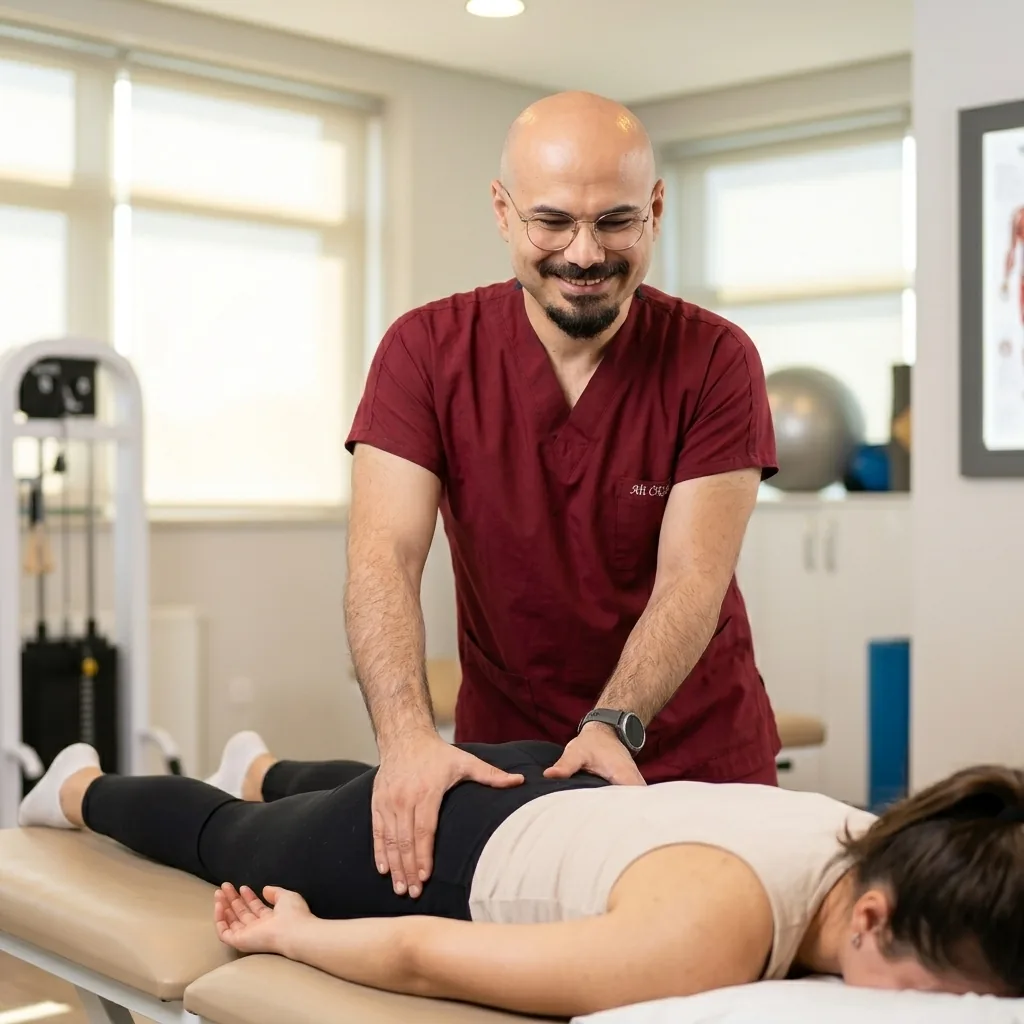 * This image does not depict an actual clinical application. It was created using AI, modeled after Physiotherapist Ali Oksuz, for promotional and visionary purposes.
Do you feel a deep, single-sided, and uncomfortable pain just below your waist, at the back of your hip? Does a sharp pain suddenly shoot through your hip when getting out of bed, putting on your socks, or getting out of a car? Often, patients with these complaints are approached with suspicion of a "herniated disc" (lumbar disc herniation); however, when the MRIs are clean or the herniated disc treatments do not relieve the pain, the real culprit is overlooked: Sacroiliac Joint Dysfunction.
At our clinic in Antalya Konyaaltı, we identify the underlying biomechanical and functional lockings that cause your persistent lower back and hip pain. We plan a process aimed at long-term gains using evidence-based physiotherapy and manual therapy methods.
Biomechanical and Neurophysiological Aspects: What Are You Experiencing?
The sacroiliac joint (SIJ) is one of the strongest and least mobile joints in our body, connecting the triangular bone at the very bottom of your spine (sacrum) to your pelvis (ilium). Its primary function is to transfer the weight of the upper body to the legs and absorb the shock waves generated during walking and running.
However, according to Kinetic Chain Principles, even the slightest imbalance in this joint activates compensatory mechanisms throughout the entire body:
- Mechanical Load Distribution: The sacroiliac joint is wrapped with strong ligaments and muscles to ensure pelvic stability. In cases such as pregnancy, falls, leg length discrepancy, or incorrect heavy lifting, this joint may become less mobile than it should be (hypomobility / locking) or move too much due to laxity of the ligaments (hypermobility). This situation leads to excessive friction on joint surfaces and local inflammation.
- Kinetic Chain Balance: When the sacroiliac joint is locked, the immobile pelvis forces the upper lumbar spine and lower hip/knee joints to work excessively during walking. In other words, the locking of your sacroiliac joint can pave the way for a lumbar disc herniation, hip osteoarthritis, or knee pain over time.
Secondary Symptoms Alert: Is It Only Your Hip That Hurts?
The ligaments and nerve networks around the sacroiliac joint are highly dense. Mechanical stress in this region triggers the following secondary complaints:
- Symptom 1 (Venus Dimple Pain): The pain is localized precisely at the "dimple" point on your lower back and creates severe tenderness when pressed.
- Symptom 2 (Thigh Pain): The pain can radiate from the hip to the back of the thigh, and sometimes into the groin area. This is easily confused with sciatica or a herniated disc.
- Symptom 3 (Difficulty Changing Positions): Locking in the hip and limping during the first few steps are common when standing up after sitting for a long time. Climbing stairs or turning over in bed can become a challenge.
How Does Manual Therapy Approach the Sacroiliac Joint?
In classic approaches, applying heat or using painkillers only offers temporary relief to the painful hip region because the problem is mechanical and requires a mechanical intervention. In our clinic, when managing sacroiliac joint pain, we focus not just on relieving the pain but on re-establishing the biomechanical balance of the pelvis.
What Do We Do Biomechanically in a Session?
- 1. Muscle Energy Techniques (MET): In cases where the pelvis is rotated forward or backward (pelvic torsion), we utilize your body's own muscle contractions instead of forceful manipulations. By resisting a gentle force you apply, we aim to support pelvic alignment in a gentle and controlled way.
- 2. Maitland and Mulligan Joint Mobilization: We apply rhythmic, gentle, and glide-oriented mobilizations to free up the locked joint. These rhythmic movements reduce tension in the ligaments while sending neurophysiological signals (Descending Pain Inhibition) to the brain to suppress pain.
- 3. Myofascial Release and Piriformis Therapy: When the sacroiliac joint is inflamed, surrounding muscles like the Piriformis, Gluteus Medius, and Iliopsoas spasm excessively as a protective response, creating painful trigger points. We resolve these deep muscle spasms using myofascial release and ischemic compression to lift the heavy pressure off the pelvis.
Treatment Protocol: How Does the Process Work and How Many Weeks Does It Take?
After a physician's diagnosis, sacroiliac joint dysfunction can often be managed non-surgically with holistic physiotherapy. The program in our clinic generally spans 4 to 6 weeks; duration varies from person to person:
- Phase 1 (Acute & Pain Management - Weeks 1-2): The primary goal is to calm the inflammation in the joint, relax muscle spasms, and initiate joint movement through gentle manual mobilizations.
- Phase 2 (Mobility & Alignment - Weeks 3-4): Active mobilizations and muscle energy techniques take center stage to correct pelvic symmetry, stretch shortened hip and leg muscles, and completely eliminate joint lockings.
- Phase 3 (Stabilization & Protection - Weeks 5-6): We transition to medical exercise and clinical reformer pilates to strengthen the pelvic stabilizers (Gluteus Medius, Transversus Abdominis, and Pelvic Floor muscles) that reduce the load on the joint and keep it in the correct alignment.
Solution Specifications: "Sleeping Muscles" and Reformer Pilates
The greatest enemy of the sacroiliac joint is weak hip (especially Gluteus Medius) and weak abdominal (Core) muscles. When these muscles "sleep", the corset mechanism that holds your pelvis in place collapses, and all the load is transferred onto the joint's ligaments.
The Clinical Reformer Pilates we apply in the stabilization phase of our sessions aligns the pelvis by neutralizing gravity. Thanks to the controlled resistance of springs, we strengthen the deep stabilizer muscles without stressing the joints. This is the most crucial biomechanical investment ensuring the permanence of the treatment.
🚫 Dangerous Mistakes to Avoid!
- Uncontrolled Sudden Cracking (Manipulations): If there is ligament laxity (hypermobility) in the sacroiliac joint, forceful and uncontrolled cracking causes the joint to become even looser, leading to chronic pain.
- Continuous Corset Use: Pelvic support belts (sacroiliac corsets) should only be used for short periods during highly acute painful phases. Continuous use weakens hip and core muscles, leaving the joint unprotected.
- Performing Excessive Stretching Exercises: Uncontrolled glute stretches seen online can overstretch the already unstable joint ligaments, making the pain chronic.
FAQ
1. I was recommended surgery for a herniated disc, but could my pain actually be coming from the sacroiliac joint? Yes, this is very common in medical literature. Even if a herniated disc is visible on the MRI, the actual source of the pain may be the sacroiliac joint. The source must be differentiated through clinical tests (Gaenslen, Patrick-Faber, Compression tests).
2. Does sacroiliac joint pain radiate to the leg? Yes, it can cause pain radiating from the hip down the back of the thigh to the knee. The most important difference from a herniated disc is that the pain usually does not go below the knee (to the ankle and toes).
3. Is this joint the cause of my hip pain after pregnancy? During pregnancy, the hormone 'Relaxin' is secreted to loosen the pelvic ligaments. If these ligaments cannot regain their former tension after birth, sacroiliac joint instability and associated chronic hip pain can develop. After a physician's assessment, physiotherapy and stabilization exercises are among the recommended approaches.
📚 Academic Bibliography and Evidence-Based Medicine (EBM)
- Vleeming, A., et al. (2012). The Sacroiliac Joint: An Overview of Anatomy, Function, and Sensory Innervation. Journal of Anatomy.
- McGill, S. (2016). Low Back Disorders: Evidence-Based Prevention and Rehabilitation.
- Lee, D. (2011). The Pelvic Girdle: An Integration of Clinical Expertise and Research.
- Bialosky, J. E., et al. (2009). The Mechanisms of Manual Therapy in the Treatment of Musculoskeletal Pain. Physical Therapy.
- Laslett, M. (2008). Evidence-Based Diagnosis and Treatment of the Sacroiliac Joint. Journal of Manual & Manipulative Therapy.
Advanced Physiotherapy Support in Antalya Konyaalti
If your movements are restricted due to pain, let's unlock that hip together. In our T.C. Ministry of Health licensed clinic, we stand by you with holistic methods that target the root of the pain.
📍 [Physiotherapist Ali Oksuz | Private Health Profession Service Unit]
Toros Mah. 801. Sok. No:4/4 Konyaaltı / Antalya
👉 For Pre-assessment and Session Appointment Contact Us Directly on WhatsApp.
Legal Disclaimer: This page does not replace a physician's diagnosis or guarantee a cure. It has been prepared in accordance with the Health Advertising Regulation based on physiotherapy science (articles and guidelines) to raise health awareness.
Related Treatments
The methods described in this article are delivered within the following treatments.
Manual Therapy & Joint Mobilization
International Evidence-Based (EBM) Joint and Spine Rehabilitation
Learn moreClinical Reformer Pilates in Antalya
Personalized Reformer Pilates with Physiotherapist Ali Öksüz · Konyaaltı
Learn moreMuscle & Chronic Pain Management
Biomechanical Approach to Fibromyalgia and Myofascial Pain Syndrome
Learn moreFrequently Asked Questions
The most common questions about this topic. If you can't find your answer, message us directly on WhatsApp.
Both conditions can cause pain radiating to the hip and leg. However, herniated disc pain usually extends below the knee and into the foot, while sacroiliac joint pain mostly remains above the knee. Additionally, sacroiliac pain features distinct localized tenderness at the 'Venus dimple' (PSIS) on the pelvis.
No. The mobilization and muscle energy techniques applied are extremely gentle, pain-free, and performed within the body's physiological limits. You can feel the pressure on the joint decrease from the very first session.
Depending on whether the clinical picture is acute or chronic, pain relief and joint mobilization are generally achieved within a 4 to 6 session physiotherapy protocol. For long-term gains, maintaining pelvic stabilization via home exercises and clinical pilates is essential.
Ready to talk about your complaint?
Call or message us on WhatsApp for a personalised clinical physiotherapy programme after your physician's diagnosis. I'm happy to answer your questions.
About the Author
Physiotherapist Ali Oksuz
Physiotherapist providing clinical physiotherapy services in Konyaaltı, Antalya. Applies evidence-based approaches (Mulligan, Maitland, Vodder MLD) in manual therapy, lymphedema rehabilitation, clinical reformer pilates, and orthopedic rehabilitation. The articles convey the physiotherapy process after a physician's diagnosis for informational purposes; it does not replace medical treatment.