
Tennis Elbow Rehabilitation and Exercises in Antalya
Do you have pain when moving your wrist and elbow? Read about clinical rehabilitation for tennis elbow (lateral epicondylitis), Mulligan mobilization and Cyriax massage techniques in Antalya.
Fzt. Ali Öksüz | Özel Sağlık Meslek Hizmet Birimi
Physiotherapist
Last updated: · Reviewed by: Fzt. Ali Öksüz
Quick Answer
Tennis elbow (lateral epicondylitis) is an overuse condition with local pain on the outside of the elbow that can affect anyone who makes repetitive wrist movements, not only tennis players. It can be managed with eccentric exercise, Mulligan mobilization and activity modification.
Table of Contents
- What Is Happening Biomechanically and Neurophysiologically?
- Secondary Complaint Alert: Is It Only Your Elbow?
- How Does Manual Therapy Approach Tennis Elbow?
- Treatment Protocol: How Does It Work and How Many Weeks Does It Take?
- 🚫 "Dangerous Mistakes" to Avoid!
- Transparent Frequently Asked Questions (FAQ)
- 📚 Academic References and Evidence Base (EBM)
- Advanced Physiotherapy Support in Antalya Konyaaltı
Tennis Elbow (Lateral Epicondylitis) and Our Clinical Approach in Antalya
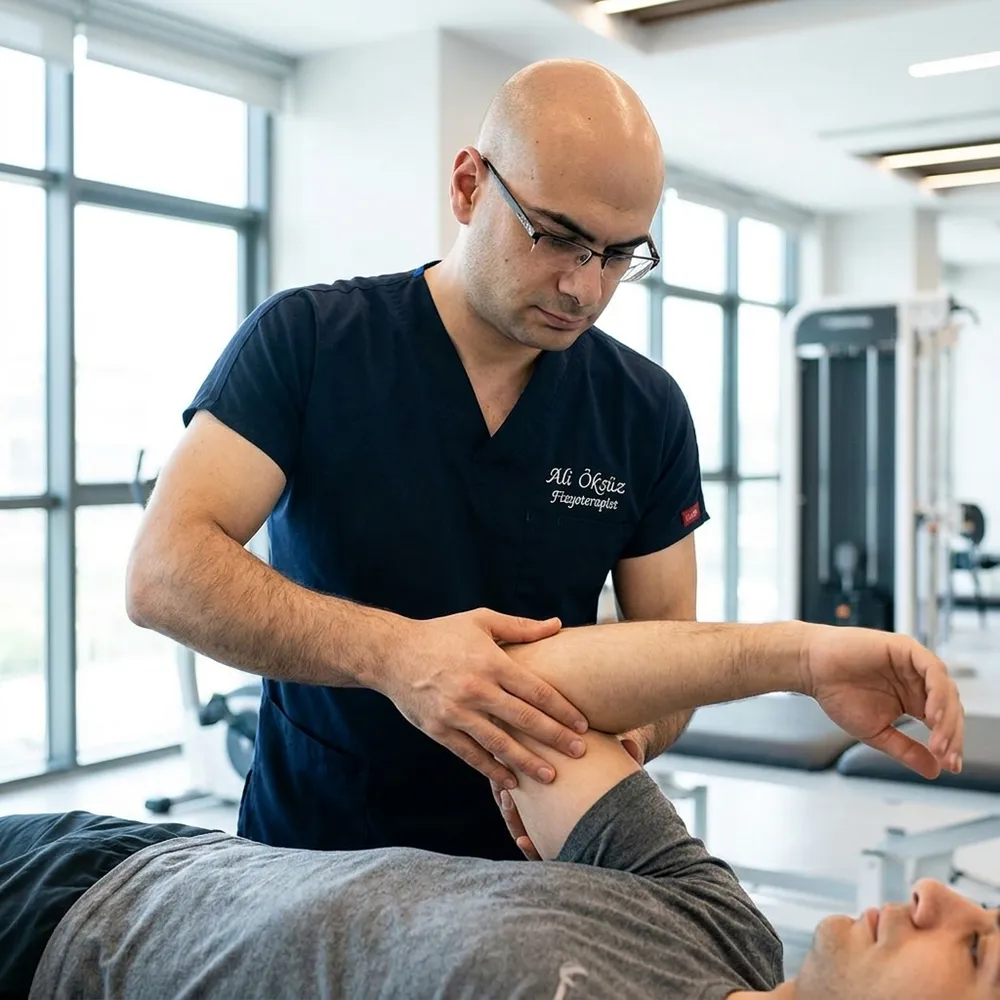 * This image was created with artificial intelligence. It is not a session photo.
Do you feel a sudden, stabbing pain on the outside of your elbow when you lift your morning coffee mug? Or do you almost drop things because of weakness in your hand when using a computer mouse or turning a door handle? If this sounds familiar, the problem is not just simple muscle fatigue; it is a disturbance in the kinetic balance of your elbow and wrist biomechanics. Let's look at this common condition, which we see every day at our clinic in Antalya Konyaaltı, through the lens of evidence-based physiotherapy literature.
What Is Happening Biomechanically and Neurophysiologically?
When people hear "tennis elbow" (lateral epicondylitis), they think of a tennis player's condition; yet most of our clinical cases are office workers who use a keyboard/mouse all day, tradespeople who work with hand tools and people who make repetitive wrist movements in housework.
The pathophysiological changes involved are:
- Tendinosis (Degeneration): Contrary to popular belief, this is not an active inflammation (tendinitis). As a result of constantly repeated micro-strain, the collagen fibres in the tendon attached to the outer bony prominence of the elbow become disorganized and the tissue loses quality (Tendinosis – Angiofibroblastic Hyperplasia).
- ECRB Tendon Damage: The structure primarily affected is the bony attachment of the Extensor Carpi Radialis Brevis (ECRB) tendon, which lifts the wrist. Micro-tears here stimulate pain neurons with every wrist movement.
- Kinetic Chain and the Shoulder Connection: The body works as a whole. According to the kinetic chain principle, weakness of the muscles that stabilize the shoulder blade (scapula) or of the rotator cuff (especially infraspinatus and teres minor) leads to compensatory overload of the wrist extensor muscles and sets the stage for elbow damage.
Secondary Complaint Alert: Is It Only Your Elbow?
A breakdown in elbow biomechanics also affects the upper kinetic chain and nerve pathways:
- Numbness and tingling in the forearm: Compression of the radial nerve as it passes through the tunnel under the supinator muscle in the forearm (supinator syndrome / radial tunnel syndrome) can cause numbness on the back of the hand.
- Spasm of the upper shoulder muscles: A reflex of constantly hitching up the painful arm to protect it develops; this causes chronic trigger points and stiffness in the upper shoulder muscles (upper trapezius).
- Marked drop in grip strength: Because of structural weakness in the tendon, sudden loss of strength and clumsiness can be seen when shaking hands or gripping a simple object.
How Does Manual Therapy Approach Tennis Elbow?
Painkillers or superficial massage cannot address the mechanical and cellular problem in the tendon. At our clinic, we work with the following concepts in line with evidence-based physiotherapy:
- Mulligan Concept (Mobilisation with Movement – MWM): With a lateral glide applied to the elbow joint, the patient grips or moves the hand without pain. This mechanical technique aims to break the pain cycle.
- Cyriax Deep Transverse Friction: Deep cross-friction applied at right angles to the ECRB tendon fibres stimulates blood flow in the chronic degenerative area and supports the body's natural healing (collagen synthesis) process.
- Radial Nerve Mobilization: Specific neurodynamic gliding exercises (neural flossing) are applied to improve the mechanical mobility of the radial nerve in the forearm.
- IASTM (Graston Technique): Anatomical metal instruments are used to address chronic tendon adhesions and to stimulate fibroblasts at the cellular level to support new collagen production.
Treatment Protocol: How Does It Work and How Many Weeks Does It Take?
Taking tissue healing times into account, our clinical rehabilitation program is usually planned in phases over 6 weeks (10-12 sessions):
- Phase 1 (Acute Phase – Weeks 1 and 2): The priority is to modulate pain and reduce spasm. Isometric loading (static wrist contractions) is applied within pain limits together with manual traction, nerve mobilizations and kinesiology taping.
- Phase 2 (Regeneration Phase – Weeks 3 and 4): The tendon-strengthening phase. Cyriax transverse massage, the Graston technique and eccentric loading exercises – the gold standard of tendon rehabilitation for aligning collagen fibres – are added to the program.
- Phase 3 (Functional & Kinetic Chain Phase – Weeks 5 and 6): The recurrence-prevention phase. The whole kinetic chain is protected with scapular stabilization exercises (Y-T-W-L movements), rotator cuff strengthening and grip coordination work.
🚫 "Dangerous Mistakes" to Avoid!
Wrong practices in tendon injuries can make the problem chronic:
- Repeated cortisone injections: Although cortisone may reduce pain in the short term, worse long-term outcomes and a higher recurrence rate have been reported (Coombes et al., 2013, JAMA). Repeated injections can weaken tendon tissue; the decision belongs to your physician.
- Doing grip exercises despite pain: Constantly straining the tendon with stiff hand grippers during its rest and healing period deepens the damage.
- Careless use of an elbow strap: Straps worn constantly and in the wrong position make the muscles lazy. An elbow strap should be used only in the acute period and at the correct angle.
Transparent Frequently Asked Questions (FAQ)
1. Are physiotherapy sessions painful? No. Mulligan and other mobilization techniques are applied within pain-free limits. Mild tenderness is considered normal with Cyriax massage and IASTM, but it is kept within the patient's tolerance.
2. Can tennis elbow come back after recovery? When the tendon's load capacity is increased with eccentric exercise and the shoulder is strengthened along the kinetic chain, the aim is to reduce the risk of recurrence. Continuing home exercises after the program is important for maintaining the gains.
📚 Academic References and Evidence Base (EBM)
The lateral epicondylitis rehabilitation approaches used at our clinic are based on the following key medical literature:
- Bisset, L., et al. (2006 – BMJ) – Mobilisation with movement and exercise, corticosteroid injection, or wait and see for tennis elbow: randomised trial.
- Coombes, B. K., et al. (2013 – JAMA) – Effect of corticosteroid injection, physiotherapeutic exercise, or both on clinical outcomes in unilateral lateral epicondylalgia.
- Vicenzino, B., et al. (2007) – Mobilisation with movement as a clinical tool in lateral epicondylalgia.
Advanced Physiotherapy Support in Antalya Konyaaltı
For the sharp pain when lifting a coffee cup or the feeling of weakness in your hand, we can plan an individual physiotherapy program after your physician's diagnosis. Contact us for a program aimed at strengthening the tendon structure of your elbow with scientific approaches.
📍 [Fzt. Ali Öksüz | Özel Sağlık Meslek Hizmet Birimi]
Toros Mah. 801. Sok. No:4/4 Konyaaltı / Antalya
👉 For a preliminary consultation and clinic appointment, contact us on WhatsApp.
Legal Disclaimer: This page does not replace a physician's diagnosis or a definitive cure promise. It has been prepared on the basis of physiotherapy science (articles and guidelines) to raise health awareness, in accordance with the Health Advertising Regulation.
Related Treatments
The methods described in this article are delivered within the following treatments.
Frequently Asked Questions
The most common questions about this topic. If you can't find your answer, message us directly on WhatsApp.
Passive rest is usually insufficient. Eccentric loading exercises support the structural healing of the tendon.
It can reduce pain in the short term, but for long-term results it is recommended to consider it together with physiotherapy. The decision belongs to your physician.
Carrying loads such as bags, kettles or shopping bags with the palm facing up, adjusting keyboard and mouse height so the wrist stays neutral, and correcting technique in repetitive screwdriver/racket movements reduce the load. An epicondylitis strap can temporarily reduce pain but is not a long-term solution on its own. The program is always planned after a physician's diagnosis and a physiotherapist's assessment, with an individual, evidence-based approach built on eccentric loading principles.
Ready to talk about your complaint?
Call or message us on WhatsApp for a personalised clinical physiotherapy programme after your physician's diagnosis. I'm happy to answer your questions.
About the Author
Physiotherapist Ali Oksuz
Physiotherapist providing clinical physiotherapy services in Konyaaltı, Antalya. Applies evidence-based approaches (Mulligan, Maitland, Vodder MLD) in manual therapy, lymphedema rehabilitation, clinical reformer pilates, and orthopedic rehabilitation. The articles convey the physiotherapy process after a physician's diagnosis for informational purposes; it does not replace medical treatment.