Manual Lymph Drainage (MLD) and Clinical Edema Therapy in Antalya
Do you have persistent edema, post-surgical swelling, or lymphedema in Antalya? Read about the Manual Lymph Drainage (MLD) technique, Complex Decongestive Therapy (CDT), and PubMed evidence.

Fzt. Ali Öksüz | Special Health Services Unit
Physiotherapist
Last updated: · Reviewed by: Fzt. Ali Öksüz
Quick Answer
Manual Lymph Drainage (MLD) is entirely different from classic massage; it stimulates lymph vessels with very light, specific pressure to direct accumulated fluid to healthy areas. International Society of Lymphology (ISL) guidelines recommend Complex Decongestive Therapy (CDT) as the gold standard approach for lymphedema and post-surgical edema.
Table of Contents
- What Do You Experience Biomechanically and Neurophysiologically?
- Secondary Symptoms Alarm: Is It Just Edema?
- How Does Manual Lymph Drainage Approach the Problem?
- Treatment Protocol: How Does the Process Work and How Many Weeks Does It Take?
- Solution Specifications: Muscle Pump and Clinical Exercise
- 🚫 "Dangerous Mistakes" to Avoid!
- Transparent Frequently Asked Questions (FAQ)
- 📚 Academic Bibliography and Evidence-Based Basis (EBM)
- Advanced Physiotherapy Support in Antalya Konyaaltı
Manual Lymph Drainage (MLD) and Clinical Edema Therapy in Antalya
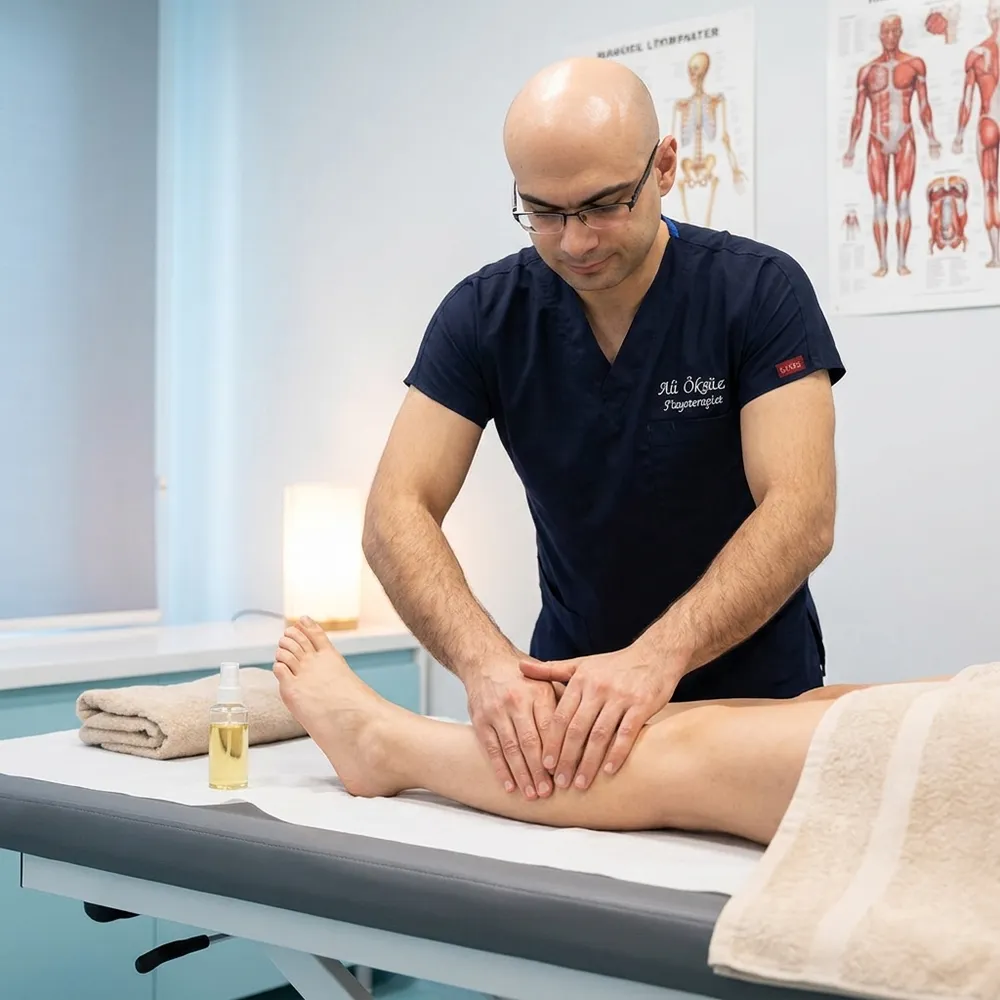 This image was created with artificial intelligence for informational purposes and is not a session photograph.
Legs that squeeze your shoes towards the evening although they are normal in the morning... An abnormal fullness and weight in your arm that you notice after breast cancer surgery... Or persistent hardness after aesthetic surgery (liposuction, abdominoplasty). These are critical signals your body is sending you: Your lymphatic system, the fluid drainage infrastructure of the body, is now working above its capacity. In our clinic in Antalya Konyaaltı, we free the fluid trapped under the tissue using scientific techniques with Manual Lymph Drainage (MLD) in accordance with international standards in doctor-diagnosed edema and lymphedema cases.
This problem goes far beyond a cosmetic concern. Protein-rich fluid accumulating in the tissue space causes not only swelling but also joint movement restriction, local drop of the immune system (infection risk), and irreversible hardening of the tissue (fibrosis) in the long term. According to the 2020 consensus reports of the International Society of Lymphology (ISL), early initiation of treatment is critical because as the stage of lymphedema progresses, the treatment response decreases significantly.
What Do You Experience Biomechanically and Neurophysiologically?
The lymphatic system is your body's cleaning and immunity highway. Unlike the blood circulation, however, this system does not have its own pump muscle; fluid is transported through skeletal muscle movements, diaphragmatic breathing, and rhythmic contractions in the vessel walls (lymphangion reflex). Surgical trauma, radiotherapy, genetic predisposition, or chronic immobility create traffic congestion on this fluid highway.
- Fluid Accumulation in the Body: Fluid that cannot return to the circulation accumulates in the tissue space (interstitial area). This accumulation stretches the connective tissue, exerts mechanical pressure on nerve endings, and initiates a chronic inflammation and pain cycle in the area.
- Kinetic Chain Balance: A swollen and heavy limb disrupts the biomechanics of the entire body. Edema in your right leg increases the load on your left hip and lower back without you noticing; the problem in a single area insidiously turns into a compensation mechanism for the entire body.
Secondary Symptoms Alarm: Is It Just Edema?
- Joint Stiffness: Difficulty in bending and morning stiffness especially in the knee, ankle, or shoulder due to swelling.
- Skin Changes: Tightness, shining, drying of the skin, and Stemmer's sign in advanced stages (inability to lift the skin fold at the base of the second toe).
- Chronic Fatigue: A feeling of heaviness described as "like having lead weights tied to the legs" and decreased functional capacity.
- Recurrent Infections (Erysipelas/Cellulitis): Immunity is weak in lymphedematous tissue; even small scratches can open the door to serious skin infections.
How Does Manual Lymph Drainage Approach the Problem?
Classic spa massages aim to increase blood circulation by applying deep pressure into the muscle. However, the lymphatic system is a very thin and superficial network just beneath the skin. Deep pressure in classic massage crushes these thin lymph capillaries, making the blockage even worse. Systematic reviews published in PubMed clearly state that deep tissue massage is contraindicated in lymphedema management.
Clinical Manual Lymph Drainage (MLD), on the other hand, is a scientific manipulation technique performed within the framework of globally accepted schools (Vodder, Földi, Leduc, Casley-Smith) that stimulates the lymph pathways under the skin and directs the fluid to healthy lymph nodes. The anatomical logic of MLD is based on a "hinge opening" philosophy:
- First, the evacuation gates are opened (healthy lymph nodes in the neck, armpit, and groin area).
- Then, the pooled fluid is swept towards these open gates with light rhythmic touches.
- Finally, the drained area is wrapped with a compression bandage to prevent the fluid from returning.
Treatment Protocol: How Does the Process Work and How Many Weeks Does It Take?
According to the guidelines of the International Society of Lymphology (ISL) and the European Lymphedema Framework (ELFS), the gold standard for clinical edema and lymphedema treatment is Complex Decongestive Therapy (CDT). This protocol usually requires an intensive program of 10-20 sessions.
- Phase 1 — Acute Decongestion (2-4 Weeks): Manual Lymph Drainage 3-5 sessions per week + multilayer short-stretch compression bandaging. Significant reduction in limb circumference is targeted in this phase. The systematic review by Ezzo et al. (2015) in the Cochrane database shows that MLD provides significant volume reduction when applied in combination with compression.
- Phase 2 — Compression and Exercise (4-8 Weeks): Lymphatic pumping exercises applied while bandaged and deep diaphragmatic breathing activate the muscle pump. Special custom-made compression garments (pressurized stockings/sleeves) are ordered to prevent the drained fluid from returning.
- Phase 3 — Maintenance and Stabilization (Lifelong): The muscle pump is regularly strengthened with Clinical Reformer Pilates and functional training. The patient is trained in self-care (self-MLD), compression garment use, and skin care.
Solution Specifications: Muscle Pump and Clinical Exercise
The transport of lymphatic fluid upward against gravity depends entirely on the muscle pump mechanism. When calf muscles or arm muscles do not work, lymph fluid does not move. Randomized controlled trials in the PEDro database show that exercise programs are as important as MLD in lymphedema management.
Therefore, after Manual Lymph Drainage, Clinical Reformer Pilates and medical exercises performed while the tissue is wrapped with special bandages pump the fluid upward like a siphon mechanism:
- Axial elongation provides decompression of the spine and increases lymphatic flow in the thoracic cavity.
- Diaphragmatic breathing creates negative pressure in the rib cage, "vacuuming" the lymph fluid.
- Lower extremity pumping exercises work the calf and thigh muscles rhythmically.
Drainage alone provides temporary relief; when combined with exercise, it becomes the insurance of the treatment.
🚫 "Dangerous Mistakes" to Avoid!
- Having Deep and Hard Massage: It crushes the thin lymph capillaries and locks the system. MLD is a touch applied with very light pressure, approximately 30-40 mmHg.
- Hot Applications (Hot baths, Hammam, Sauna, Hot Water Bag): It dilates blood vessels, causing more fluid to rush to the area and increasing edema.
- Using Tight Clothing and Tight Jewelry: It creates a tourniquet effect in the lymph pathways, preventing the fluid from moving proximally (upward).
- Unconscious Diuretic Use: It only discards the water in the blood; it concentrates the protein fluid in the tissue space, increasing the risk of fibrosis.
- Having Blood Drawn or Blood Pressure Measured from Lymphedematous Limb: It may trigger edema by overloading the weak lymphatic capacity in the area.
Transparent Frequently Asked Questions (FAQ)
1. Does Manual Lymph Drainage hurt? Absolutely not. MLD is one of the lightest, most relaxing, and painless techniques in physical therapy. It is a very gentle touch directed at the subcutaneous fluid; many patients fall asleep during the session.
2. Is MLD necessary after aesthetic surgery (liposuction, tummy tuck)? Yes, with doctor approval. Fluid accumulating under the tissue and hardness (seroma/fibrosis) formed after surgical trauma can be effectively managed with MLD started in the early period. Hardness may become permanent in delayed cases.
3. Can I do lymph drainage on myself at home? Yes, with "self-MLD" techniques you learn from a certified lymphedema therapist. However, techniques applied without training should be avoided as they may push the fluid in the wrong direction.
4. How long should MLD be applied? How are the effects maintained? Lymphedema is a chronic condition; the gains are maintained by the use of compression garments, regular exercise, and periodic maintenance sessions continued lifelong after the intensive treatment phase (Phase 1).
📚 Academic Bibliography and Evidence-Based Basis (EBM)
- International Society of Lymphology (ISL). The Diagnosis and Treatment of Peripheral Lymphedema: 2020 Consensus Document. — The international consensus report accepting CDT as the gold standard in the conservative management of lymphedema.
- Ezzo, J., Manheimer, E., McNeely, M. L., et al. (2015). Manual Lymphatic Drainage for Lymphedema Following Breast Cancer Treatment. Cochrane Database of Systematic Reviews. — This systematic review of 6 RCTs (n=208) shows that MLD significantly reduces edema volume when applied in combination with compression.
- Müller, M., Klingwall, S., et al. (2018). Effectiveness of Complex Decongestive Therapy for Lymphedema: A Systematic Review and Meta-Analysis. JOSPT. — Meta-analysis reporting that CDT reduces limb volume by an average of 30-40% and improves quality of life.
- Thompson, B., Gaitatzis, K., et al. (2021). Manual Lymphatic Drainage Treatment for Lymphedema: A Systematic Review of the Literature. J Cancer Survivorship. — Review supporting the Level 1 evidence of MLD on pain reduction and quality of life improvement.
- PEDro (Physiotherapy Evidence Database). Randomized Controlled Trials on MLD and Lymphedema Exercise Programs. — Studies showing that exercise programs exhibit synergistic efficacy with MLD in lymphedema management.
Advanced Physiotherapy Support in Antalya Konyaaltı
Correct clinical intervention is essential to reduce the load on the lymphatic system, manage edema and the feeling of heaviness long-term, prevent tissue hardening (fibrosis), and regain your functional capacity. If you have a doctor's diagnosis, take action to re-establish the fluid balance of your body with our evidence-based and certified Complex Decongestive Therapy (CDT) applications.
📍 Fzt. Ali Öksüz | Special Health Services Unit
Toros Mah. 801. Sok. No:4/4 Konyaaltı / Antalya
👉 For consultation and clinical appointment, contact us now on WhatsApp.
Legal Disclaimer: This page is not a substitute for a doctor's diagnosis or a promise of absolute healing. It has been prepared on the basis of physical therapy science in accordance with the Health Advertising Regulations in order to increase health awareness.
Related Treatments
The methods described in this article are delivered within the following treatments.
Frequently Asked Questions
The most common questions about this topic. If you can't find your answer, message us directly on WhatsApp.
MLD is a rhythmic and directional technique applied to the skin surface with very light pressure, mimicking lymph flow. Classic massage involves deep pressure directed at the muscle; applying it to a lymphedematous area can increase edema.
Starting as early as possible following doctor approval is critical to prevent the edema from turning into permanent tissue hardening (fibrosis).
No. Lipedema management requires combining MLD, medical compression garments, and a custom exercise program. Massage alone does not yield permanent results.
Ready to talk about your complaint?
Call or message us on WhatsApp for a personalised clinical physiotherapy programme after your physician's diagnosis. I'm happy to answer your questions.
About the Author
Physiotherapist Ali Oksuz
Physiotherapist providing clinical physiotherapy services in Konyaaltı, Antalya. Applies evidence-based approaches (Mulligan, Maitland, Vodder MLD) in manual therapy, lymphedema rehabilitation, clinical reformer pilates, and orthopedic rehabilitation. The articles convey the physiotherapy process after a physician's diagnosis for informational purposes; it does not replace medical treatment.