
Sitting Cross-Legged: The Forgotten Movements Series
Why has sitting cross-legged on the floor become harder? A physiotherapist's view on how sitting cross-legged relates to hip, knee and ankle mobility, how to do it correctly and what to watch out for.

Fzt. Ali Öksüz | Özel Sağlık Meslek Hizmet Birimi
Physiotherapist
Last updated: · Reviewed by: Fzt. Ali Öksüz
Quick Answer
Sitting cross-legged is a simple movement that requires the hip, knee and ankle to work together, but one we rarely do any more. A chair- and sofa-centred lifestyle can gradually reduce this ability. Being able to sit down on and get up from the floor comfortably is being studied as one of the indicators of general musculoskeletal fitness. If there is pain or restriction, progress without forcing and consult a professional.
Table of Contents
- Videos and Posts
- What Happens Biomechanically When You Sit Cross-Legged?
- Secondary Complaints: Is It Only Sitting That's Hard?
- Why Does Being Able to Get Up From and Sit Down on the Floor Matter?
- A Safe Start at Home
- 🚩 Things to Watch Out For
- How Can Physiotherapy Help?
- Frequently Asked Questions (FAQ)
- 📚 Academic References
- Movement Assessment in Antalya Konyaaltı
Sitting Cross-Legged: The Forgotten Movements Series
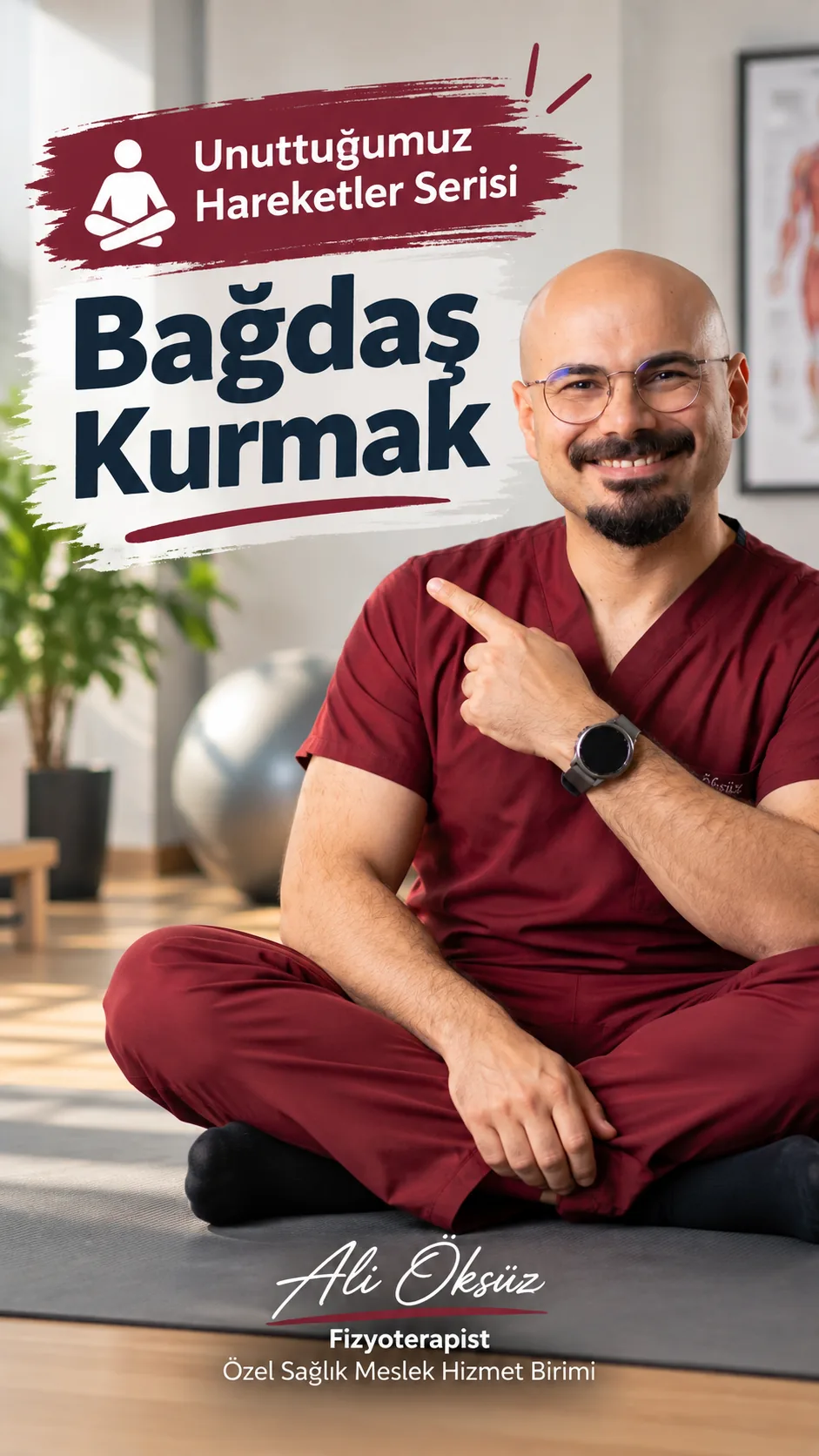 The image is not a treatment photo. It was created with artificial intelligence for illustrative purposes.
As children, sitting cross-legged on the floor was the most natural thing. Today, many of us feel tension in the hips, pinching in the knees or tiredness in the lower back after just a few minutes on the floor. "The Forgotten Movements Series" is a content series we created to remind you of basic movements that are quietly disappearing from daily life. Our first stop: sitting cross-legged.
At our clinic in Antalya Konyaaltı we often see this: the complaint is usually hidden not in a single joint but in the movement as a whole. Sitting cross-legged is exactly that kind of movement.
Videos and Posts
We explained how to do this movement in short videos:
What Happens Biomechanically When You Sit Cross-Legged?
Sitting cross-legged is not the job of a single muscle; it needs several areas to work in harmony:
- Hip: The hip needs to rotate outwards and bend. In someone who sits on a chair all day, this range of movement around the hip can gradually narrow.
- Knee: The knee joint sits in a bent and outward-rotated position. Restriction in the hip can shift this load onto the knee.
- Ankle: Being able to position the ankle comfortably determines how comfortable the position is.
- Trunk and lower back: If the hip does not open enough, the pelvis tilts backwards to keep balance and the lower back rounds; lower back fatigue soon follows.
That is why difficulty sitting cross-legged may suggest restricted movement in one link of the kinetic chain (most often the hip).
Secondary Complaints: Is It Only Sitting That's Hard?
In clients who cannot sit comfortably on the floor, we also often see:
- Needing to push off with the hands or a knee when getting up from the floor.
- Stiffness around the hips and lower back after sitting for a long time.
- Difficulty with daily movements such as squatting or tying shoelaces.
- Feeling dependent on chairs; less desire to play on the floor, pray, do yoga or exercise.
Why Does Being Able to Get Up From and Sit Down on the Floor Matter?
In a cohort study listed on PubMed, 2002 adults aged 51-80 performed a test of sitting down on and rising from the floor without support; the more support they needed, the higher the risk of death over an average follow-up of 6.3 years (DOI). This shows an association; being able to get up from the floor is not a guarantee of health or a diagnosis on its own. However, it suggests that this skill, which needs both muscle strength and flexibility, may be a simple indicator of general musculoskeletal fitness.
Another study on PubMed, with 47 older adults, reported that a 5-week flexibility program improved scores on sit-and-rise, timed up-and-go and five-times sit-to-stand tests (DOI). In other words, this skill can be improved with regular and correct practice.
A Safe Start at Home
- Raise yourself on a cushion: Sit with your hips on a folded mat or cushion so that your knees are slightly lower than your hips. This reduces the load on your lower back and hips.
- Start for short periods: 2-3 minutes in the first days, then increase gradually as you get comfortable.
- Switch sides: Change which leg is on top at regular intervals.
- Stay upright but relaxed: Shoulders relaxed, lower back in its natural curve.
- Use support to get up: At first it is safe to get up by holding on to the floor or a sturdy piece of furniture.
🚩 Things to Watch Out For
- Forcing through pain: Stop the position if you feel pinching in the knee, sharp pain in the hip or numbness.
- Pushing the knee down to the floor: Forcing the knee before the hip has opened enough can put unnecessary load on knee structures.
- Staying in the same position for long: Change position often for circulation and joint comfort.
- Ignoring post-operative restrictions: If you have a hip/knee replacement or have had recent surgery, don't try it without your physician's approval.
- With symptoms such as night pain, swelling, fever or sudden weakness, see a physician first, not a physiotherapist.
How Can Physiotherapy Help?
After a physician's assessment, the goal in physiotherapy is to improve hip, knee and ankle range of motion, muscle strength and position control with an individual program. Identifying which link limits the movement is the first step in choosing the right exercise. For related information, see our Orthopedic Rehabilitation and Clinical Reformer Pilates pages. Our article on Walking as Exercise may also be useful on the role of movement in daily life.
Frequently Asked Questions (FAQ)
1. Is sitting cross-legged bad for the body? In healthy people it is not harmful as long as it is done comfortably and without pain. Staying in the same position for a long time can increase discomfort, so changing position often is important.
2. I can't sit cross-legged – is that a problem? It may indicate limited hip, knee or ankle range of motion, but on its own it is not a sign of disease. If it comes with pain, have it assessed.
3. I have a knee or hip replacement – can I sit cross-legged? After joint replacement and surgery, some positions may be restricted. Always consult your physician before trying.
📚 Academic References
- de Brito LBB, Ricardo DR, de Araújo DSMS, Ramos PS, Myers J, de Araújo CGS. Ability to sit and rise from the floor as a predictor of all-cause mortality. Eur J Prev Cardiol. 2014;21(7):892-898. DOI: 10.1177/2047487312471759 (PMID: 23242910)
- Johnson NF, Hutchinson C, Hargett K, Kosik K, Gribble P. Bend Don't Break: Stretching Improves Scores on a Battery of Fall Assessment Tools in Older Adults. J Sport Rehabil. 2021;30(1):78-84. DOI: 10.1123/jsr.2019-0246 (PMID: 32087599)
Sources were compiled via PubMed.
Movement Assessment in Antalya Konyaaltı
If you find it hard to sit down on and get up from the floor comfortably, or feel tension around your hips, knees or lower back, with your physician's approval we can assess your movement together at our clinic.
📍 Fzt. Ali Öksüz | Özel Sağlık Meslek Hizmet Birimi Toros Mah. 801. Sok. No:4/4 Konyaaltı / Antalya
👉 For a preliminary consultation and clinic appointment, contact us on WhatsApp.
Legal Disclaimer: This page does not replace a physician's diagnosis or a definitive cure promise. It has been prepared on the basis of physiotherapy science (articles and guidelines) to raise health awareness, in accordance with the Health Advertising Regulation.
Related Treatments
The methods described in this article are delivered within the following treatments.
Frequently Asked Questions
The most common questions about this topic. If you can't find your answer, message us directly on WhatsApp.
In healthy people it is not harmful as long as it is done comfortably and without pain. However, staying in the same position for a long time can increase discomfort in people with hip or knee complaints. It is important to change position frequently and not ignore pain.
It may indicate limited range of motion in the hip, knee or ankle, but on its own it is not a sign of disease. If it comes with pain or has started recently, an assessment by a physician or physiotherapist is useful.
After joint replacement and surgery, your physician may have restricted certain positions. These restrictions must be followed; always consult the surgeon who operated on you before trying to sit cross-legged.
Ready to talk about your complaint?
Call or message us on WhatsApp for a personalised clinical physiotherapy programme after your physician's diagnosis. I'm happy to answer your questions.
About the Author
Physiotherapist Ali Oksuz
Physiotherapist providing clinical physiotherapy services in Konyaaltı, Antalya. Applies evidence-based approaches (Mulligan, Maitland, Vodder MLD) in manual therapy, lymphedema rehabilitation, clinical reformer pilates, and orthopedic rehabilitation. The articles convey the physiotherapy process after a physician's diagnosis for informational purposes; it does not replace medical treatment.