Manual Therapy in Antalya: Joint and Spine Rehabilitation
Looking for manual therapy in Antalya? An informative guide to the Mulligan, Maitland and Kaltenborn concepts applied at our Konyaaltı clinic, how sessions work and clinical reformer pilates.
Fzt. Ali Öksüz | Özel Sağlık Meslek Hizmet Birimi
Physiotherapist
Last updated: · Reviewed by: Fzt. Ali Öksüz
Quick Answer
Manual therapy in Antalya is an internationally evidence-based (Level A) joint and spine rehabilitation approach applied without drugs, surgery or devices. At our Konyaaltı clinic, the Mulligan, Maitland and Kaltenborn concepts are planned individually after physician approval; gains in range of motion and pain control are targeted over an average of 4-8 sessions.
Table of Contents
- What Is Happening Biomechanically and Neurophysiologically?
- Secondary Complaint Alert: Is It Only Your Neck/Back?
- How Does Manual Therapy Approach This Picture?
- Treatment Protocol: How Does It Work and How Many Weeks Does It Take?
- The Key Step: "Sleeping Muscles" and Reformer Pilates
- 🚫 "Dangerous Mistakes" to Avoid!
- Transparent Frequently Asked Questions (FAQ)
- 📚 Academic References and Evidence Base (EBM)
- Advanced Physiotherapy Support in Antalya Konyaaltı
Manual Therapy in Antalya and Our Clinical Approach
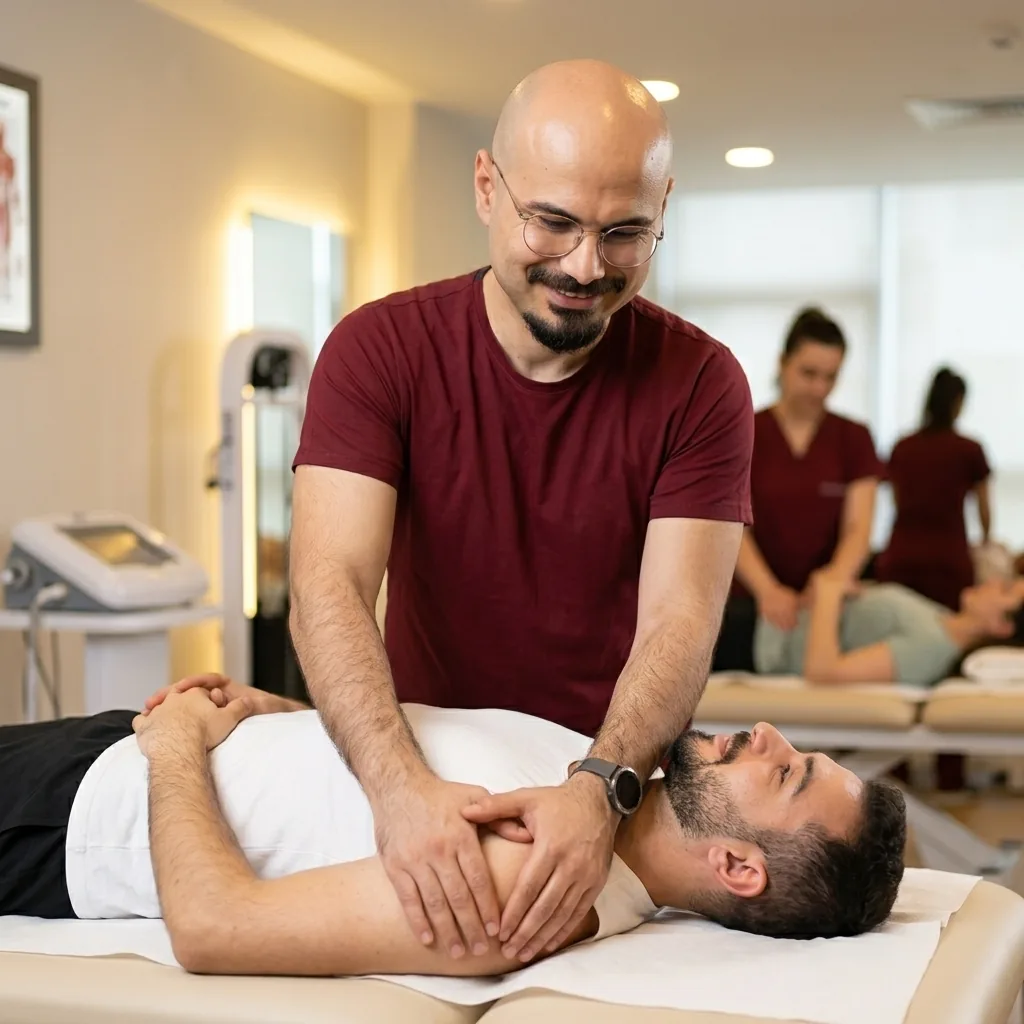 Physiotherapist Ali Öksüz applies manual therapy and joint mobilization to a client at his clinic in Antalya Konyaaltı.
Most clients looking for manual therapy in Antalya come to us with neck or back stiffness or restricted movement that has lasted for months. The problem is often not simple muscle fatigue but a biomechanical breakdown that posture, loading habits and tissue quality have created over time. At our clinic in Konyaaltı, internationally recognized manual therapy concepts are applied to manage this picture without drugs, devices or surgery.
This article aims to explain clearly, for people looking for manual therapy in Antalya, how the process works, which concepts (Mulligan, Maitland, Kaltenborn) we apply at our clinic and why it is different from classic massage.
What Is Happening Biomechanically and Neurophysiologically?
The effect of manual therapy is not simply "opening the joint". According to the current Bialosky model, specific hands-on techniques reorganize pain perception both through the mechanical dynamics within the joint and through the central nervous system.
- Load on the body: Prolonged sitting, screen work, poor posture and repetitive movements disturb synovial fluid flow in the facet joints and create adhesions and trigger points in the muscle fascia. This shows up as morning stiffness, restricted movement and referred pain in the neck, upper back and low back.
- Kinetic chain balance: Restricted movement in one joint forces the segments above and below to compensate. In a frozen shoulder, for example, instead of lifting the arm, the body compensates with the shoulder blade and neck, which turns into headaches and trapezius spasm. Manual therapy addresses this chain segment by segment.
Secondary Complaint Alert: Is It Only Your Neck/Back?
Most clients who come to our clinic for manual therapy in Antalya actually have several secondary complaints:
- Complaint 1: Numbness and tingling spreading from the neck to the arm or from the low back to the leg.
- Complaint 2: A feeling of locking in the low back/upper back lasting 15-20 minutes after getting up in the morning.
- Complaint 3: Recurring headaches, jaw locking or ringing in the ears (TMJ-related) during long periods of sitting.
- Complaint 4: Reliance on painkillers and difficulty changing position during sleep.
How Does Manual Therapy Approach This Picture?
Classic massage relaxes superficial tissue; medication temporarily suppresses the pain signal. The manual therapy concepts we apply in Antalya, however, target the joint play and fascial restriction at the source of the pain:
- Mulligan Concept (MWM): A specific glide applied to the joint surface during pain-free active movement. The aim is to increase range of motion (ROM).
- Maitland Concept: A rhythmic, dosable mobilization classification (Grade I-IV). It can be used safely even in the acute, painful phase.
- Kaltenborn-Evjenth: Assessment of joint surfaces according to traction and translation principles; in-depth biomechanical correction, especially in the spine and peripheral joints.
- Myofascial Release and Trigger Point Therapy: Releasing fascial adhesions and painful knots within the muscle with ischemic compression.
For detailed technical explanations, see our Manual Therapy and Joint Mobilization in Antalya treatment page.
Treatment Protocol: How Does It Work and How Many Weeks Does It Take?
At our clinic in Antalya Konyaaltı, the manual therapy process is divided into three phases after the physician's diagnosis and approval:
- Phase 1 (Acute – Weeks 1-2): Pain and spasm control; low-grade mobilization, trigger point and myofascial release. The aim is to support sleep and quality of daily life.
- Phase 2 (Mobility – Weeks 3-5): High-grade joint mobilization, manipulation where indicated; introducing ROM and posture correction exercises.
- Phase 3 (Stabilization – Week 6 onwards): Activation of the core muscles with Clinical Reformer Pilates, building biomechanical muscular support and reducing the risk of recurrence.
A protocol of on average 4-8 sessions is individualized according to how chronic the condition is and any other health conditions.
The Key Step: "Sleeping Muscles" and Reformer Pilates
If joints opened up with manual therapy are not actively protected, they fall back into the same faulty movement pattern. That is why the clinical reformer pilates program we recommend after manual therapy in Antalya supports maintaining the gains through axial elongation, spinal decompression and deep stabilizer activation. The same approach is the basis of lumbar disc herniation physiotherapy in Antalya and frozen shoulder rehabilitation.
🚫 "Dangerous Mistakes" to Avoid!
- Uncertified "cracking" treatments: Fast, uncontrolled manipulations of the neck and back can increase disc damage and neurological complications. Manual therapy must always be applied by a certified physiotherapist after a physician's diagnosis.
- Long-term use of a back brace/neck collar: It switches the muscles off and deepens the "sleeping muscle" picture; the pain comes back.
- Exercising hard despite pain, or the opposite – complete rest: Both harm tissue quality. The right way is dosed movement and evidence-based exercise.
- Reliance on painkillers: It silences the symptom while the problem progresses.
Transparent Frequently Asked Questions (FAQ)
1. Will a manual therapy session in Antalya hurt? No. Manual therapy is applied within pain-free limits. It is dosed according to the grade system and can be used safely even in the acute phase.
2. After how many sessions does relief start? This varies from person to person. For long-term gains, usually 4-8 sessions are recommended.
3. Will my pain come back after I recover? Continuing with a stabilization program with clinical reformer pilates after manual therapy can help reduce the risk of recurrence.
4. I have a herniated disc – can manual therapy harm me? In physician-diagnosed disc herniations, manual therapy is among the conservative recommendations of international guidelines; suitability is determined by the physician's and physiotherapist's assessment. It helps reduce the mechanical pressure of the disc on the nerve.
📚 Academic References and Evidence Base (EBM)
- Bialosky JE et al. The Mechanisms of Manual Therapy in the Treatment of Musculoskeletal Pain: A Comprehensive Model. Manual Therapy, 2009.
- Cochrane Review: Manipulation and mobilisation for neck pain contrasted against an inactive control or another active treatment.
- JOSPT Clinical Practice Guidelines: Low Back Pain, Neck Pain, Adhesive Capsulitis.
- Maitland GD. Vertebral Manipulation. Butterworth-Heinemann.
- Kaltenborn FM. Manual Mobilization of the Joints: The Kaltenborn Method of Joint Examination and Treatment.
Advanced Physiotherapy Support in Antalya Konyaaltı
If you would like to manage your joint and spinal health with manual therapy in Antalya, without drugs or surgery, let's plan a physician-approved, individual program at our Konyaaltı clinic.
📍 Fzt. Ali Öksüz | Özel Sağlık Meslek Hizmet Birimi Toros Mah. 801. Sok. No:4/4 Konyaaltı / Antalya
👉 For a preliminary consultation and clinic appointment, contact us on WhatsApp.
Legal Disclaimer: This page does not replace a physician's diagnosis or a definitive cure promise. It has been prepared on the basis of physiotherapy science (articles and guidelines) to raise health awareness, in accordance with the Health Advertising Regulation.
Related Treatments
The methods described in this article are delivered within the following treatments.
Manual Therapy & Joint Mobilization
International Evidence-Based (EBM) Joint and Spine Rehabilitation
Learn moreClinical Reformer Pilates in Antalya
Personalized Reformer Pilates with Physiotherapist Ali Öksüz · Konyaaltı
Learn moreMuscle & Chronic Pain Management
Biomechanical Approach to Fibromyalgia and Myofascial Pain Syndrome
Learn moreFrequently Asked Questions
The most common questions about this topic. If you can't find your answer, message us directly on WhatsApp.
In physician-diagnosed cervical/lumbar disc herniation, facet syndrome, frozen shoulder, chronic neck, back and low back pain, sacroiliac joint dysfunction and TMJ (jaw joint) problems, it is listed in international guidelines as a primary conservative approach.
A session usually lasts 40-60 minutes. It is applied within pain-free limits; manipulation, known as 'cracking', is only performed in suitable cases and when considered necessary.
This varies from person to person; progress is re-evaluated at every session. For long-term functional gains, a program of usually 4-8 sessions followed by stabilization with clinical reformer pilates is recommended.
Manual therapy is applied entirely with the physiotherapist's hands; it directly targets the mechanical dynamics within the joint and neurophysiological pain-inhibition pathways. Unlike device-based applications, it is a specific tissue and joint intervention that can be dosed individually.
Ready to talk about your complaint?
Call or message us on WhatsApp for a personalised clinical physiotherapy programme after your physician's diagnosis. I'm happy to answer your questions.
About the Author
Physiotherapist Ali Oksuz
Physiotherapist providing clinical physiotherapy services in Konyaaltı, Antalya. Applies evidence-based approaches (Mulligan, Maitland, Vodder MLD) in manual therapy, lymphedema rehabilitation, clinical reformer pilates, and orthopedic rehabilitation. The articles convey the physiotherapy process after a physician's diagnosis for informational purposes; it does not replace medical treatment.