Antalya Lumbar Disc Herniation Treatment and Medical Exercise
Do you have persistent lower back and leg pain in Antalya? Read about clinical treatment for herniated disc, the difference manual therapy makes, and clinical reformer pilates.
Physiotherapist Ali Oksuz | Private Health Profession Service Unit
Fizyoterapist
Hızlı Cevap
A significant portion of herniated disc cases diagnosed by a physician can be managed without surgery through manual therapy, clinical reformer pilates, and a properly defined medical exercise program. The process is conducted with physician approval and a personalized program.
İçindekiler Tablosu
- What Do You Experience Biomechanically and Neurophysiologically?
- Secondary Complaints Alarm: Is Only Your Back Aching?
- Treatment Protocol: How Does the Process Work and How Many Weeks Does It Take?
- Solution Conditions: "Sleeping Muscles" and Reformer Pilates
- 🚫 Dangerous Mistakes to Avoid!
- Transparent Frequently Asked Questions (FAQ)
- 📚 Academic Bibliography and Evidence-Based Medicine (EBM)
- Advanced Physical Therapy Support in Antalya Konyaaltı
Antalya Lumbar Disc Herniation and Clinical Treatment Approach
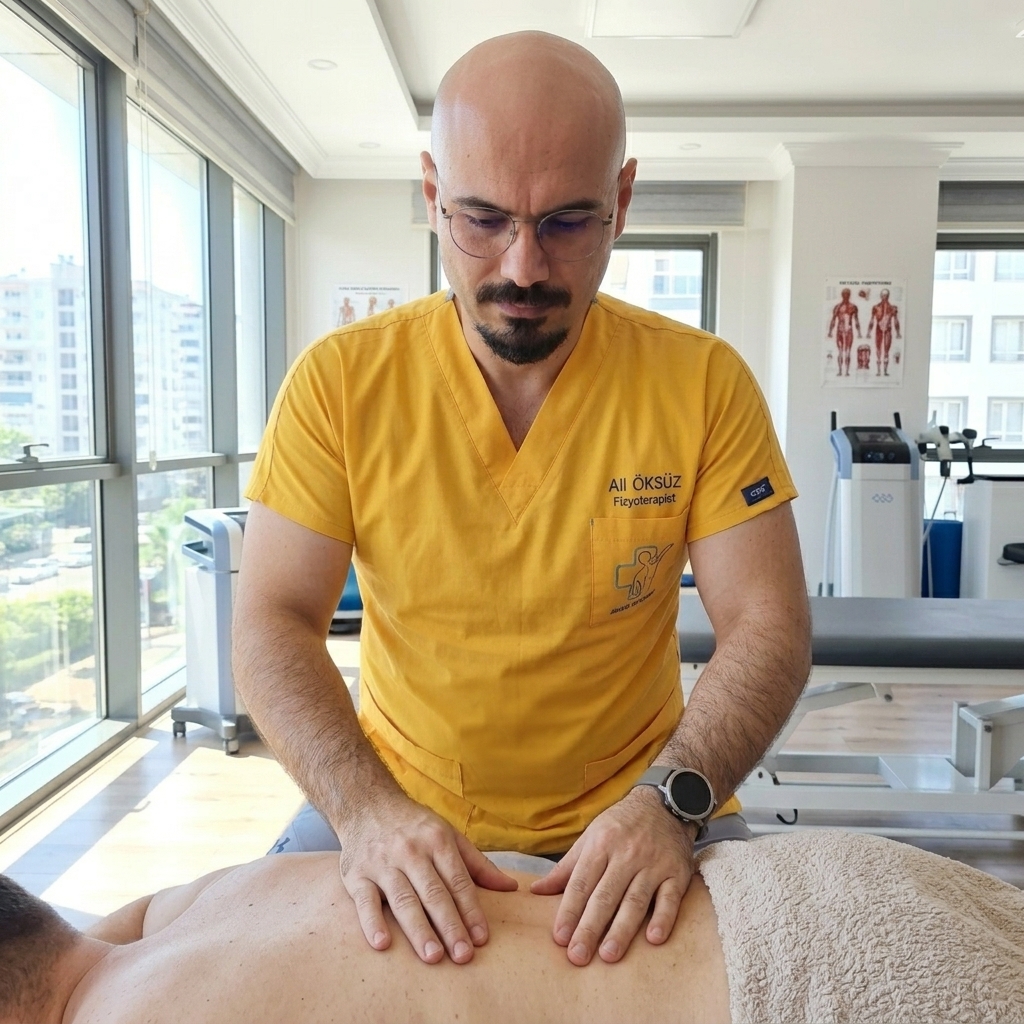 * Image is for illustrative purposes. It is not an actual clinical photo, but created using AI based on Physiotherapist Ali Oksuz.
Does severe pain radiating to your lower back or leg decrease your enjoyment of life? In modern physical therapy approaches, we know that the problem is often not just simple muscle fatigue, but a gradual biomechanical collapse. In our clinic located in Antalya Konyaaltı, we activate the body's own healing potential to permanently resolve your non-surgical lumbar disc herniation complaints.
What Do You Experience Biomechanically and Neurophysiologically?
A herniated disc occurs when the jelly-like structure inside the discs between the vertebrae leaks out and presses on nerves. However, the situation is not just a mechanical compression; there is a serious imbalance in the interconnected structure of the body according to Kinetic Chain Principles.
- Loading on the Body: Discs act like shock absorbers. When the disc is damaged as a result of aging, sudden heavy lifting, or incorrect posture, the inner material leaks into the canal and contacts the nerve. However, the pain radiating to the leg is mostly caused by chemical inflammation spread by the hernia.
- Kinetic Chain Balance: A problem in the lower back region affects everything from your gait to your posture. Compensatory incorrect movements in the hip joint or knee lead to the disease being felt in the whole body.
Secondary Complaints Alarm: Is Only Your Back Aching?
In many patients, other complaints also occur due to nerve compression and inflammation:
- Complaint 1: Electric shock sensation or numbness radiating to the leg (sciatica).
- Complaint 2: Feeling of loss of strength in the leg and foot.
- Complaint 3: Experience of locking when sitting down or standing up.
What Does Manual Therapy Actually Do to a Herniated Disc?
In street-corner or unconscious applications, people claim that by "cracking" the back, they will push the hernia back inside. However, according to PubMed / PEDro scientific data and physical therapy reality, a hernia cannot be physically "pushed" back with a finger. The physiotherapist relieves the pressure on the nerve and activates the healing reflex using specific spinal techniques.
What Happens Anatomically During the Session?
- 1. McKenzie and Centralization: That sciatic pain striking your leg like lightning is actually the signal of the crisis in your lower back. With the McKenzie method, we determine your personalized "directional preference". When the correct angle is found, the pain radiating to the leg suddenly decreases and is drawn back to its source (the back). In medical literature, this is called Centralization and is one of the key clinical indicators of a successful conservative response.
- 2. Spinal Mobilization (Opening the Joint): The holes (foramina) through which the nerve going to the leg passes have narrowed. When the physiotherapist performs millimeter-level glides on your locked vertebrae with their hands, both that hole is mechanically opened and the Descending Pain Inhibition mechanism going to your brain is activated, enabling the body to secrete its own natural painkillers (endorphins, serotonin).
- 3. Trigger Point and Ischemic Compression: Herniated disc creates severe spasms (trigger points) in the hip muscles (Piriformis) and around the lower back to protect the body. Most patients try to punch the aching spot themselves. We apply specific ischemic compression and fascial glides to these "knots" in your hip and lower back to instantly stop that suffocating deep ache.
Treatment Protocol: How Does the Process Work and How Many Weeks Does It Take?
95% of herniated disc cases heal without surgery. We target significant pain relief within the first 2-4 weeks. At the end of 6-8 weeks, a fully functional life is restored.
- Phase 1 (Acute): Reducing edema in the nerve root, breaking pain and spasm using TENS/heat packs and physiotherapist-controlled manual interventions.
- Phase 2 (Mobility): Ensuring the compressed nerve glides smoothly inside the canal (nerve gliding) using spinal and nerve mobilization movements.
- Phase 3 (Stabilization): Building your "natural corset" with Reformer Pilates applications that provide core stabilization.
Solution Conditions: "Sleeping Muscles" and Reformer Pilates
The most key insurance of treatment, Reformer Pilates, eliminates gravity and removes the pressure on the lower back (decompression). In our clinic sessions, thanks to spring resistance, sleeping muscles are revitalized and gain active load-bearing properties. This not only reduces your current pain but also minimizes the risk of future flare-ups.
🚫 Dangerous Mistakes to Avoid!
- Unconscious Back Pulling: Severe pulling or cracking operations performed by unqualified people can cause irreversible nerve damage in the spine.
- Continuous Bed Rest: Absolute bed rest lasting more than 2 days weakens your lower back muscles further and slows down your healing process.
Transparent Frequently Asked Questions (FAQ)
1. Does clinical physical therapy hurt? We work completely within painless boundaries and controlled ranges. Manual therapy does not physically push the hernia inside with a finger; it corrects spinal mechanics, providing internal protection.
2. Will my pain return after I heal? The Medical Exercise and Reformer Pilates protocols we provide at the end of the treatment build a "natural corset" for your body, which greatly reduces the risk of recurrence. Your body returns to the strength to carry itself.
📚 Academic Bibliography and Evidence-Based Medicine (EBM)
- McGill, S. (2015). Low Back Disorders.
- McKenzie, R. (2003). The Lumbar Spine: Mechanical Diagnosis and Therapy.
- Jensen, M. C., et al. (1994). MRI of the Lumbar Spine in People without Back Pain. (New England Journal of Medicine).
- Bialosky, J.E. (2009). The Mechanisms of Manual Therapy in the Treatment of Musculoskeletal Pain.
- Travell, J. G., & Simons, D. G. (1999). Myofascial Pain and Dysfunction: The Trigger Point Manual.
Advanced Physical Therapy Support in Antalya Konyaaltı
A herniated disc is not your fate! By determining the biomechanical map of your pain with expert assessments, we can start your healing process today.
📍 P.T. Ali Oksuz | Private Health Profession Service Unit
Toros Mah. 801. Sok. No:4/4 Konyaaltı / Antalya
👉 For Pre-consultation and Clinical Appointment, Contact Us Now on WhatsApp.
Legal Disclaimer: This page does not replace a physician's diagnosis or a definitive cure promise. It has been prepared on the basis of physical therapy science (articles and guidelines) in accordance with the Health Advertising Regulation to increase health awareness.
Bu Konuyla İlgili Uygulamalarımız
Yazıda bahsedilen yöntemler aşağıdaki uygulamalarımız kapsamında yürütülür.
Antalya Manuel Terapi & Eklem Mobilizasyonu
Konyaaltı Kliniğinde Uluslararası Kanıta Dayalı (EBM) Eklem ve Omurga Rehabilitasyonu
Detaylı bilgiKlinik Reformer Pilates
Kişiye Özel, Güvenli ve Medikal Egzersiz Yaklaşımı
Detaylı bilgiKas & Kronik Ağrı Yönetimi
Fibromiyalji ve Miyofasiyal Ağrı Sendromuna Biyomekanik Yaklaşım
Detaylı bilgiSıkça Sorulan Sorular
Yazıyla ilgili en çok sorulan sorular. Cevabı bulamadığınız bir konu varsa doğrudan WhatsApp'tan yazabilirsiniz.
Some disc problems at the protrusion level can regress with appropriate lifestyle modifications and physical therapy support. This process is managed and monitored with physician diagnosis; each case is evaluated individually.
In case of severe pain radiating to the leg, loss of strength, changes in bowel/bladder control, you must consult a doctor. These conditions require urgent evaluation.
The duration depends on the case, clinical picture, and physician evaluation. Programs are usually planned as 2-3 sessions per week and re-evaluated in 4-8 week periods. The permanence of gains is determined by home exercises, correct posture, and load-bearing habits. The process is always shaped individually, in line with the physician's diagnosis and guidance, using current evidence-based approaches; a fixed number of sessions cannot be promised.
Şikayetinizi konuşmaya hazır mısınız?
Hekim teşhisi sonrası kişiye özel klinik fizyoterapi programı için bizi arayın veya WhatsApp'tan yazın. Sorularınız varsa cevaplamaktan memnuniyet duyarım.
About the Author
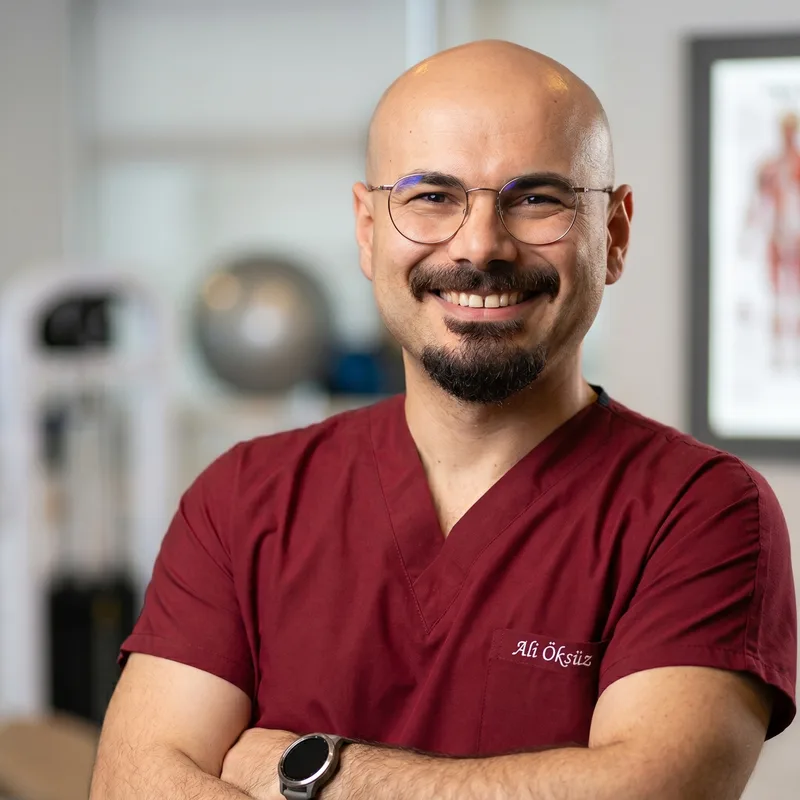
Physiotherapist Ali Oksuz
Expert physiotherapist providing clinical physiotherapy services in Konyaaltı, Antalya. Applies evidence-based approaches (Mulligan, Maitland, Vodder MLD) in manual therapy, lymphedema rehabilitation, clinical reformer pilates, and orthopedic rehabilitation. The articles convey the physiotherapy process after a physician's diagnosis for informational purposes; it does not replace medical treatment.