
Swimming and Spine Health in Physical Therapy
Does swimming help low back pain? Swimming biomechanics, correct strokes, and clinical findings from PubMed/PEDro databases from a physiotherapist's perspective.

Fzt. Ali Öksüz | Özel Sağlık Meslek Hizmet Birimi
Physiotherapist
Last updated: · Reviewed by: Fzt. Ali Öksüz
Quick Answer
Swimming provides an excellent exercise environment by unloading joint compression forces through buoyancy. However, 'just go swim' is not a universal cure for back pain. Poor stroke mechanics can increase stress on facet joints. Correct strokes and structured clinical aquatic exercise programs are key to spinal health.
Table of Contents
- Physical Principles of Water: How Our Body Relaxes in Water
- Swimming vs. Land Exercises: Which is More Effective? (EBM Evidence)
- Spine-Friendly Swimming Techniques: Which Stroke is Best for Back Pain?
- 1. Backstroke — The Gold Standard
- 2. Freestyle — Requires Proper Technique
- 3. Breaststroke — High Risk
- 4. Butterfly — Contraindicated
- 3 Common Mistakes in Swimming
- 📚 Academic References and Evidence-Based Medicine (EBM)
- Advanced Clinical Exercise Support in Antalya Konyaaltı
Swimming and Spine Health in Physical Therapy
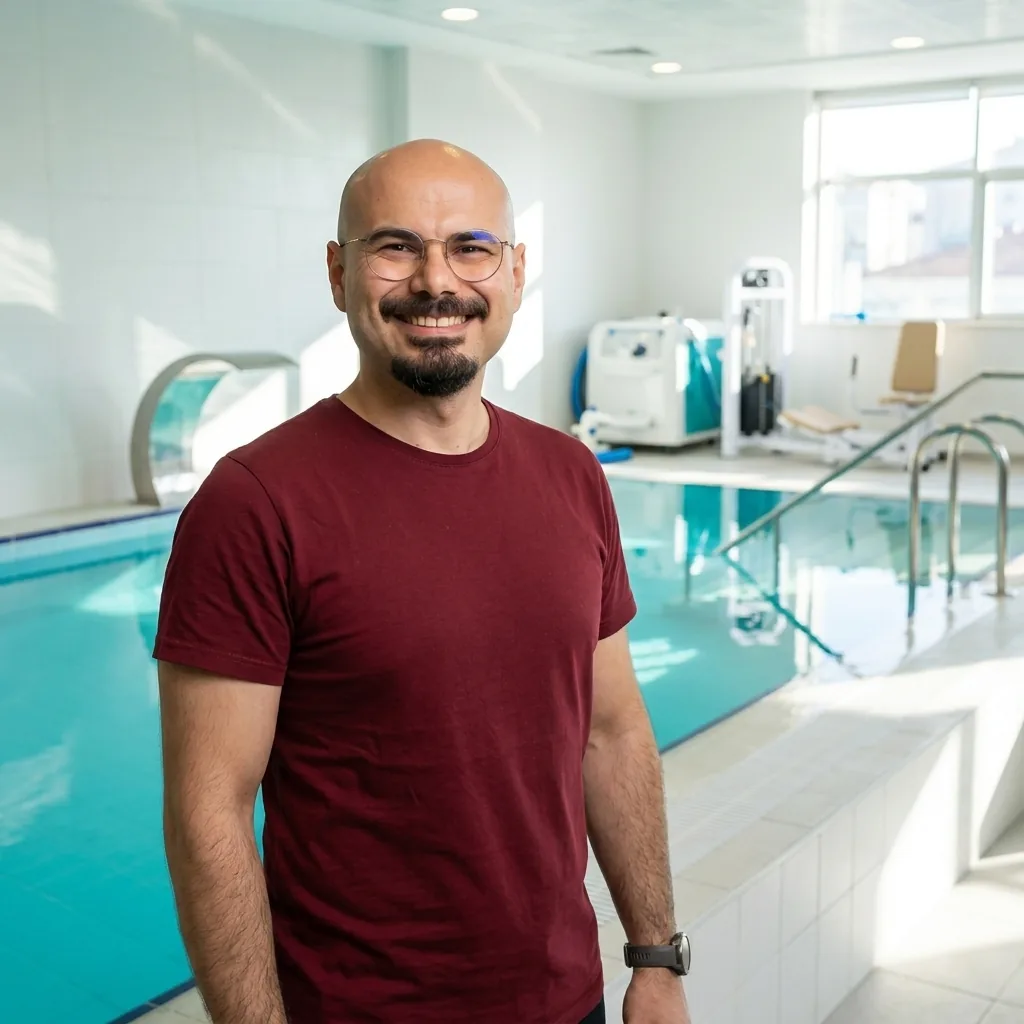 Physiotherapist Ali Oksuz explains aquatic rehabilitation and buoyancy-assisted exercise analysis in Antalya Konyaaltı.
In public settings and general medical advice, a common recommendation for patients with neck or back pain is: "Just go swimming, it will cure all your pain." However, clinical experience and current medical literature show that it is not that simple. Improperly planned swimming activities can disrupt spinal biomechanics, potentially worsening existing herniated discs or joint irritations. In this article, we will examine the effects of swimming on spine health supported by PubMed and PEDro evidence.
Physical Principles of Water: How Our Body Relaxes in Water
The unique environment water offers allows us to perform many movements that we cannot do on land. This is based on three main physical principles:
- Hydrostatic Buoyancy (Archimedes' Principle): When immersed in water up to chest level, approximately 90% of our body weight is supported. This virtually eliminates the axial compression (axial loading) gravity exerts on our vertebrae and discs, allowing them to decompress.
- Viscosity and Resistance: Water is about 800 times denser than air. The resistance encountered when moving in water allows for balanced muscle strengthening without microtrauma to the joints (co-contraction).
- Hydrostatic Pressure: The uniform pressure water applies to the body surface stimulates the circulatory system, increasing venous return and facilitating the dispersion of localized swelling and inflammation.
Swimming vs. Land Exercises: Which is More Effective? (EBM Evidence)
Systematic reviews indexed in PubMed and PEDro (Physiotherapy Evidence Database) clarify the place of aquatic interventions in low back pain management:
- Aquatic Physical Therapy: Cochrane reviews indicate that structured aquatic exercises under a physical therapist's guidance are as effective as land-based exercises (and in some cases more effective) in reducing pain, improving functional capacity, and enhancing quality of life in chronic low back pain patients.
- The Recreational Swimming Gap: According to scoping reviews, direct clinical trial evidence showing that recreational lap swimming (swimming casually in a pool) prevents or treats low back pain is limited. In other words, clinical target-oriented exercises should be preferred over unstructured swimming.
Spine-Friendly Swimming Techniques: Which Stroke is Best for Back Pain?
Each swimming stroke has different implications for spinal biomechanics:
1. Backstroke — The Gold Standard
Backstroke is the safest style as the spine remains in a neutral position throughout, and there is no need to bend the neck to keep the head above water. It ensures symmetrical work of the back muscles and minimizes stress on the facet joints. We primarily recommend this style to our patients with active back pain.
2. Freestyle — Requires Proper Technique
The main issue in freestyle swimming is excessive neck and trunk rotation during breathing. If your breathing technique is poor, you may hyperextend the spine (increasing the lower back arch) to lift your head out of the water. It is safe when performed with proper technique, rotating the body symmetrically along its axis.
3. Breaststroke — High Risk
Swimming breaststroke while keeping the head above water excessively increases lumbar and cervical lordosis (lower back and neck arch). This compresses the facet joints at the back of the vertebrae, triggering facet joint syndrome pain. You should avoid this style if you have active back pain.
4. Butterfly — Contraindicated
Butterfly swimming requires significant spinal undulation (hyperextension and flexion cycles). It demands high muscle strength and flexibility. It is risky for individuals with a history of back pain or herniated discs and is strictly not recommended.
3 Common Mistakes in Swimming
Common errors observed in our clinic that aggravate pain instead of healing it:
- Keeping the Head Constantly Above Water: Trying to keep the head out of the water due to fear of drowning or habit keeps the neck and back muscles in constant spasm.
- Not Activating Core Muscles: Failing to engage the abdominal muscles causes the pelvis to sink and the lower back to arch excessively, imposing shearing forces on the lumbar vertebrae.
- Jumping into Cold Water Without Warming Up: Cold water triggers muscle spasms. Dynamic range-of-motion (mobilization) exercises on land should be performed before entering the water.
📚 Academic References and Evidence-Based Medicine (EBM)
- Shiri, R., et al. (2018). Association between swimming and low back pain: A systematic review and meta-analysis. American Journal of Epidemiology. (PubMed)
- Shi, Z., et al. (2020). Aquatic exercises for chronic low back pain: A systematic review of randomized controlled trials. Clinical Rehabilitation. (PEDro indexed, high score).
- Bialosky, J. E., et al. (2018). The systemic neurophysiological mechanisms of manual therapy and physical agents in musculoskeletal pain. Journal of Pain Research.
- Cochrane Database of Systematic Reviews: Aquatic exercise for the treatment of musculoskeletal diseases.
Advanced Clinical Exercise Support in Antalya Konyaaltı
Before starting an exercise program for your back and neck health, a biomechanical analysis is highly important. At our clinic, we design safe aquatic and land-based (Clinical Reformer Pilates, Manual Therapy) exercise programs for your spine issues diagnosed by a physician.
📍 Fzt. Ali Öksüz | Özel Sağlık Meslek Hizmet Birimi
Toros Mah. 801. Sok. No:4/4 Konyaaltı / Antalya
👉 For consultation and appointments, Contact Us on WhatsApp.
Legal Disclaimer: This page does not replace physician diagnosis or offer definitive cure guarantees. It has been prepared based on physiotherapy science (articles and guidelines) to raise health awareness, in compliance with the Health Advertising Regulations.
Related Treatments
The methods described in this article are delivered within the following treatments.
Sports Injury Rehabilitation
Safe Return to Play and Performance Support
Learn moreClinical Reformer Pilates in Antalya
Personalized Reformer Pilates with Physiotherapist Ali Öksüz · Konyaaltı
Learn moreMuscle & Chronic Pain Management
Biomechanical Approach to Fibromyalgia and Myofascial Pain Syndrome
Learn moreFrequently Asked Questions
The most common questions about this topic. If you can't find your answer, message us directly on WhatsApp.
They can, but stroke selection is crucial. Keeping the head above water in freestyle or breaststroke increases lumbar lordosis, compressing facet joints. For these patients, we recommend backstroke and guided aquatic exercises.
Swimming 2 to 3 days a week for 30-45 minutes at moderate intensity is ideal for cardiovascular fitness and strengthening spinal stabilizer muscles.
General swimming is a recreational sport. Aquatic physical therapy is a structured clinical protocol conducted under a physical therapist's guidance, using water's physical properties to target specific muscle groups and rehabilitation goals.
Ready to talk about your complaint?
Call or message us on WhatsApp for a personalised clinical physiotherapy programme after your physician's diagnosis. I'm happy to answer your questions.
About the Author
Physiotherapist Ali Oksuz
Physiotherapist providing clinical physiotherapy services in Konyaaltı, Antalya. Applies evidence-based approaches (Mulligan, Maitland, Vodder MLD) in manual therapy, lymphedema rehabilitation, clinical reformer pilates, and orthopedic rehabilitation. The articles convey the physiotherapy process after a physician's diagnosis for informational purposes; it does not replace medical treatment.