
What Is a Herniated Disc? Is Every Low Back Pain a Hernia? Herniated Disc in 14 Questions - Day 1
Day 1 of the 'Herniated Disc in 14 Questions' series: not every low back pain is a herniated disc. What is a herniated disc, what does an MRI tell us, and what is looked at in the assessment? Physiotherapist Ali Öksüz explains.

Fzt. Ali Öksüz | Özel Sağlık Meslek Hizmet Birimi
Physiotherapist
Last updated: · Reviewed by: Fzt. Ali Öksüz

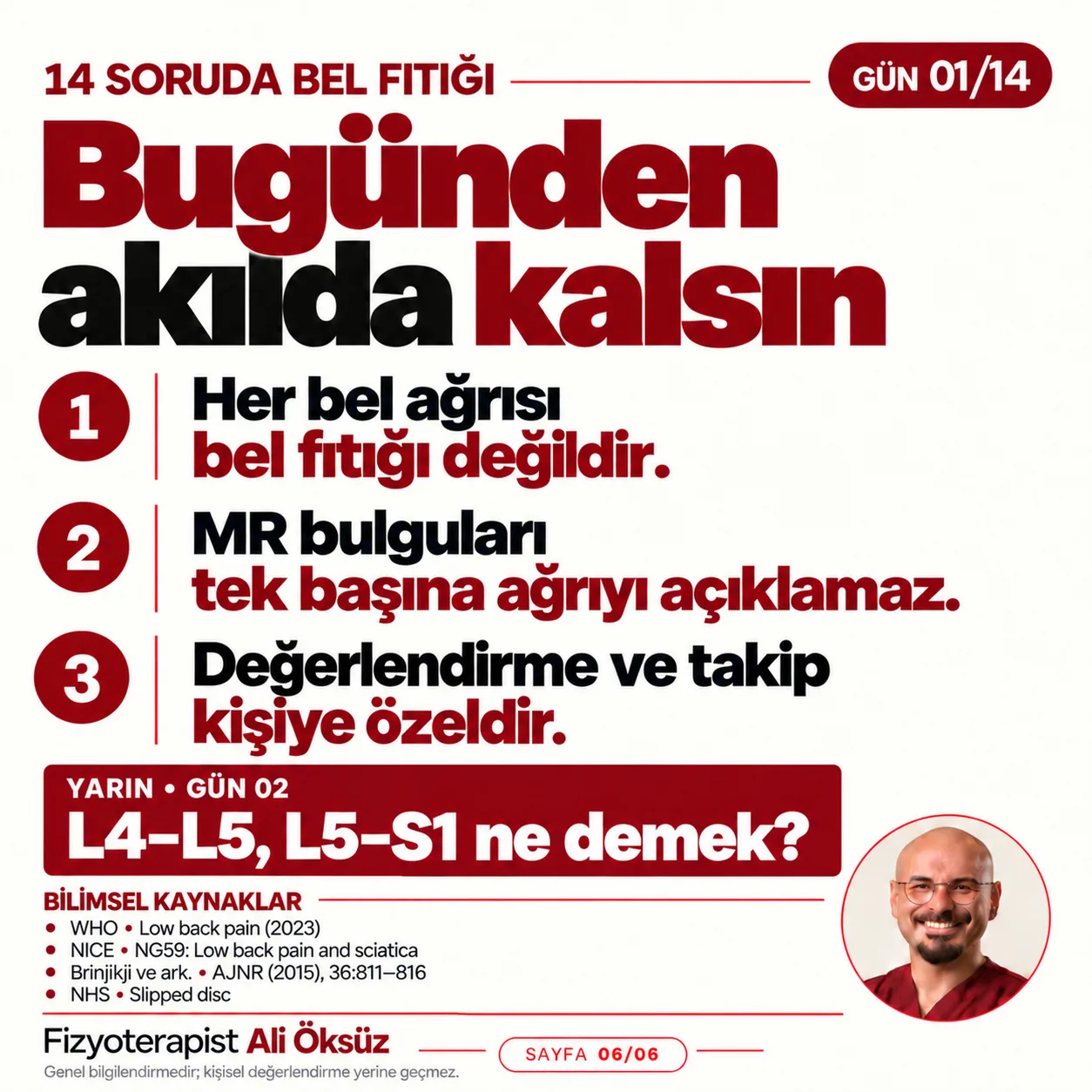
Sayfa 1/6
The slides are in Turkish. The images are not treatment photos; they were created with artificial intelligence for illustrative purposes.
Quick Answer
Not every low back pain is a herniated disc. Low back pain often cannot be explained by a single structural problem, and MRI findings can also be seen in people without pain. That is why MRI findings, symptoms and the examination are assessed together. Whether imaging is needed is decided by the physician based on clinical findings.
Table of Contents
What Is a Herniated Disc? Is Every Low Back Pain a Hernia?
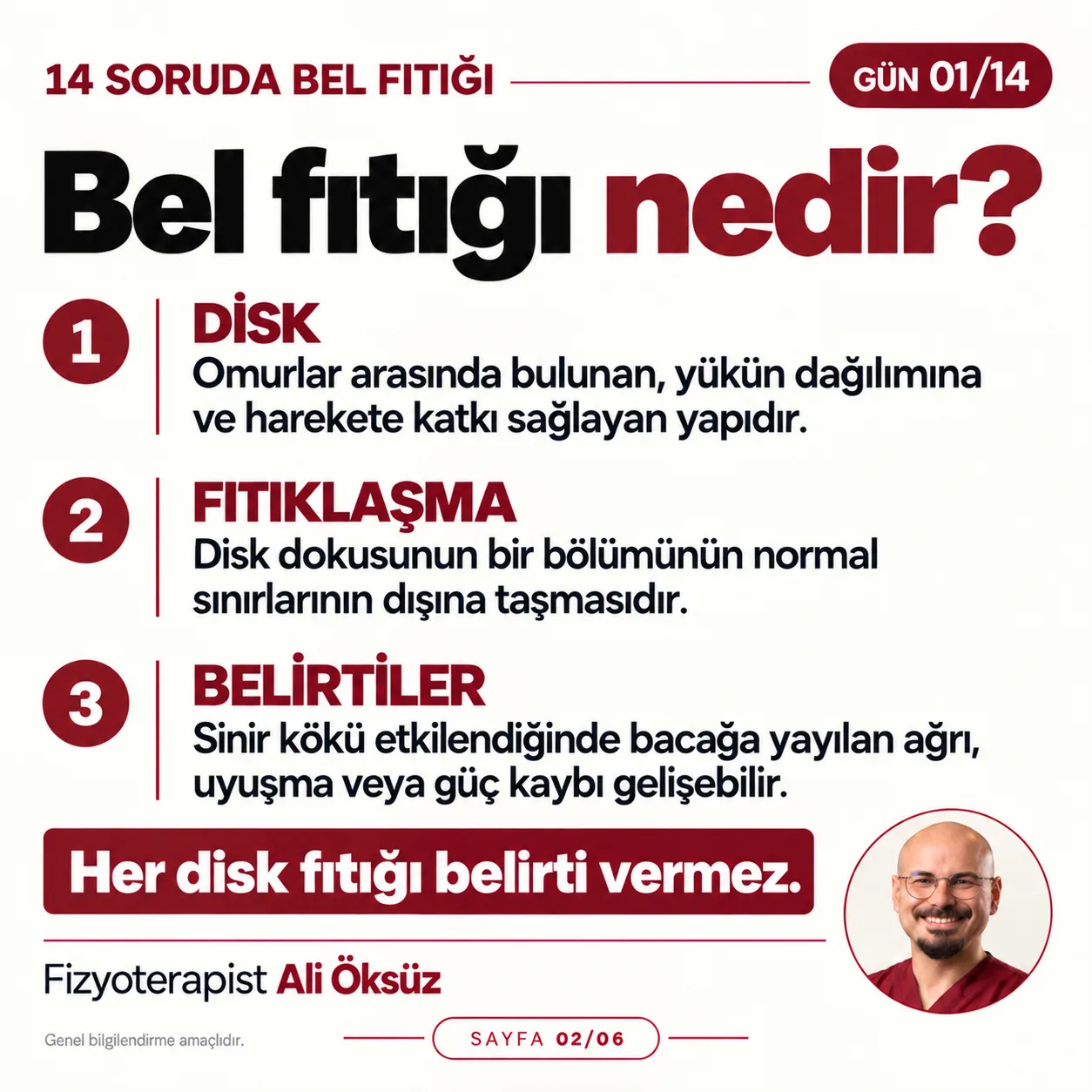
Most clients who come to our clinic in Antalya Konyaaltı with low back pain start with the same sentence: "I think I have a herniated disc." Yet the answer is short: No, not every low back pain is a herniated disc. Low back pain can have different causes.
On the first day of our "Herniated Disc in 14 Questions" series, we go through the basic questions together. You can swipe through the 6-page post above (in Turkish) and also take a look at our Instagram post.
What Is a Herniated Disc?
- Disc: A structure between the vertebrae that contributes to load distribution and movement.
- Herniation: Part of the disc tissue extends beyond its normal boundaries.
- Symptoms: When a nerve root is affected, pain radiating to the leg, numbness or weakness may develop.
Not every disc herniation causes symptoms. For general information, see the NHS: Slipped disc page.
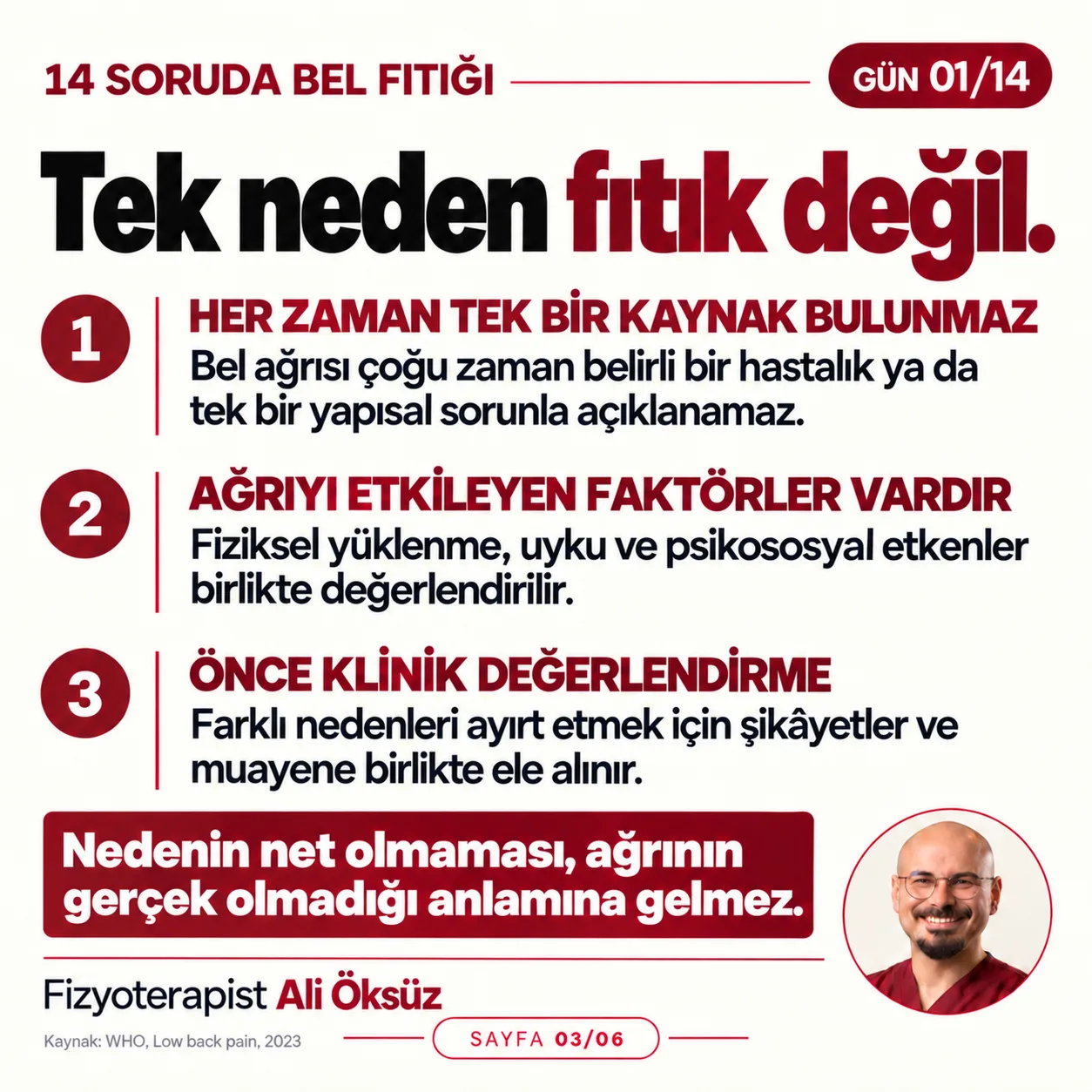
A "Hernia" Is Not the Only Cause
- There is not always a single source: Low back pain often cannot be explained by a specific disease or a single structural problem.
- There are factors that affect pain: Physical load, sleep and psychosocial factors are assessed together.
- Clinical assessment first: To distinguish between different causes, symptoms and the examination are considered together.
The cause not being clear does not mean the pain is not real. (Source: WHO, Low back pain, 2023)
From a kinetic chain perspective, the low back is not a region that works on its own; the hips, upper back and posture habits are also part of the picture. For a broad look at low back pain, see our Low Back Pain Physiotherapy article, and for the approach specific to herniated discs, our Herniated Disc Physiotherapy article.
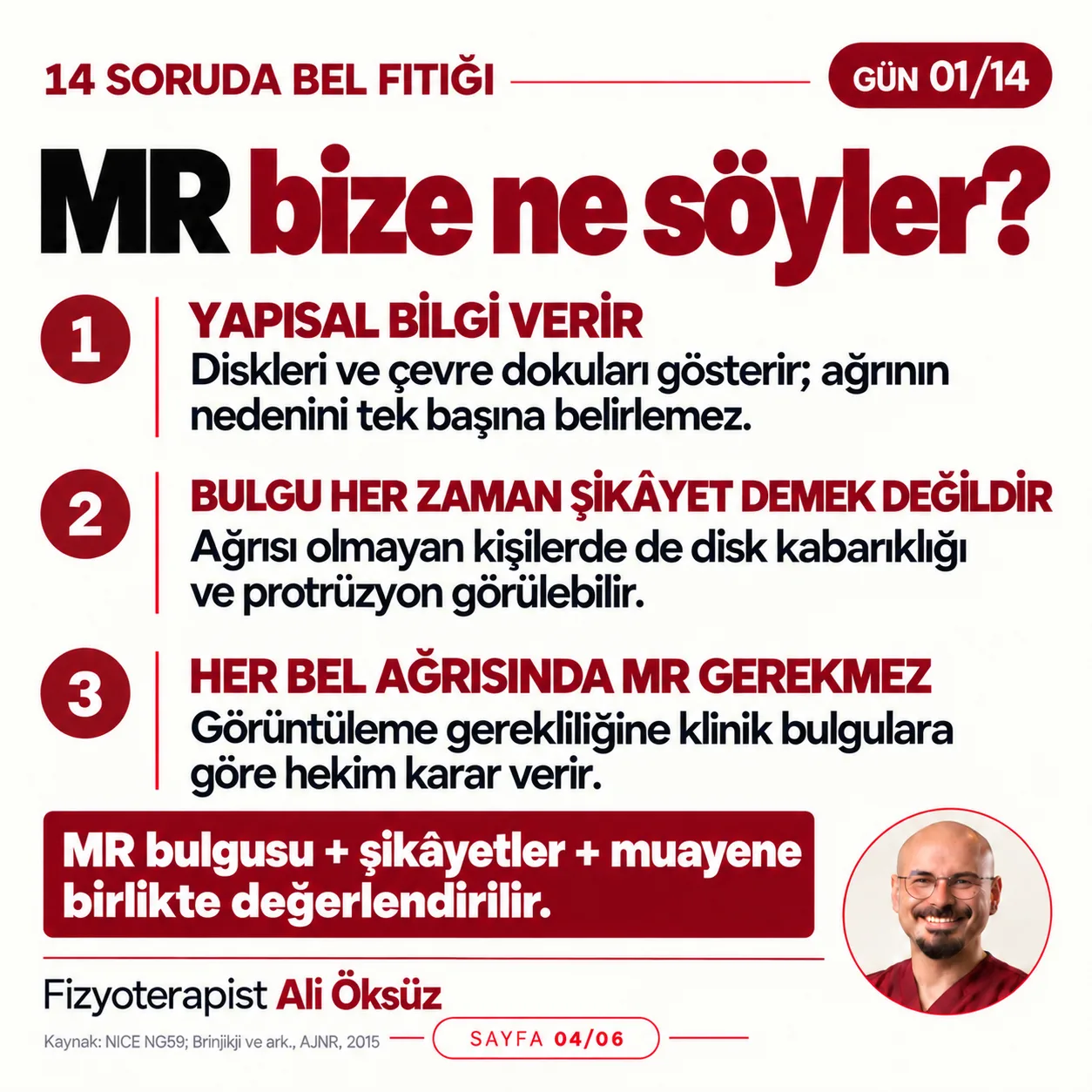
What Does an MRI Tell Us?
- It gives structural information: It shows the discs and surrounding tissues; on its own it does not determine the cause of pain.
- A finding does not always mean a complaint: Disc bulges and protrusions can also be seen in people without pain.
- Not every low back pain needs an MRI: The physician decides whether imaging is needed based on clinical findings.
Important: MRI findings + symptoms + examination are assessed together.
A systematic review of how often spinal imaging findings appear in people without pain is one of the key sources on this topic (Brinjikji et al., AJNR, 2015).
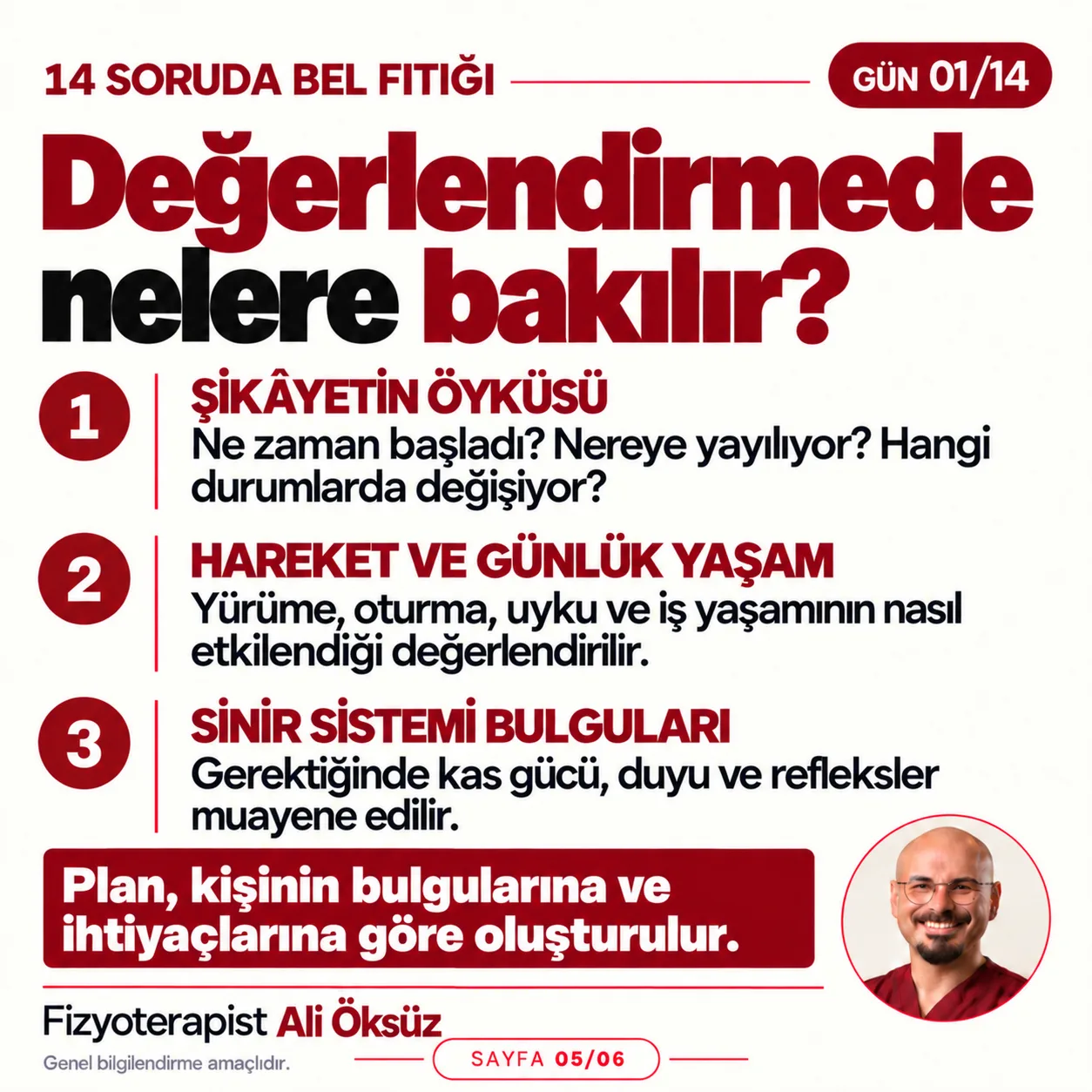
What Is Looked at in the Assessment?
- History of the complaint: When did it start? Where does it spread? In which situations does it change?
- Movement and daily life: How walking, sitting, sleep and work life are affected is assessed.
- Nervous system findings: When necessary, muscle strength, sensation and reflexes are examined.
The plan is built according to the person's findings and needs. For our related treatments, see the Manual Therapy and Orthopedic Rehabilitation pages.
🚩 When You Should See a Physician
- Progressive weakness or numbness in the leg.
- Changes in bladder or bowel control, numbness between the legs.
- Severe low back pain after trauma.
- Fever, unexplained weight loss, or pain at night that does not ease with rest.
With these symptoms, a physician's assessment comes first; seek emergency care if necessary.
Key Takeaways for Today
- Not every low back pain is a herniated disc.
- MRI findings alone do not explain pain.
- Assessment and follow-up are individual.
Tomorrow • Day 02: What do L4-L5 and L5-S1 mean?
Frequently Asked Questions (FAQ)
1. Is every low back pain a herniated disc? No. Causes can differ; symptoms and the examination are assessed together.
2. If an MRI shows a hernia, does that mean the hernia is causing the pain? Not on its own. Disc bulges and protrusions can also be seen in people without pain.
3. Do I need an MRI for every episode of low back pain? No. The physician decides whether imaging is needed based on clinical findings.
📚 Scientific Sources
- WHO. Low back pain. 2023. who.int
- NICE. NG59: Low back pain and sciatica in over 16s: assessment and management. nice.org.uk
- Brinjikji W, et al. Systematic literature review of imaging features of spinal degeneration in asymptomatic populations. AJNR Am J Neuroradiol. 2015;36:811-816. (PMID: 25430861)
- NHS. Slipped disc. nhs.uk
Low Back Pain Assessment in Antalya Konyaaltı
If you are wondering about the cause of your low back pain, with your physician's approval we can assess your complaints and movements together at our clinic.
📍 Fzt. Ali Öksüz | Özel Sağlık Meslek Hizmet Birimi Toros Mah. 801. Sok. No:4/4 Konyaaltı / Antalya
👉 For a preliminary consultation and clinic appointment, contact us on WhatsApp.
Legal Disclaimer: This page is for general information; it does not replace a physician's diagnosis, an individual assessment or a definitive cure promise. It has been prepared in accordance with the Health Advertising Regulation.
Related Treatments
The methods described in this article are delivered within the following treatments.
Frequently Asked Questions
The most common questions about this topic. If you can't find your answer, message us directly on WhatsApp.
No. Low back pain can have different causes and often cannot be explained by a single disease or structural problem. Symptoms and examination findings are assessed together.
Not on its own. Disc bulges and protrusions can also be seen in people without pain. MRI findings, symptoms and the examination are interpreted together.
No. The physician decides whether imaging is needed based on clinical findings.
No. When a nerve root is affected, pain radiating to the leg, numbness or weakness may develop; however, not every disc herniation causes symptoms.
Ready to talk about your complaint?
Call or message us on WhatsApp for a personalised clinical physiotherapy programme after your physician's diagnosis. I'm happy to answer your questions.
About the Author
Physiotherapist Ali Oksuz
Physiotherapist providing clinical physiotherapy services in Konyaaltı, Antalya. Applies evidence-based approaches (Mulligan, Maitland, Vodder MLD) in manual therapy, lymphedema rehabilitation, clinical reformer pilates, and orthopedic rehabilitation. The articles convey the physiotherapy process after a physician's diagnosis for informational purposes; it does not replace medical treatment.