
Reformer Pilates in Antalya: Who Benefits and Who Can Start?
Looking for reformer pilates in Antalya? See who benefits, who can start, and how sessions work with a physiotherapist. A clinical guide from Konyaaltı.

Physiotherapist Ali Oksuz | Private Health Profession Service Unit
Physiotherapist
Last updated: · Reviewed by: Fzt. Ali Öksüz
Quick Answer
Clinical reformer pilates is a low-impact exercise method performed on spring-resistance equipment, guided by a physiotherapist and personalized to you. It can be adapted for a wide range of people, including those with back or neck pain, posture problems, scoliosis, desk workers, older adults and beginners.
Table of Contents
- What Is Happening in Your Body? (Biomechanics and Neurophysiology)
- Secondary Complaints Alert: Is It Only Your Back?
- Who Benefits from Reformer Pilates?
- Who Can Start Reformer Pilates?
- Reformer Pilates with a Physiotherapist: What Is the Difference?
- How Do Manual Therapy and Reformer Work Together?
- How Does the Process Work?
- The Solution: "Sleeping Muscles" and Reformer Pilates
- 🚫 "Dangerous Mistakes!" to Avoid
- Transparent Frequently Asked Questions (FAQ)
- 📚 Academic References and Evidence-Based Foundation (EBM)
- Reformer Pilates with a Physiotherapist in Antalya Konyaaltı
- Legal Disclaimer
Reformer Pilates in Antalya: Who Benefits and Who Can Start?
You may wake up with stiffness in your lower back, or finish the day with a heavy neck. Or you may have no pain at all, but years at a desk have changed your posture and you are wondering where to begin. At our clinic in Konyaaltı, Antalya, one of the questions we hear most is exactly this: "Is reformer pilates right for me, and can I start?"
Most of the time the problem is not "tired muscles"; it is a body that can no longer distribute load well. When the deep spinal muscles stop doing their job, the load falls on joints and discs. Clinical reformer pilates is one of the methods we use to bring these muscles back into play in a controlled, joint-friendly way. In this article we explain who can benefit from reformer pilates, who can start comfortably, and how a session works with a physiotherapist.
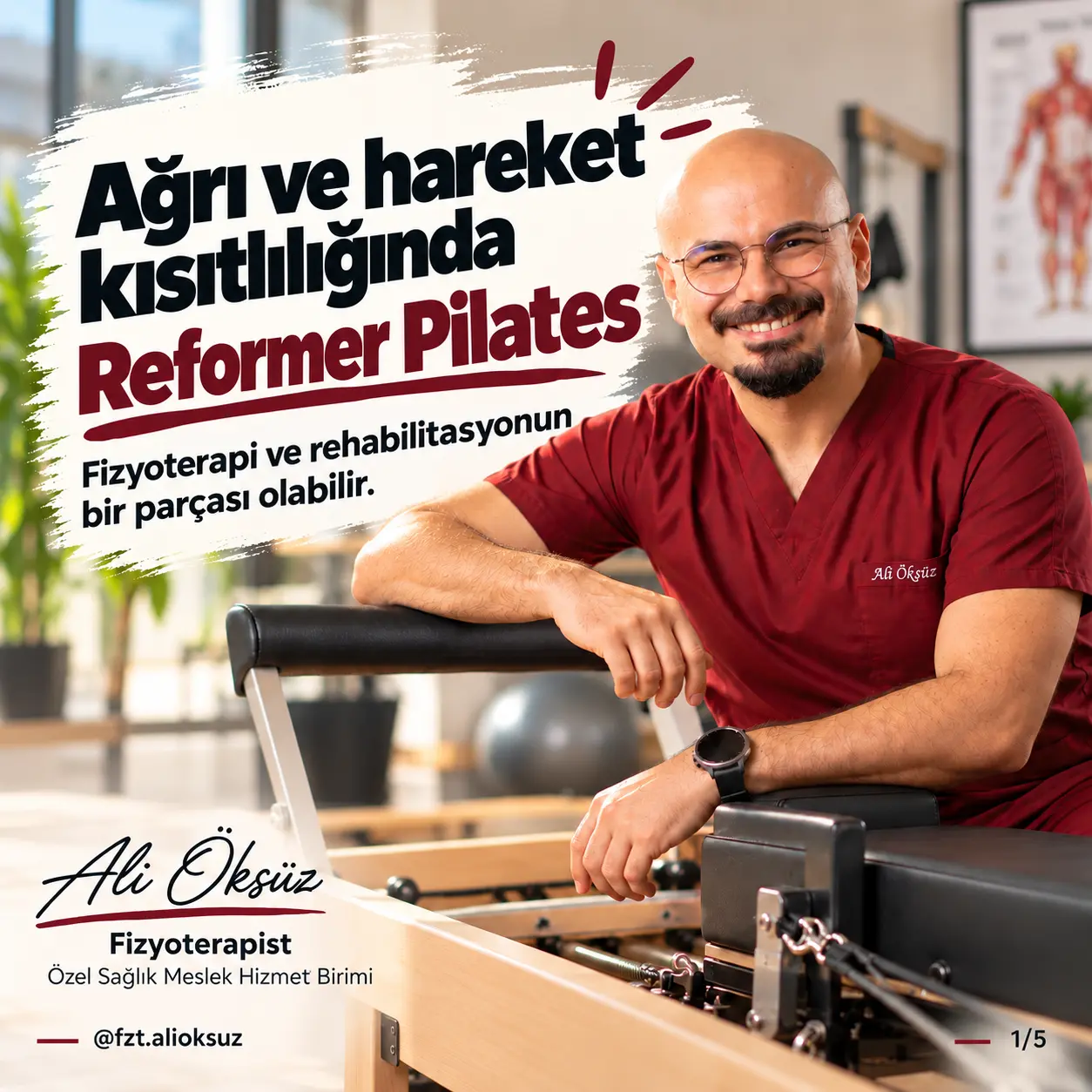
- Image is not an actual treatment photo. It was created with AI for promotional purposes.
What Is Happening in Your Body? (Biomechanics and Neurophysiology)
The body is a connected kinetic chain. When one link weakens, others take over its work and gradually tire.
- Load on the Body: Sitting for long periods, carrying a bag on one side or staying inactive "puts to sleep" the deep abdominal, hip and back muscles. When they stop working, the spine and joints try to carry most of the load alone.
- Kinetic Chain Balance: Weakness in the hips affects the lower back, a locked lower back affects the neck and shoulders, and shoulder imbalance affects the head. Pain often appears not where the problem started, but where compensation is happening.
On the reformer, movements are performed with spring support, in a controlled way and with neutral spine principles. The aim is not just muscle growth, but helping the brain relearn how to use the right muscle at the right time (neuromuscular motor control).
Secondary Complaints Alert: Is It Only Your Back?
The story of people who come for reformer pilates is rarely about a single pain:
- Back and neck pain: Stiffness and heaviness that increase after long periods of sitting.
- Posture changes: Rounded shoulders, forward head, rounded upper back.
- Loss of balance and fitness: Tiring quickly, difficulty on stairs or long walks.
- Fear of movement: Not being able to return to exercise after pain, or fearing the pain will come back.
Who Benefits from Reformer Pilates?
Because reformer pilates can be adapted to age and fitness level, it suits a wide range of people. At our Konyaaltı clinic we most often work with these groups:
- People with back and neck pain: Strengthens the deep muscles that support the spine and helps reduce load on the lower back and neck. For disc problems, see our article Antalya Lumbar Disc Herniation Physiotherapy.
- People with posture problems: Works the muscles that support posture in rounded back, forward shoulders and head position. You can find details in our posture and scoliosis rehabilitation article.
- Scoliosis: Supports trunk control and symmetry with personalized movements suited to spinal asymmetry. See our Scoliosis page for details.
- Desk workers: Balances the stiffness and weakness caused by long sitting.
- Those regaining strength after treatment or surgery: Helps rebuild muscle strength and movement confidence in a controlled way after rehabilitation.
- Before and after pregnancy: Supports the core, pelvic floor and back muscles with movements suited to this period. In an uncomplicated pregnancy, we recommend checking with your obstetrician before starting.
- Adults over 40 and older adults: Supports balance, flexibility and muscle strength without adding load to the joints.
- Athletes: Supports performance and helps reduce injury risk by identifying weak links.
- Anyone seeking tone and fitness: Works the whole body with joint-friendly, controlled resistance.
- People under stress or tension: Improves body awareness through breath and movement.
Who Can Start Reformer Pilates?
Short answer: almost anyone. The reformer's springs can make a movement easier or harder; your program is built around your starting level.
- People who have never exercised can start comfortably.
- There is no age limit; it is adapted from young adults to older adults.
- People with limited flexibility: range of motion opens up gradually during the session.
- People with low fitness: the work is low-impact and joint-friendly.
- People who avoid movement because of pain: a controlled, spring-assisted and safe start.
Reformer Pilates with a Physiotherapist: What Is the Difference?
What separates clinical pilates from studio pilates is who leads the session. At our clinic, physiotherapist Ali Oksuz leads sessions from start to finish.
- Assessment: At the first meeting your posture, joint range of motion, muscle balance and painful areas are examined.
- A personalized program: Spring resistance, position, repetitions and exercise selection are set for your body and goals.
- Real-time correction: Breathing, spinal alignment and muscle activation are checked throughout, so wrong compensation patterns are corrected before they settle in.
- Follow-up and home exercises: Your progress is tracked, the program is updated and you receive short exercises to do between sessions.
How Do Manual Therapy and Reformer Work Together?
For some people, joint mobility needs to be improved first. After a restricted joint is opened up with manual therapy techniques based on the Mulligan, Maitland and Kaltenborn schools, the reformer supports this new range with muscle strength. The aim is for the gained movement to become lasting. The biggest advantage of this approach is a single, continuous process with one practitioner.
How Does the Process Work?
Because everyone is different, the process does not follow a fixed calendar. In general:
- Phase 1 (Assessment and Preparation): Your complaints are heard, posture and movement are analyzed and goals are set.
- Phase 2 (Mobility and Control): Work on range of motion and correct muscle activation, supported by manual therapy when needed.
- Phase 3 (Stabilization and Maintenance): The spine and surrounding muscles are strengthened with the reformer and the gains are kept with home exercises.
For the session schedule and details, you can contact our clinic directly.
The Solution: "Sleeping Muscles" and Reformer Pilates
The reformer's spring system reduces the load gravity places on the spine, making it possible to isolate the deep muscles. Because the movement is controlled and rhythmic, it tires the muscles without straining the joints. This way the "sleeping" deep muscles wake up and start supporting the spine in daily life. Our goal is a pain-free and resilient movement pattern.
🚫 "Dangerous Mistakes!" to Avoid
- Trying "for everyone" videos on your own: General movements online may not suit your spine or painful area.
- Ignoring pain and pushing through: Continuing exercise with sharp or increasing pain can make things worse.
- Not moving at all: Fear of pain leading to total inactivity weakens muscles further.
- Starting without qualified guidance: Movements done without proper direction can lock in compensations.
Transparent Frequently Asked Questions (FAQ)
1. Will reformer pilates hurt? Movements are controlled and spring-assisted; the aim is to work without pain. If you feel discomfort during a session, the movement is adapted immediately.
2. I have never exercised. Can I start? Yes. The program is built around your starting level and updated as you progress.
3. When will I notice results? It varies from person to person. At the first meeting we discuss your goals and clarify expectations together.
4. Can I do it during pregnancy? In an uncomplicated pregnancy, yes, with modified movements and under a physiotherapist's guidance. We recommend checking with your obstetrician before starting.
📚 Academic References and Evidence-Based Foundation (EBM)
In the scientific literature, pilates has been studied most for chronic low back pain. These studies do not promise a definitive cure, but they show a direction:
- Yamato TP, Maher CG, Saragiotto BT, et al. (2015). Pilates for low back pain. Cochrane Database of Systematic Reviews, (7): CD010265. doi:10.1002/14651858.CD010265.pub2. The review reports low to moderate quality evidence that pilates can help with pain and disability compared with minimal intervention, and no conclusive evidence that it is superior to other forms of exercise.
- Fernández-Rodríguez R, et al. (2022). Best Exercise Options for Reducing Pain and Disability in Adults With Chronic Low Back Pain: Pilates, Strength, Core-Based, and Mind-Body. A Network Meta-analysis. J Orthop Sports Phys Ther, 52(8):505-521. doi:10.2519/jospt.2022.10671. In an analysis of 118 trials, pilates was among the most effective options for reducing pain and disability.
- Hayden JA, et al. (2021). Some types of exercise are more effective than others in people with chronic low back pain: a network meta-analysis. J Physiother, 67(4):252-262. doi:10.1016/j.jphys.2021.09.004. The authors emphasize that choosing an exercise you enjoy supports adherence.
Reformer Pilates with a Physiotherapist in Antalya Konyaaltı
Let us assess together whether reformer pilates suits you. Physiotherapist Ali Oksuz leads your sessions from start to finish. For more information, see our Clinical Reformer Pilates page and our Konyaaltı region page.
📍 P.T. Ali Oksuz | Private Health Profession Service Unit
Toros Mah. 801. Sok. No:4/4 Konyaaltı / Antalya
👉 For Pre-consultation and Clinical Appointment, Contact Us Now on WhatsApp.
Legal Disclaimer
This page does not replace a physician's diagnosis or a definitive cure promise. It has been prepared on the basis of physical therapy science in accordance with the Health Advertising Regulation to raise health awareness.
Related Treatments
The methods described in this article are delivered within the following treatments.
Clinical Reformer Pilates in Antalya
Personalized Reformer Pilates with Physiotherapist Ali Öksüz · Konyaaltı
Learn moreManual Therapy & Joint Mobilization
International Evidence-Based (EBM) Joint and Spine Rehabilitation
Learn moreScoliosis Physiotherapy (Schroth Method)
Three-Dimensional Spine Correction Exercises
Learn moreFrequently Asked Questions
The most common questions about this topic. If you can't find your answer, message us directly on WhatsApp.
Yes. The reformer's spring system can make a movement easier or harder. Your program is adapted to your starting level after the first assessment; there is no age or fitness limit.
Studio pilates is for general fitness and is usually done in groups. Clinical pilates is built around a physiotherapist's assessment of your posture, movement and pain; movements are followed one-to-one and corrected in real time.
For many people, strengthening the deep spinal muscles is a supportive step in managing pain. Scientific reviews suggest pilates can help with pain and function in chronic low back pain compared with passive approaches. Results vary from person to person, so we assess your situation together at the first meeting.
In an uncomplicated pregnancy, yes, with modified movements suited to this period and under a physiotherapist's guidance. We recommend checking with your obstetrician before starting, and not starting without their approval if your pregnancy is high-risk.
It is not a weight-loss method on its own; it supports muscle strength, posture and body shape. Combined with balanced nutrition and daily activity, it contributes to your goals.
Ready to talk about your complaint?
Call or message us on WhatsApp for a personalised clinical physiotherapy programme after your physician's diagnosis. I'm happy to answer your questions.
About the Author
Physiotherapist Ali Oksuz
Physiotherapist providing clinical physiotherapy services in Konyaaltı, Antalya. Applies evidence-based approaches (Mulligan, Maitland, Vodder MLD) in manual therapy, lymphedema rehabilitation, clinical reformer pilates, and orthopedic rehabilitation. The articles convey the physiotherapy process after a physician's diagnosis for informational purposes; it does not replace medical treatment.