Posture Deformity and Scoliosis: What Should We Do?
Hunchback (kyphosis), scoliosis, and postural deformities are not just aesthetic but biomechanical issues. How to correct posture with specific exercise?
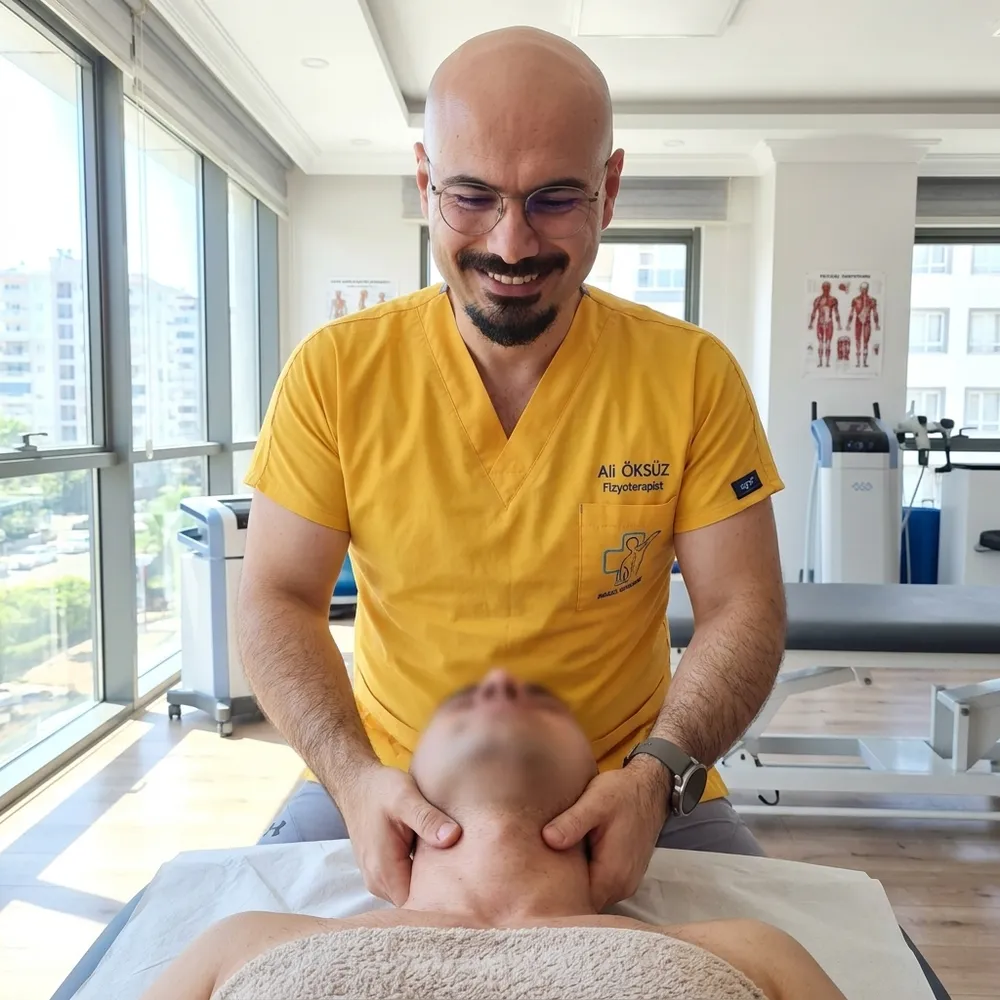
Physiotherapist Ali Oksuz | Private Health Profession Service Unit
Fizyoterapist
Hızlı Cevap
Postural deformities (hunchback, asymmetric shoulders, scoliosis) are not merely aesthetic issues; they alter the spine's load distribution, paving the way for pain and functional loss. They can be managed with specific Schroth exercises and postural education following a physician's diagnosis.
Posture Deformity and Scoliosis: Rebuilding Biomechanics
Do you see that one of your shoulders is lower than the other when you look in the mirror? Have you noticed a curvature on your child's back? Or, when you look in the mirror from the side, do your shoulders lean forward and your head stretch completely towards the computer (Hunchback / Kyphosis)?
Posture is not just an aesthetic concept related to how we look. It is an immense biomechanical foundation that determines the alignment of all our organs, our breathing capacity, and our spinal health.
Scoliosis: The Transformation Story of the Spine
Scoliosis (spinal curvature) is a 3-dimensional spinal deformity that is very common, especially during rapid growth spurts in adolescence. The spine not only bends to the right or left (in an 'S' or 'C' shape), but also rotates around itself.
Advice like "let's wait and see" or "stand straight and it will pass" is scientifically invalid. In scoliosis, early intervention and personalized 3-dimensional (Schroth and similar) spinal exercises performed with a physiotherapist are the most vital steps to halt progression.
Our Clinical Exercise and Therapy Approach
"Postural correction braces" often bought off the internet make the ligaments and muscles lazy by keeping the spine upright artificially. The evidence-based approach in Scoliosis and Kyphosis is as follows:
What Happens Anatomically in the Session?
- 1. 3D Correction (e.g. Schroth Principles): Scoliosis is not a one-way curve, but a rotational twist. By teaching the patient at which specific breathing and rotation angle to pull their spine to the center (Elongation), we break the three-dimensional asymmetry.
- 2. Fascial Stretching (For Kyphosis / Hunchback): Trying to just \"stand straight\" without stretching the tight \"fascia\" structures in the pectoral muscles, which are narrowed, closed, and shortened, pulling the rib cage forward, does not work. First, we unlock the key.
- 3. Medical Reformer Pilates: After the locks are opened and the rotation is broken, we imprint that perfect upright posture into the Permanent Motor Memory by loading Reformer resistance on the weakened and lengthened back muscles (stabilizers).
Do Not Wait, Change Your Posture
If you suspect spinal curvature (Scoliosis) in your child, following a physician's diagnosis, or if you want to intervene in your own postural deformity, breathe correctly, and open your shoulders, our physiotherapy guidance is at your service.
👉 To schedule a comprehensive posture analysis appointment, reach us on WhatsApp.
Legal Disclaimer: The information provided does not guarantee diagnosis or a definitive cure, it carries awareness.
Bu Konuyla İlgili Uygulamalarımız
Yazıda bahsedilen yöntemler aşağıdaki uygulamalarımız kapsamında yürütülür.
Sıkça Sorulan Sorular
Yazıyla ilgili en çok sorulan sorular. Cevabı bulamadığınız bir konu varsa doğrudan WhatsApp'tan yazabilirsiniz.
Reduction of the Cobb angle in adults is rare; however, pain, postural asymmetry, and functional capacity can be significantly supported with an appropriate exercise program.
You should first consult an Orthopedics physician. After the diagnosis and curvature degree are determined, a Schroth-based physiotherapy program is planned with the physician's guidance.
SOSORT (International Society on Scoliosis Orthopaedic and Rehabilitation Treatment) guidelines define PSSE (Physiotherapeutic Scoliosis-Specific Exercises) approaches as complementary methods in managing curvature progression in idiopathic scoliosis. The Schroth method is based on three-dimensional corrective posture, asymmetric breathing, and stabilization principles. The program is always planned individually within the framework of a certified approach, after evaluating the physician's diagnosis, Cobb angle, Risser stage, and growth potential.
Şikayetinizi konuşmaya hazır mısınız?
Hekim teşhisi sonrası kişiye özel klinik fizyoterapi programı için bizi arayın veya WhatsApp'tan yazın. Sorularınız varsa cevaplamaktan memnuniyet duyarım.
About the Author
Physiotherapist Ali Oksuz
Expert physiotherapist providing clinical physiotherapy services in Konyaaltı, Antalya. Applies evidence-based approaches (Mulligan, Maitland, Vodder MLD) in manual therapy, lymphedema rehabilitation, clinical reformer pilates, and orthopedic rehabilitation. The articles convey the physiotherapy process after a physician's diagnosis for informational purposes; it does not replace medical treatment.