
Neck Flattening Treatment in Antalya and Lordosis Exercises
Do you have persistent neck and head pain in Antalya? Read about the clinical treatment of neck flattening (loss of cervical lordosis), massage differences, and clinical reformer pilates methods.
Fzt. Ali Öksüz | Special Health Services Unit
Physiotherapist
Last updated: · Reviewed by: Fzt. Ali Öksüz
Quick Answer
Loss of cervical lordosis (neck flattening) is not a disease in itself; it is the biomechanical result of long-term static posture, phone/computer use, and muscle imbalances. It can be managed with manual therapy, deep neck flexor training, and clinical reformer pilates following doctor diagnosis.
Table of Contents
- What Do You Experience Biomechanically and Neurophysiologically?
- Secondary Symptoms Alarm: Does Only Your Neck Hurt?
- How Does Manual Therapy View Neck Flattening?
- Treatment Protocol: How Does the Process Work and How Many Weeks Does It Take?
- Solution Specifications: "Longus Colli" and Reformer Pilates
- Waking Up the "Core" Neck Muscle (Longus Colli)!
- Medical Reformer Pilates
- 🚫 "Dangerous Mistakes" Not to Do!
- Transparent Frequently Asked Questions (FAQ)
- 📚 Academic Bibliography and Evidence-Based Basis (EBM)
- Advanced Physiotherapy Support in Antalya Konyaaltı
Neck Flattening (Loss of Cervical Lordosis) and Clinical Treatment Approach in Antalya
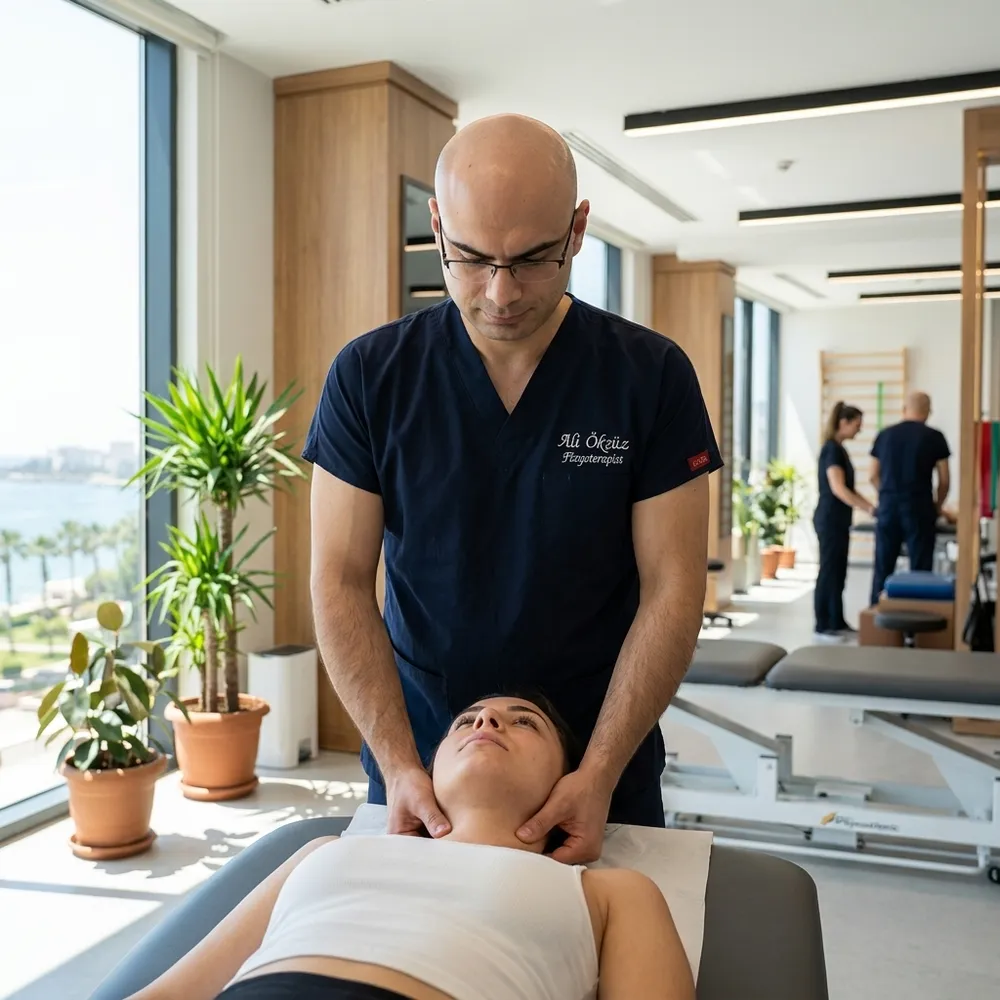 * This image was created with artificial intelligence. It is not a session photograph.
"I have a pain shooting from my back to my head, my arms are tingling, and now pain relievers only work for 1-2 hours." If this sentence sounds familiar and your MRI result says "Loss of Cervical Lordosis (Neck Flattening)", the problem is not that your muscles are tired, but that the biomechanical architecture of your neck is collapsing. Let's look at this common picture that we encounter every day in our clinic in Antalya Konyaaltı through the window of international "Antalya Neck Flattening Treatment" and physical therapy literature.
What Do You Experience Biomechanically and Neurophysiologically?
In human anatomy, the neck (cervical) region has a gentle "C" curve (Lordosis) structure to carry the head's weight of approximately 4.5 – 5 kilograms and to absorb shocks. However, leaning towards the computer or phone for long hours (Text-Neck Syndrome) causes this anatomical shock-absorbing curve of the neck to be lost and the spine to become straight like the letter "I".
From this moment of flattening, a destructive process begins in terms of nerve physiology:
- Load Tripled: Every 2.5 cm the head shifts forward, the load on your neck muscles increases by another 5 kilograms. This situation causes early aging (calcification - spondylosis) in the neck discs.
- Kinetic Chain Balance: Remember, the body consists of interconnected chains. Sometimes a severe hunchback in your back (Hunchback - Kyphosis) or the wrong posture of your pelvis can directly force your neck to flatten in order to compensate.
Secondary Symptoms Alarm: Does Only Your Neck Hurt?
The loss of the neck curve initiates a series of chain reactions in the upper part of the body:
- Chronic Neck and Shoulder Pain: The feeling of Chronic Pain and Fibromyalgia resulting from the muscles working "overtime" 24 hours a day to prevent the head from falling.
- Dizziness and Lightheadedness (Vertigo-Like): Severe spasm in the neck muscles interrupting the blood flow and fine balance signals going to the brain.
- Tension-Type Headache: A feeling of tightness starting from the base of the neck and shooting behind the eyes like a helmet.
- Herniation and Nerve Compression: Numbness and tingling radiating to the arms, down to the fingertips due to narrowed nerve passage channels (the same mechanism as the pain shooting to the leg in Lumbar Hernia).
How Does Manual Therapy View Neck Flattening?
The golden rule in treatment is to accept that drugs or simple massages cannot change the angle of the spine (mechanical physiology). Based on the PubMed / PEDro literature, the following manual therapy schools are designed in our clinic with the philosophy of "lubricating the hinges of a locked shelf":
What Happens Anatomically in the Session?
- 1. Mulligan (Painless Joint Gliding): The upward kinetic movement direction is reminded to the collapsed, flattening structure with the SNAGs technique (special specific facet pressures). When nerve tissue is mechanically freed, tension-type headaches are suddenly interrupted.
- 2. Maitland Mobilization: With Grade I-IV mobilization oscillations applied to the facet joints that have turned into calcification and locked the spine in the "I" shape, pain neurons in the brain are reset (Descending Pain Inhibition).
- 3. Fascial Release and Traction: Thickened connective tissue membranes (fascia tissue) wrapping the vertebrae like a shell are released with special ischemic pulls (Decompression), increasing blood flow to the disc and accelerating recovery.
Treatment Protocol: How Does the Process Work and How Many Weeks Does It Take?
Our rehabilitation program is designed based on scientific evidence rather than promises, usually as 4 to 6 Weeks (8-12 sessions):
- Phase 1 (Acute - 1st and 2nd Week): Resolving muscle spasm and silencing the nerve. Dizziness and pain radiating to the arms start to decrease in this process.
- Phase 2 (Mobility - 3rd and 4th Week): Regaining full movement of the joint spaces. This is the phase where Maitland and Mulligan techniques are applied intensively.
- Phase 3 (Stabilization - 5th and 6th Week): The actual critical part, "Dynamic Protection". The insurance of the treatment is made with Clinical Pilates.
Solution Specifications: "Longus Colli" and Reformer Pilates
Waking Up the "Core" Neck Muscle (Longus Colli)!
Just relaxing the outer muscles is not enough; it is essential to find and strengthen the "Deep Neck Flexor" muscles that carry the spine inside so that the head does not fall forward. With specific posture exercises ("Postural Re-education") in our clinic, these "sleeping" muscles are aligned again.
Medical Reformer Pilates
Reformer Pilates is not just an exercise for us, but a spine treatment (decompression) unit:
- Axial Elongation: After joint locks are opened with manual therapy, the spine is elongated along its length using Reformer's spring systems. Discs breathe.
- Back Support: The actual area protecting the neck as a shield against gravity is A Strong Back. In Reformer sessions, the goal is to transfer your neck load to the strong core and back structure.
🚫 "Dangerous Mistakes" Not to Do!
The neck is a very sensitive transition path. The biggest public misconceptions undermining the treatment process are:
- Unconscious Pulls and Cracks: Sudden rotational cracks performed by people who have not examined you and do not know the ligament integrity of the joint (do not read MRI) can cause ligament injuries and increased flattening.
- Using a Collar Constantly: Relying on artificial external corsets for your skeleton will waste your neck muscles (Atrophy) and make the problem huge.
- Passive Therapy Without Exercise: The approach of "let them connect devices to me and let it pass". It is like just painting the wall without plastering the crack, it will return at the first blow.
Transparent Frequently Asked Questions (FAQ)
1. Does clinical physical therapy hurt? No. Manual therapy is applied within the person's comfort limits. None of the maneuvers performed (upper cervical region) in our clinic involve brute force, we work within the patient's pain limit.
2. Will my pain return after I heal? It is in your hands to prevent it from returning. We open the locked system in our clinic; however, it is the "Medical Exercise" and postural life habits that will turn the instruction "Stand upright" into a habit. Turning Medical Pilates into a routine helps reduce the risk of recurrence.
📚 Academic Bibliography and Evidence-Based Basis (EBM)
Our treatment framework is guided by these golden medical standards:
- Falla, D., et al. (2004) - Neuromuscular Control of the Cervical Spine.
- Maitland, G. D. (2013) - Vertebral Manipulation.
- Kisner, C., & Colby, L. A. (2017) - Therapeutic Exercise: Foundations and Techniques.
- Journal of Orthopaedic & Sports Physical Therapy (JOSPT) - Cervical Mobilization Success Rates.
Advanced Physiotherapy Support in Antalya Konyaaltı
You are not condemned to wake up with tension-type headache, numbness in your arms, and a rock in your neck every morning. Contact us to redesign the kinematics of your neck and return to your quality of life with professional "Manual Therapy & Reformer Pilates".
📍 Fzt. Ali Öksüz | Special Health Services Unit
Toros Mah. 801. Sok. No:4/4 Konyaaltı / Antalya
👉 For consultation and clinical appointment, contact us now on WhatsApp.
Legal Disclaimer: This page is not a substitute for a doctor's diagnosis or a promise of absolute healing. It has been prepared on the basis of physical therapy science in accordance with the Health Advertising Regulations in order to increase health awareness.
Related Treatments
The methods described in this article are delivered within the following treatments.
Frequently Asked Questions
The most common questions about this topic. If you can't find your answer, message us directly on WhatsApp.
The flattened cervical curve transfers the weight of the head to the upper neck muscles. The continuous loading of these muscles can pave the way for tension-type headaches.
Yes. A pillow with medium hardness that will maintain the neutral position of the neck and suitable height for the shoulder supports the rest of the neck muscles throughout the night.
Adjusting screen height to eye level, maintaining cervical mobility with short breaks every 30-45 minutes, and using the phone by raising it to shoulder level reduces daily loading. Gentle activation exercises such as chin tucks show benefits when supporting a clinical program. These recommendations do not replace treatment; the program to be applied is determined individually and based on an evidence-based approach following doctor diagnosis and physiotherapist evaluation.
Ready to talk about your complaint?
Call or message us on WhatsApp for a personalised clinical physiotherapy programme after your physician's diagnosis. I'm happy to answer your questions.
About the Author
Physiotherapist Ali Oksuz
Physiotherapist providing clinical physiotherapy services in Konyaaltı, Antalya. Applies evidence-based approaches (Mulligan, Maitland, Vodder MLD) in manual therapy, lymphedema rehabilitation, clinical reformer pilates, and orthopedic rehabilitation. The articles convey the physiotherapy process after a physician's diagnosis for informational purposes; it does not replace medical treatment.