
Raising the Arm Above 90 Degrees: The Forgotten Movements Series
Can you raise your arm above 90 degrees and bring your hand to the back of your neck and up your back? A physiotherapist's view on 3 simple shoulder mobility tests and when to see a physiotherapist.

Fzt. Ali Öksüz | Özel Sağlık Meslek Hizmet Birimi
Physiotherapist
Last updated: · Reviewed by: Fzt. Ali Öksüz
Quick Answer
Raising the arm above 90 degrees, bringing the hand to the back of the neck and reaching the hand up the back are the shoulder's basic movements in daily life. The 3 simple movements in this article help you observe your shoulder mobility at home; they are not a diagnostic test. If you notice a difference between your two shoulders, pain or restriction, an assessment by a physician or physiotherapist is recommended.
Table of Contents
- Videos and Posts
- Why Is the Shoulder So Mobile?
- 3 Simple Shoulder Mobility Observations
- 1. Raising the Arm Above 90 Degrees
- 2. Bringing the Hand to the Back of the Neck
- 3. Reaching the Hand Up the Back
- How Should You Interpret Your Results?
- 🚩 When You Should See a Physician
- Why Does Shoulder Mobility Matter?
- How Can Physiotherapy Help?
- Frequently Asked Questions (FAQ)
- 📚 Academic References
- Shoulder Mobility Assessment in Antalya Konyaaltı
Raising the Arm Above 90 Degrees: The Forgotten Movements Series
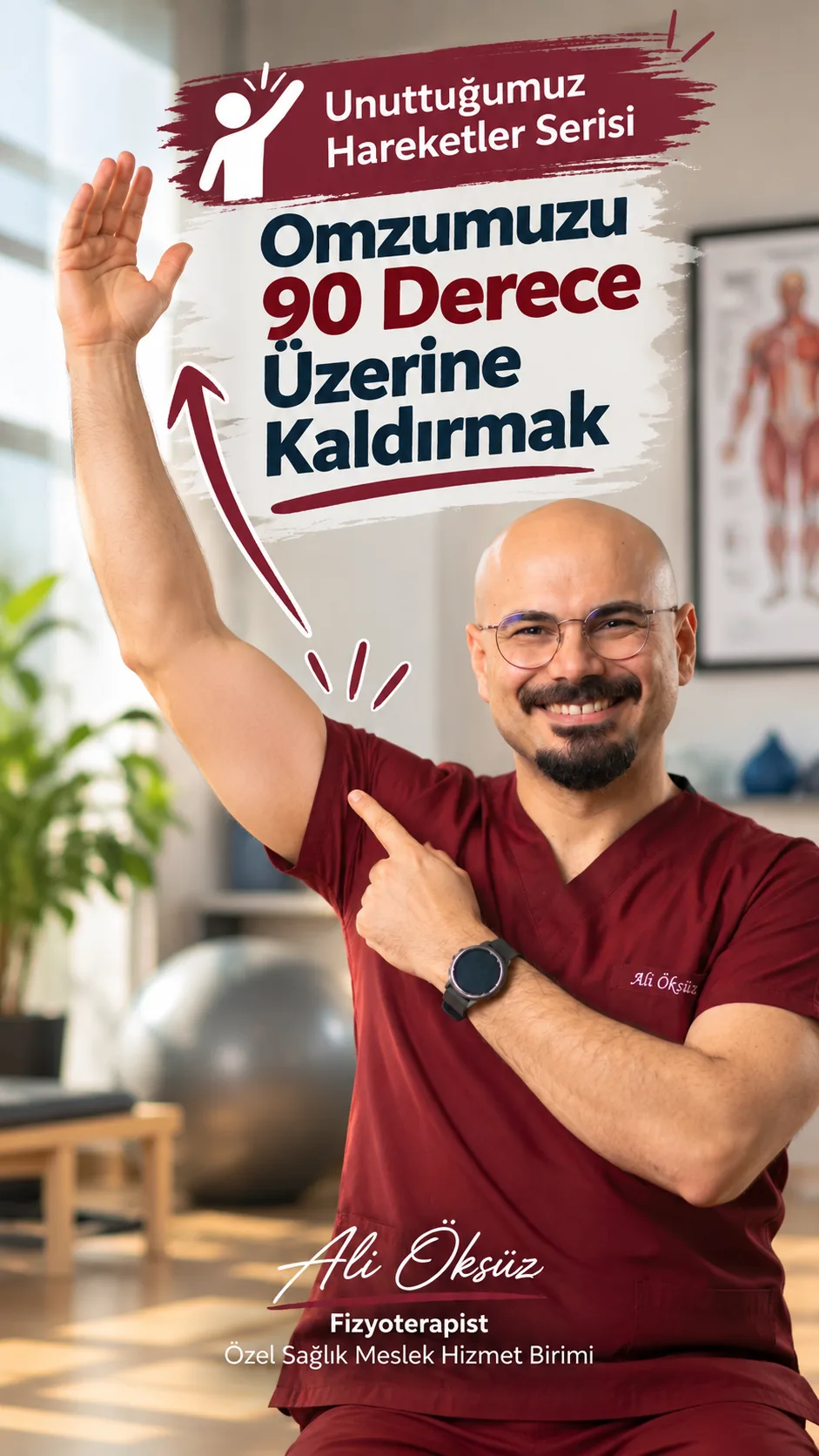 The image is not a treatment photo. It was created with artificial intelligence for illustrative purposes.
Taking something from a shelf, combing your hair, scratching your back, putting on clothes... All of these are movements where the shoulder quietly does its work. Yet as long as there is no pain, we rarely think about how much our shoulder moves. In the next stop of "The Forgotten Movements Series" we observe these movements together: raising the arm above 90 degrees. For the previous article in the series, see Sitting Cross-Legged.
Many clients who come to our clinic in Antalya Konyaaltı with shoulder complaints say they noticed the problem "the day I couldn't lift my arm". Yet loss of movement usually develops gradually. That is why a simple self-observation can be useful.
Videos and Posts
We explained how to do these movements in a short video:
Why Is the Shoulder So Mobile?
The shoulder is the most mobile region of our body, and this mobility is not provided by a single joint. When raising the arm, the upper arm bone (humerus), the shoulder blade (scapula) and the collarbone (clavicle) work together.
A study on PubMed examining functional reaching movements in people aged 45-75 reported that the collarbone, shoulder blade and upper arm bone all contribute to raising the arm. In the study, the ratio of collarbone elevation, shoulder blade rotation and upper arm elevation during forward arm raising was about 1°:2°:9° (DOI). In other words, raising the arm is not only the work of the "shoulder joint"; the shoulder blade must also move in harmony.
That is why being unable to raise your arm does not always mean there is a problem in the shoulder joint itself. Shoulder blade movement, the rib cage and upper back posture are also involved. This shows that the kinetic chain principle also applies to the shoulder.
3 Simple Shoulder Mobility Observations
Try the following movements in front of a mirror, standing or sitting upright, on each side separately. The aim is not to force the movement but to observe up to the point where it is pain-free and compare the two sides.
1. Raising the Arm Above 90 Degrees
- Raise your arm to the side or to the front up to shoulder height (90 degrees).
- Then try to raise it towards your ear, up above your head.
- What to look for: Can your arm get close to your ear? Are you compensating by hitching your shoulder up towards your ear (shrugging)? Are you arching your lower back? Does one side stay noticeably lower than the other?
2. Bringing the Hand to the Back of the Neck
- Bring your hand behind your head to neck level, with your elbow opening out to the side.
- What to look for: Can you place your hand comfortably on the back of your neck? Does your elbow drop forward? Are you compensating by bending your neck forward? Is there pain or a pinching feeling?
3. Reaching the Hand Up the Back
- Slide your hand behind your back, starting at the waist and moving up along the spine.
- What to look for: Compare the level your hand reaches on both sides. Are you leaning your trunk to the side or rolling your shoulder forward?
In the clinic this movement is known as "hand behind back" and is used to assess the shoulder's internal rotation. A study on PubMed reported that this method can be inconsistent between examiners; the researchers suggested alternative measurement methods because of the limitations of measurements based on estimating the spinal level (DOI). Another study with 60 healthy people reported that a measurement method normalized to body dimensions was reliable (DOI). This suggests that although this movement is used in the clinic, it requires professional assessment to be interpreted correctly. Your observation at home only gives an idea.
Important: These tests do not diagnose and do not indicate a specific disease. They only give a general idea of your shoulder mobility.
How Should You Interpret Your Results?
- If you can do all three movements comfortably on both sides: Your shoulder mobility may be sufficient for daily life. Keeping up regular movement and good posture habits is enough.
- If there is marked restriction, pain or compensation on one side: A physiotherapy assessment may be useful.
- If the difference between the two sides increases over time: Get an assessment without delay.
🚩 When You Should See a Physician
- Shoulder pain or loss of movement after trauma such as a fall or blow.
- Pain that wakes you at night or does not ease with rest.
- Numbness, tingling or sudden weakness in the arm.
- Swelling, redness, fever or a visible change in shape of the shoulder.
- Chest pain, shortness of breath or pain spreading to the left arm: in this case seek emergency care.
With these symptoms, a physician's assessment comes first, not physiotherapy.
Why Does Shoulder Mobility Matter?
Restricted shoulder range of motion does not just mean "not being able to lift the arm". Over time, the following daily movements can also become difficult:
- Taking something from a cupboard or shelf.
- Washing and combing your hair.
- Putting on a T-shirt or jacket, fastening a bra.
- Turning the steering wheel while driving.
- Lying on your side when sleeping.
Identifying which link the restriction is in (the shoulder joint, the shoulder blade, upper back posture or another cause) is the first step in choosing the right exercise program. For painful shoulder conditions that restrict movement, see also our Frozen Shoulder Rehabilitation article.
How Can Physiotherapy Help?
After a physician's assessment, the goal in physiotherapy is to improve the range of motion, muscle strength and movement control of the shoulder, shoulder blade and upper back with an individual program. At which stage and why the movement is restricted is determined by clinical examination. For related information, see our Orthopedic Rehabilitation and Clinical Reformer Pilates pages. Our Loss of Cervical Lordosis Physiotherapy article may also be useful on the link with posture and the neck.
Frequently Asked Questions (FAQ)
1. I can't raise my arm above 90 degrees – what does that mean? It may indicate limited shoulder range of motion; however, these tests do not diagnose. If there is pain or the restriction is new, get an assessment by a physician or physiotherapist.
2. Is it normal for my two shoulders to differ? Small differences are possible. If there is a marked difference, pain or restriction that increases over time, an assessment is useful.
3. What should I do if I feel pain during the tests? Don't force the movement. If the pain continues, wakes you at night, or comes with numbness and weakness, see a physician first.
📚 Academic References
- Pain LAM, Baker R, Sohail QZ, Hebert D, Agur AMR. Three-dimensional range of motion of the clavicle, scapula, and humerus during functional reach in adults aged 45-75. Shoulder Elbow. 2025;18(3):622-634. DOI: 10.1177/17585732251352452 (PMID: 40620470)
- Sraj SA. Internal Rotation Behind-the-Back Angle: A Reliable Angular Measurement for Shoulder Internal Rotation Behind the Back. Sports Health. 2015;7(4):299-302. DOI: 10.1177/1941738113502159 (PMID: 26137173)
- Mitsukane M, Suzuki K, Tabe R, Hasumi F, Fukushima D. Normalized hand-behind-back for the measurement of shoulder internal rotation. JSES Int. 2022;6(2):287-291. DOI: 10.1016/j.jseint.2021.12.001 (PMID: 35252928)
- Bourne DA, Choo AMT, Regan WD, MacIntyre DL, Oxland TR. Three-dimensional rotation of the scapula during functional movements: an in vivo study in healthy volunteers. J Shoulder Elbow Surg. 2007;16(2):150-162. DOI: 10.1016/j.jse.2006.06.011 (PMID: 17113324)
Sources were compiled via PubMed.
Shoulder Mobility Assessment in Antalya Konyaaltı
If you notice restriction, pain or a difference between the two sides in your shoulder movements, with your physician's approval we can assess your shoulder mobility together at our clinic.
📍 Fzt. Ali Öksüz | Özel Sağlık Meslek Hizmet Birimi Toros Mah. 801. Sok. No:4/4 Konyaaltı / Antalya
👉 For a preliminary consultation and clinic appointment, contact us on WhatsApp.
Legal Disclaimer: This page does not replace a physician's diagnosis or a definitive cure promise. It has been prepared on the basis of physiotherapy science (articles and guidelines) to raise health awareness, in accordance with the Health Advertising Regulation.
Related Treatments
The methods described in this article are delivered within the following treatments.
Frequently Asked Questions
The most common questions about this topic. If you can't find your answer, message us directly on WhatsApp.
It may indicate limited shoulder range of motion. The cause could be muscle tension, joint mobility, posture or another health problem; the tests in this article do not diagnose. If there is pain or the restriction is new, get an assessment by a physician or physiotherapist.
Most people have small differences between the dominant and the other side. However, if there is a marked difference, pain or restriction that increases over time, an assessment is useful.
Don't push through the pain; stop the movement at the point where it is still pain-free. If the pain continues, wakes you at night, or comes with numbness or sudden weakness, see a physician first.
Ready to talk about your complaint?
Call or message us on WhatsApp for a personalised clinical physiotherapy programme after your physician's diagnosis. I'm happy to answer your questions.
About the Author
Physiotherapist Ali Oksuz
Physiotherapist providing clinical physiotherapy services in Konyaaltı, Antalya. Applies evidence-based approaches (Mulligan, Maitland, Vodder MLD) in manual therapy, lymphedema rehabilitation, clinical reformer pilates, and orthopedic rehabilitation. The articles convey the physiotherapy process after a physician's diagnosis for informational purposes; it does not replace medical treatment.