Informed Consent Can Now Be Obtained Electronically: What Changes for the Patient?
Published in the Official Gazette on October 27, 2026, the Regulation on Obtaining Informed Consent Electronically explains how consent is given via e-Nabız or SMS verification code, where records are stored, and what patients should pay attention to. Physiotherapist Ali Öksüz explains.

Physiotherapist
Last updated: · Reviewed by: Fzt. Ali Öksüz


Page 1/4
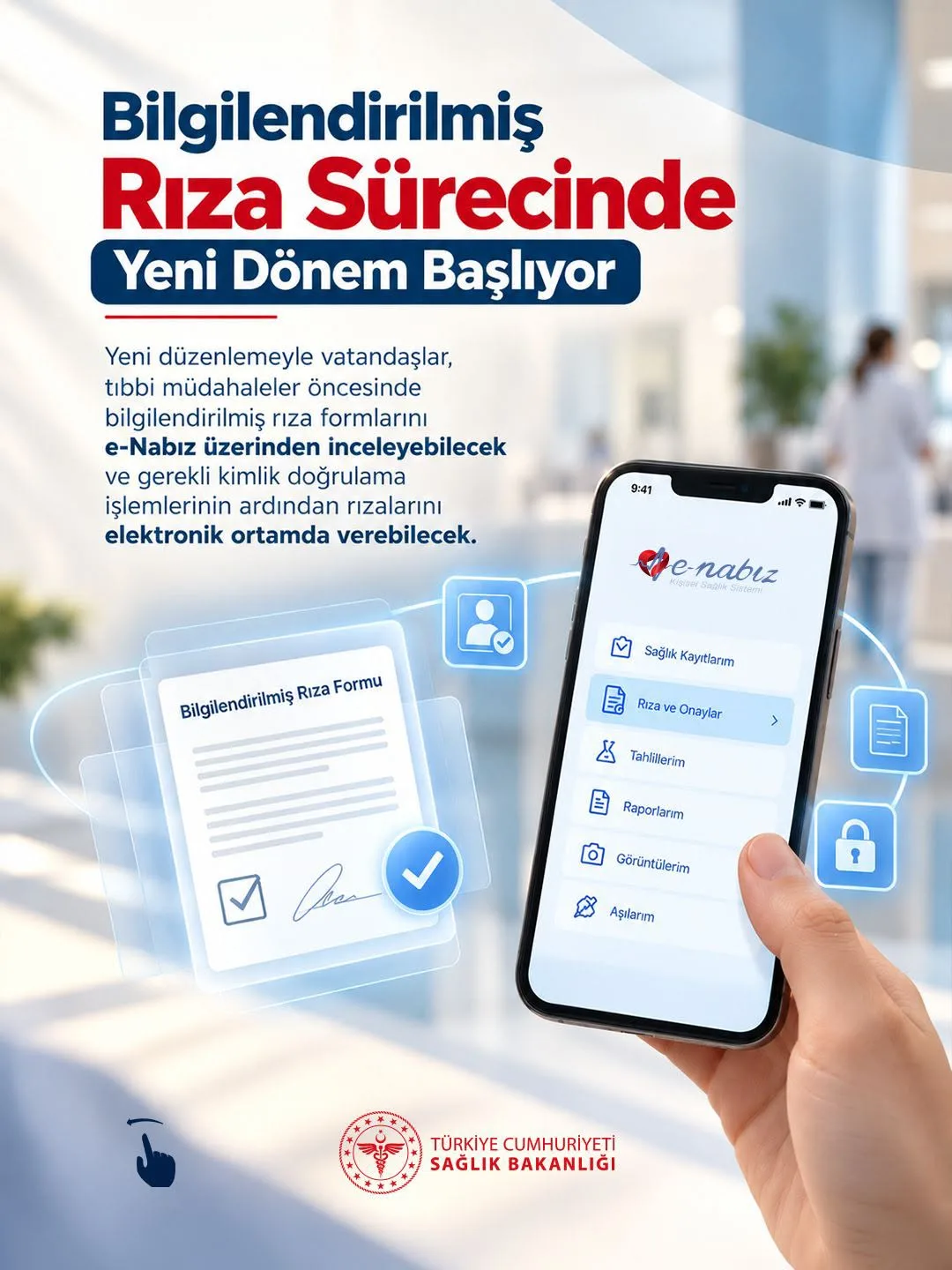
Images are official announcement graphics from the Republic of Türkiye Ministry of Health dated October 27, 2026 (source: Ministry of Health WhatsApp channel); quoted for informational purposes and do not belong to our clinic. The illustrations were generated with AI.
Quick Answer
With the regulation published in the Official Gazette on October 27, 2026, informed consent prior to a medical intervention can be given electronically via e-Nabız or a one-time SMS verification code sent to the patient's mobile phone. The identities of both the patient and the healthcare professional are verified, the form is stored in the Ministry of Health's central system, and the patient can view it via e-Nabız. The regulation covers primary, secondary, and tertiary healthcare facilities; giving consent is not an obligation, but a decision made after being informed, and patient rights are protected.
Table of Contents
- What Is Informed Consent?
- Consent Can Be Given in Two Ways
- Identity Verification and Record Security
- Children and Persons Under Guardianship
- What Should Patients Pay Attention To?
- Information and Consent in Physiotherapy
- Key Takeaways
- Frequently Asked Questions (FAQ)
- 📚 References
- Let's Plan Your Physiotherapy Process Together in Antalya Konyaaltı
Informed Consent Can Now Be Obtained Electronically
On October 27, 2026, the "Regulation on Obtaining Informed Consent Electronically" prepared by the Republic of Türkiye Ministry of Health was published in the Official Gazette (Issue No. 33413). You can access the full Turkish text of the regulation on the relevant page of the Official Gazette.
You can swipe through the Ministry of Health announcement visuals above. In this article, we summarize in plain language what the regulation means for patients.
What Is Informed Consent?
Informed consent means that prior to a medical intervention, the patient accepts the procedure of their own free will after being adequately and clearly informed. In other words, consent begins with a conversation before a signature: what will be done, why will it be done, what are the potential discomforts, and are there other options?
Until now, this acceptance was mostly obtained with a wet signature on a paper form. The new regulation establishes the electronic pathway alongside physical documents.
Consent Can Be Given in Two Ways
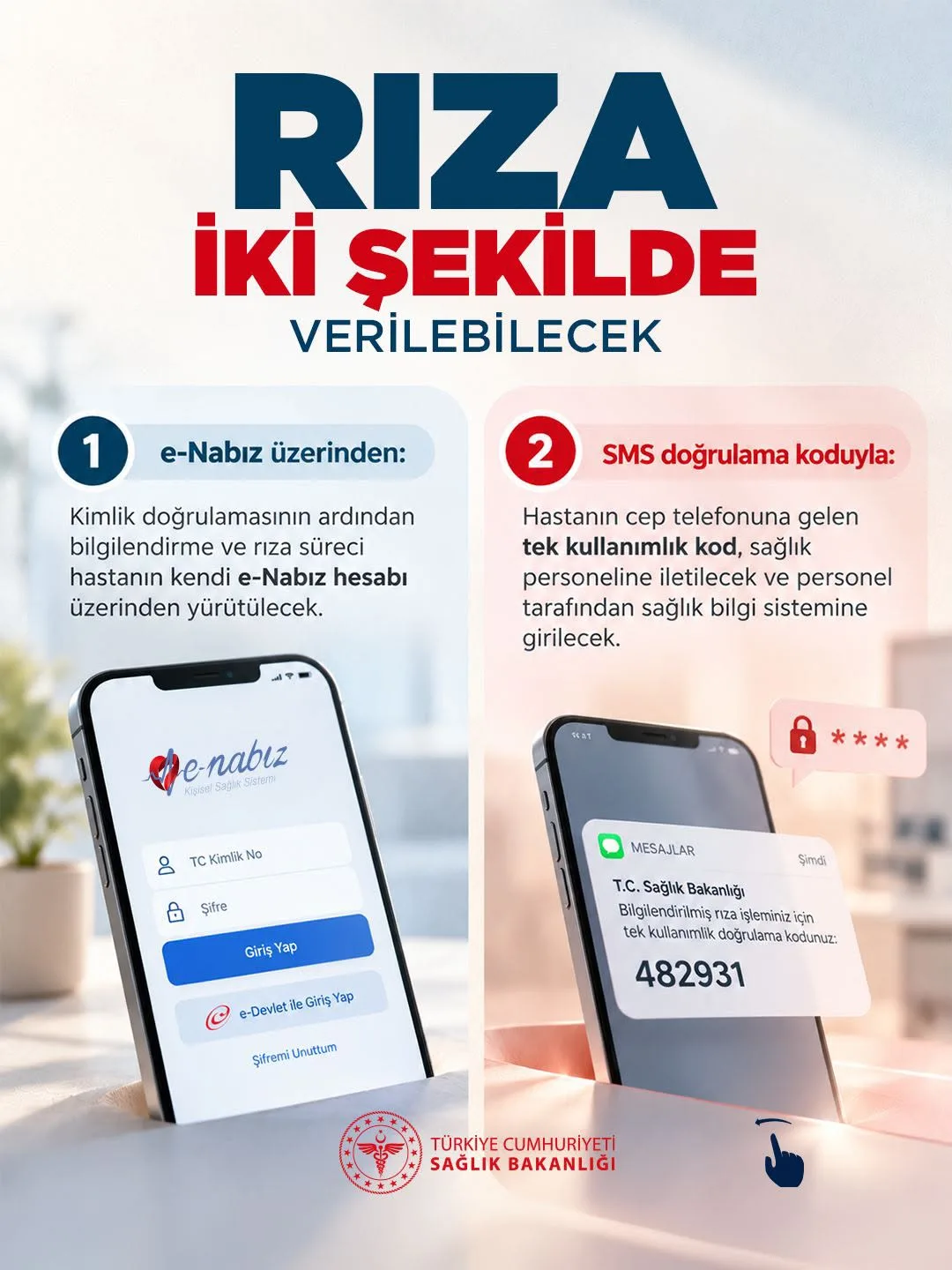
According to the Ministry of Health's announcement, two methods stand out:
- Via e-Nabız: Following identity verification, the information and consent process is carried out through the patient's own e-Nabız account. The patient reviews and approves the form.
- With an SMS verification code: A one-time code valid only for that specific transaction is sent to the patient's mobile phone. The code is shared with the healthcare staff and entered into the health information system.
For electronic consent, the patient must have a verified mobile phone number. A phone number verified via SMS remains valid for 12 months; once this period expires, re-verification is requested.
Identity Verification and Record Security
- When obtaining consent, the identities of both the patient and the healthcare professional are verified; the electronic consent process cannot be initiated before identity verification is completed.
- Forms obtained electronically are transferred to and stored in the Ministry of Health's central data registration system.
- Patients can access these records at any time via e-Nabız.
- The date and time of consent, verification details, and the healthcare professional performing the procedure are recorded; records are maintained with safeguards compliant with personal data protection and cybersecurity legislation.
Children and Persons Under Guardianship
For minors or patients under legal guardianship, transactions are carried out by the legal representative; identity and phone verification of the representative are also required. If there is no legal representative, if they cannot be reached, or if they cannot be verified electronically, consent cannot be obtained electronically. In such cases, the provisions of the Patient Rights Regulation apply.
What Should Patients Pay Attention To?
- Do not approve a form without reading it. You can ask the healthcare professional any questions you have before the procedure.
- Share your SMS code only for the relevant transaction and only with the healthcare professional who informed you.
- Make sure your phone number is up to date and belongs to you.
- You can later view the forms you approved on e-Nabız.
- Consent is not an obligation; it is a decision you make after being informed.
Information and Consent in Physiotherapy
In physiotherapy, sessions are planned after a physician's evaluation and physician approval; a physiotherapist does not make a medical diagnosis. Receiving clear information before a session about its purpose, method, potential discomforts, and options—and making the decision yourself—is a fundamental patient right regardless of the medium.
Note: The regulation covers primary, secondary, and tertiary healthcare facilities. How implementation will operate in detail across every healthcare provider will be clarified by additional procedures and principles from the Ministry of Health. Feel free to contact us for information about the consent process at our clinic.
For general information on the physiotherapy process, you can browse our articles on physiotherapist fields of practice in Antalya and physiotherapy and rehabilitation, as well as our Manual Therapy and Orthopedic Rehabilitation service pages.
Key Takeaways
- Informed consent is a voluntary decision given after being informed.
- Consent can now also be given electronically via e-Nabız or a one-time SMS code.
- The identities of both patient and healthcare professional are verified; forms are stored in the central system and can be viewed on e-Nabız.
- For minors and persons under guardianship, the legal representative steps in.
Frequently Asked Questions (FAQ)
1. What is informed consent? It is the patient's voluntary acceptance of a medical intervention after being informed about the procedure to be performed.
2. How will consent be given electronically? Through the patient's own e-Nabız account or with a one-time SMS verification code sent to their mobile phone.
3. Where will the records be stored? In the Ministry of Health's central data registration system; patients can access them via e-Nabız.
4. How is consent obtained for children and persons under guardianship? Transactions are carried out by the legal representative, whose identity and phone are also verified. If verification cannot be completed, consent cannot be obtained electronically.
5. Which institutions does the regulation cover? Primary, secondary, and tertiary healthcare facilities. Ministry of Health announcements should be followed for implementation details.
6. Why is consent important in physiotherapy? Being able to receive information, ask questions before an application, and make the decision yourself is a fundamental right; the physiotherapy process is planned following a physician's evaluation and approval.
📚 References
- Official Gazette of the Republic of Türkiye, October 27, 2026, Issue No. 33413. Regulation on Obtaining Informed Consent Electronically. resmigazete.gov.tr
- Republic of Türkiye Ministry of Health announcement graphics (October 27, 2026, Ministry of Health WhatsApp channel).
Let's Plan Your Physiotherapy Process Together in Antalya Konyaaltı
Following a physician's evaluation and with your physician's approval, we are happy to listen to you at our clinic in Antalya Konyaaltı and provide information about the process, methods, and your questions before any session.
📍 Ali Öksüz | Fizyoterapist | Özel Sağlık Meslek Hizmet Birimi Toros Mah. 801. Sok. No:4/4 Konyaaltı / Antalya
For information regarding the physiotherapy and rehabilitation consultation process, you can visit our contact and information page.
Legal Disclaimer: This page has been prepared for general informational purposes and does not constitute legal advice; it does not replace a physician's diagnosis, personal evaluation, or any promise of definitive recovery. For statutory provisions, the current text in the Official Gazette prevails. Prepared in compliance with the Health Promotion and Information Regulation.
Related Treatments
The methods described in this article are delivered within the following treatments.
Frequently Asked Questions
The most common questions about this topic. If you can't find your answer, message us directly on WhatsApp.
It is the patient's voluntary acceptance of a medical procedure after being clearly informed about the intervention to be performed. The regulation governs how this acceptance can be obtained electronically.
In two ways: through the patient's own e-Nabız account or via a one-time SMS verification code sent to their mobile phone. In the SMS method, the code is shared with the healthcare staff and entered into the health information system.
Forms obtained electronically are transferred to and stored in the central data registration system of the Ministry of Health; the patient can access these records via e-Nabız.
For minors or persons under legal guardianship, procedures are carried out by the legal representative. Identity and phone verification of the legal representative are also required; if there is no representative or verification cannot be completed electronically, consent cannot be obtained electronically.
It applies to primary, secondary, and tertiary healthcare facilities. Announcements from the Ministry of Health should be followed regarding how implementation will proceed across individual healthcare providers.
In physiotherapy, applications are planned after a physician's assessment and physician approval. Receiving information about the purpose, possible discomforts, and alternatives of a method and asking questions before the session is a fundamental right so that the decision remains yours.
Related Articles
More articles that look at this topic from other angles.
Physiotherapist in Antalya: Definition, History and Fields of Practice
What is a physiotherapist, what are the sub-disciplines? A comprehensive guide to legal authority, history, and physical therapy in Antalya, Turkey.
Read moreWhy Neurological and Orthopedic Rehabilitation Matters
We look at the role of rehabilitation and physiotherapy, with academic evidence, in helping tissues regain their strength after surgery or trauma.
Read moreManual Therapy in Antalya: Joint and Spine Rehabilitation
Looking for manual therapy in Antalya? An informative guide to the Mulligan, Maitland and Kaltenborn concepts applied at our Konyaaltı clinic, how sessions work and clinical reformer pilates.
Read moreReady to talk about your complaint?
Call or message us on WhatsApp for a personalised clinical physiotherapy programme after your physician's diagnosis. I'm happy to answer your questions.
About the Author
Physiotherapist Ali Oksuz
Physiotherapist providing clinical physiotherapy services in Konyaaltı, Antalya. Applies evidence-based approaches (Mulligan, Maitland, Vodder MLD) in manual therapy, lymphedema rehabilitation, clinical reformer pilates, and orthopedic rehabilitation. The articles convey the physiotherapy process after a physician's diagnosis for informational purposes; it does not replace medical treatment.