
What Do the Words on Your MRI Report Mean? Bulging, Protrusion, Extrusion, Sequestration - Herniated Disc in 14 Questions Day 3
Day 3 of the 'Herniated Disc in 14 Questions' series: what do bulging, protrusion, extrusion and sequestration mean on an MRI report? Are these terms a sequence of worsening stages? Physiotherapist Ali Öksüz explains.

Physiotherapist
Last updated: · Reviewed by: Fzt. Ali Öksüz

Page 1/6
The slides are in Turkish. The images are not treatment photos; they were created with artificial intelligence for illustrative purposes. Cross-sectional diagrams are simplified and not to scale.
Quick Answer
Bulging, protrusion, extrusion and sequestration are radiological terms that describe the shape of an intervertebral disc on an MRI scan. Bulging refers to a broad outward extension of the disc contour, protrusion describes a localized outpouching with a wide base, extrusion means the outer portion is wider than its connecting base, and sequestration refers to a fragment separated from the disc. These terms are not a mandatory progression of worsening stages; an MRI alone does not dictate clinical decisions—findings are evaluated together with symptoms and the physical examination.
Table of Contents
- Bulging: Broad Outward Extension
- Protrusion: Localized Outpouching
- Extrusion: Outer Portion Wider Than Its Base
- Sequestration: Separated Disc Fragment
- Are These Terms a Sequence of Worsening Stages?
- An MRI Alone Does Not Make the Decision
- 🚩 When You Should See a Physician
- Key Takeaways for Today
- Frequently Asked Questions (FAQ)
- 📚 Scientific Sources
- Low Back Pain Assessment in Antalya Konyaaltı
What Do the Words on Your MRI Report Mean? Bulging, Protrusion, Extrusion, Sequestration
Many clients reading their lumbar MRI report get stuck on the same words: "Bulging, protrusion, extrusion, sequestration..." Although these terms can sound alarming at first glance, they are simply radiological descriptors that explain the shape of the disc on the MRI scan.
On the third day of our "Herniated Disc in 14 Questions" series, we break down these terms in plain language. You can swipe through the 6-page post above (in Turkish) and also check our posts on Instagram and X (Twitter). For the previous days of the series, see What Is a Herniated Disc? Is Every Low Back Pain a Hernia? and What Do L4-L5 and L5-S1 Mean?.
Bulging: Broad Outward Extension
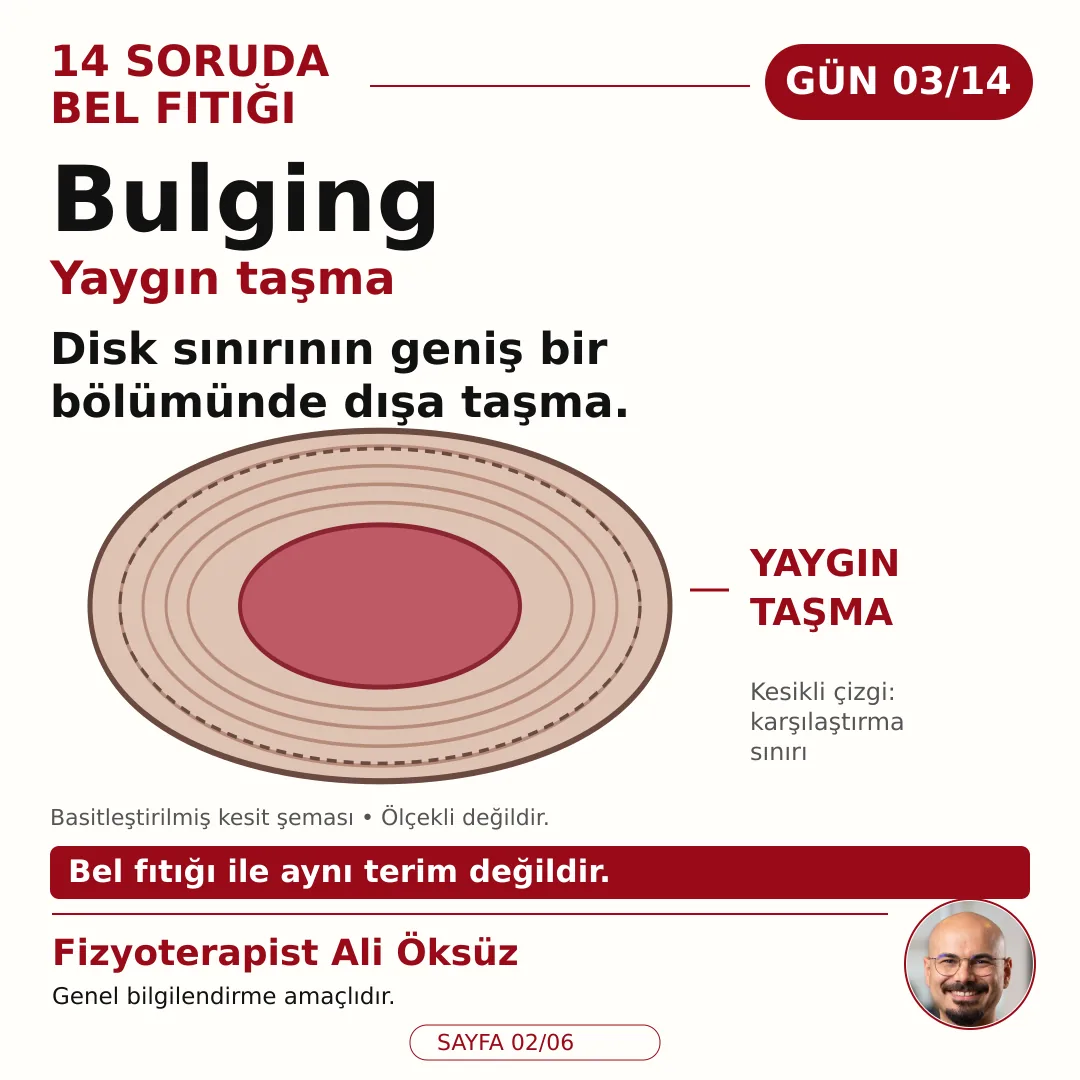
Bulging means the outer contour of the disc extends outward across a wide portion of its circumference. You can think of it as a broad, smooth widening around the disc margin rather than a focal pocket.
Note: Bulging is not the same radiological term as a herniated disc.
Protrusion: Localized Outpouching
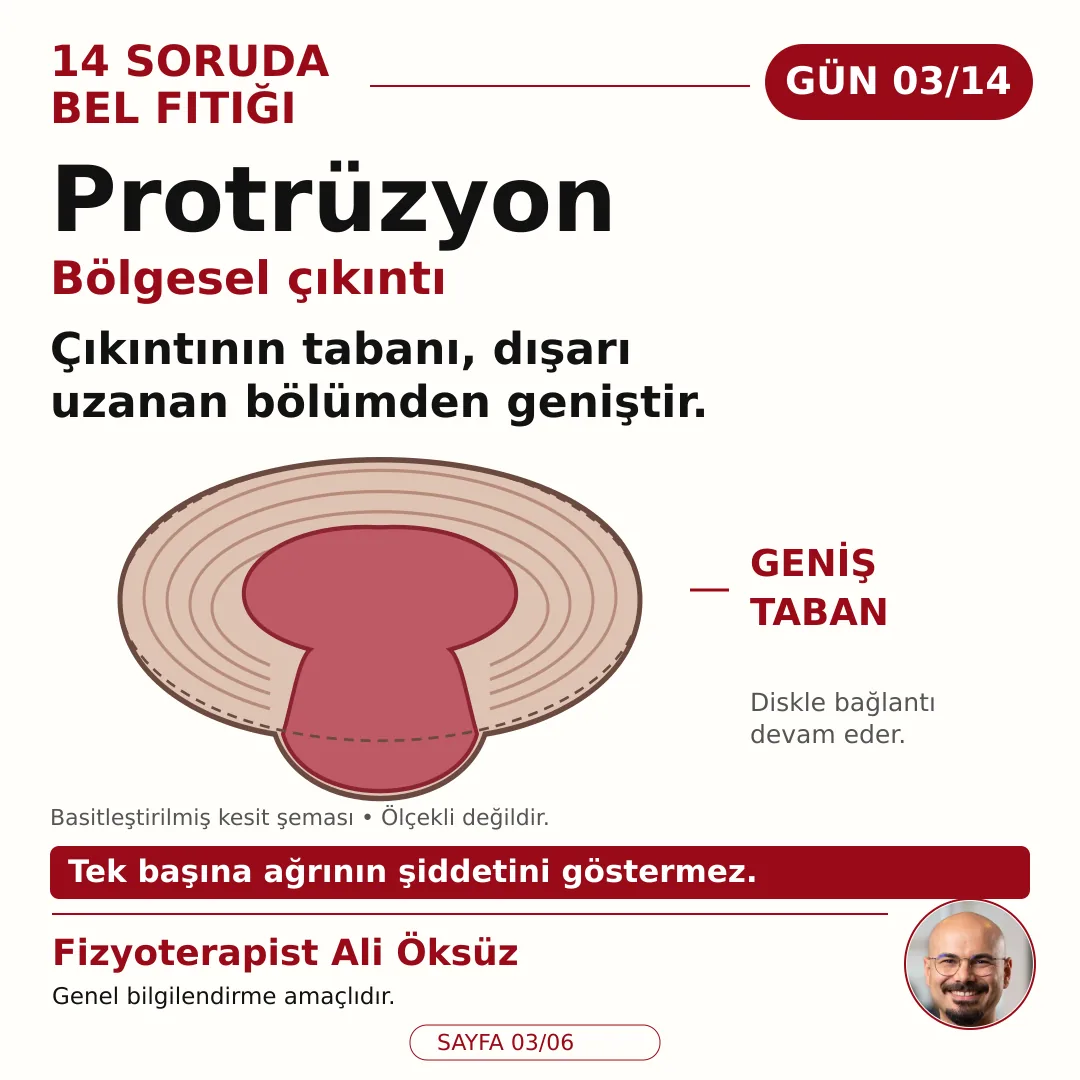
A protrusion is a focal or localized outpouching of disc tissue. Its defining feature is that the base of the outpouching is wider than the portion extending outward. Connection with the parent disc continues across a relatively wide base.
Seeing "protrusion" on a report does not, by itself, indicate how severe your pain is.
Extrusion: Outer Portion Wider Than Its Base
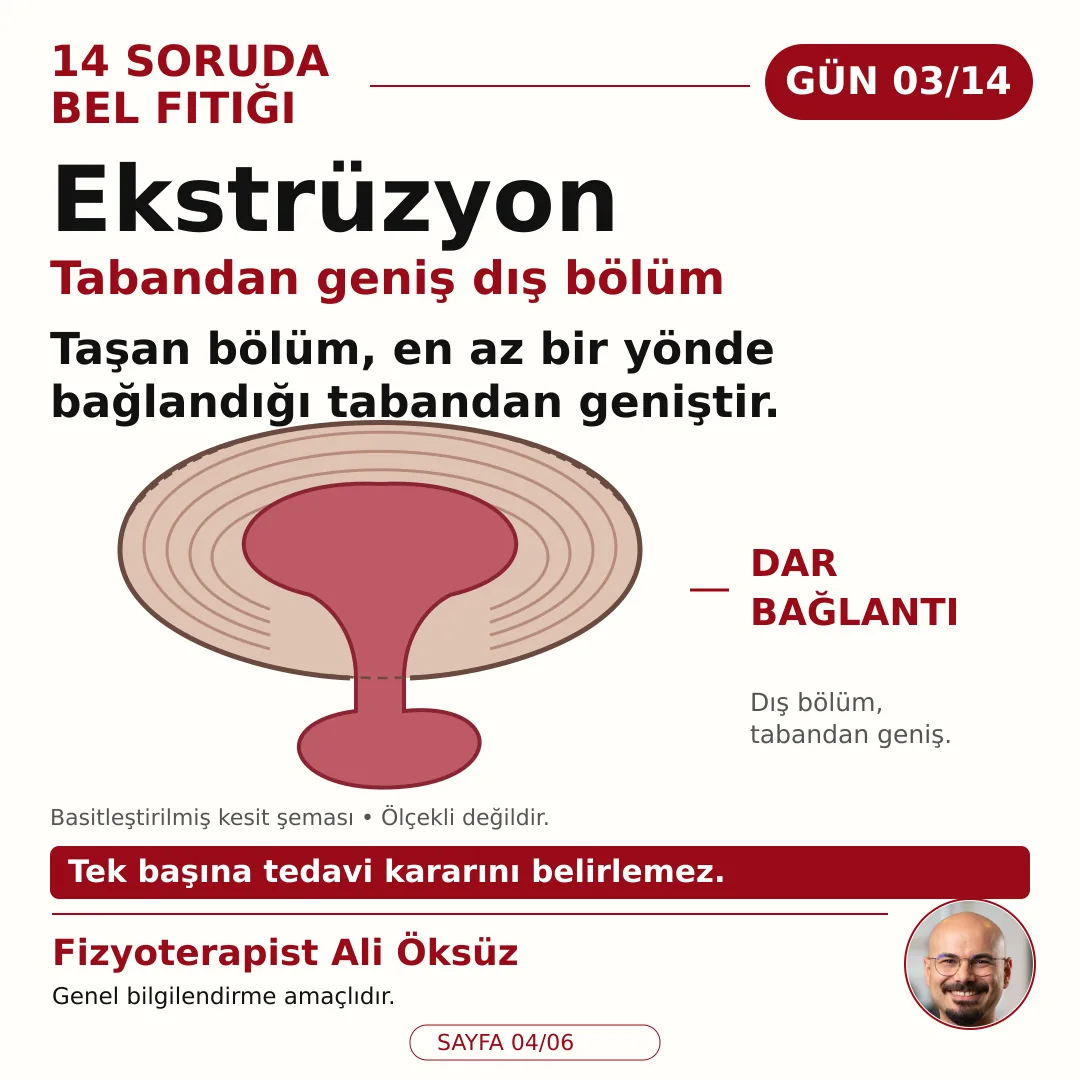
In an extrusion, the displaced disc material is wider in at least one plane than the base (neck) connecting it to the parent disc. In other words, the outer portion is larger than its attachment point, leaving a narrower connection.
Seeing "extrusion" on a report does not determine the treatment decision on its own.
Sequestration: Separated Disc Fragment
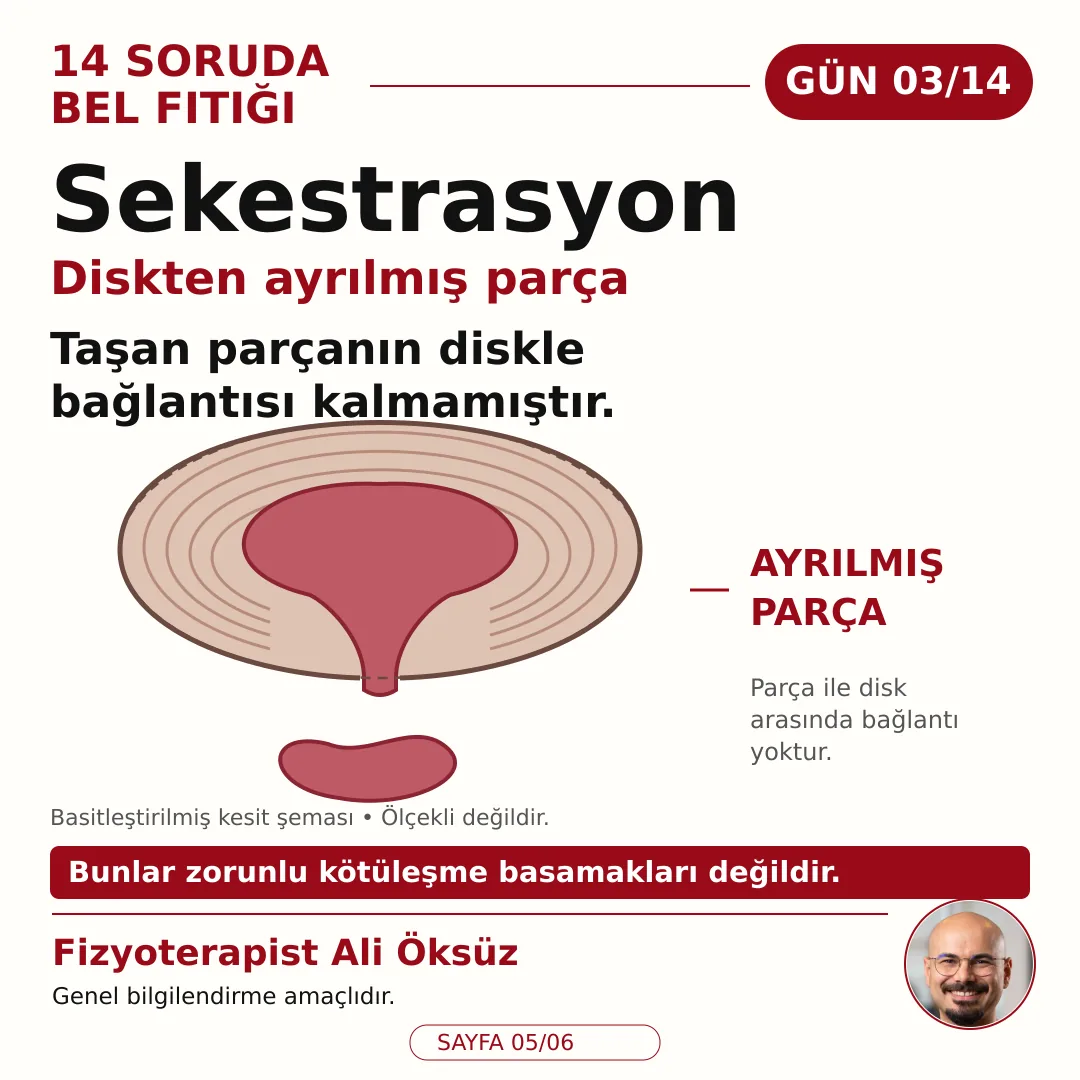
In sequestration, the displaced disc material no longer has continuity with the parent disc. It is described as a free or separated fragment.
Are These Terms a Sequence of Worsening Stages?
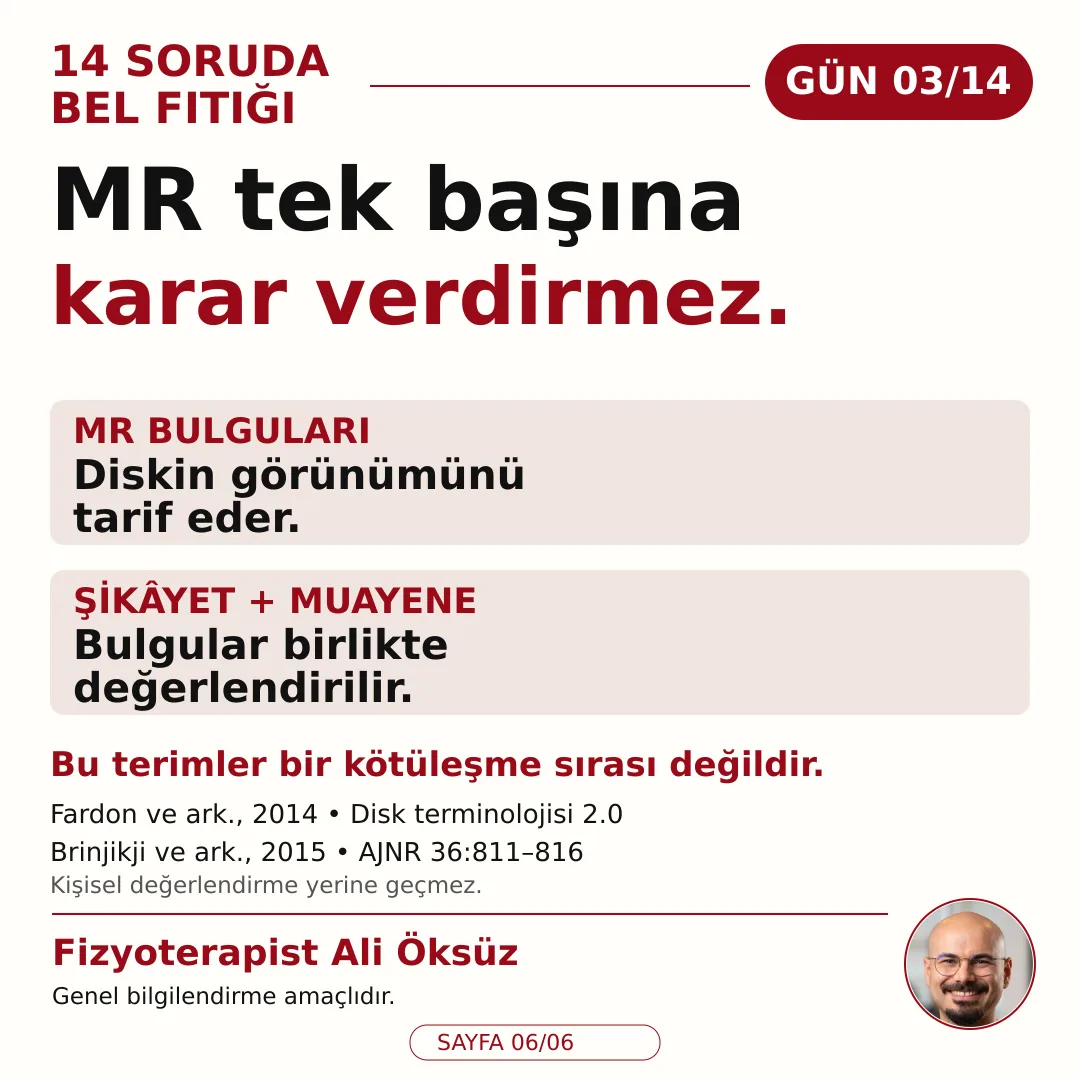
No. Bulging, protrusion, extrusion and sequestration are not mandatory "Stage 1, Stage 2, Stage 3" steps of a single progressive disease. Each word describes the visual contour of the disc on MRI. Having one of these terms on your report does not mean your spine will inevitably progress to the others.
As we highlighted on Day 1, disc changes on MRI are also frequently observed in people who have no back pain at all. That is why the term itself does not tell us the intensity of your pain or dictate a single treatment pathway on its own.
An MRI Alone Does Not Make the Decision
Important: MRI findings describe how the disc looks. Symptoms and the physical examination are evaluated together with those imaging findings.
During clinical assessment, the history of the complaint, how it affects daily activities, and—when indicated—neurological findings (muscle strength, sensation, reflexes) are considered together. From a kinetic chain perspective, the lower back is evaluated alongside the hips, thoracic spine and daily posture habits. For a broader look at low back pain, see our Low Back Pain Physiotherapy article, and for disc-specific care, see Herniated Disc Physiotherapy. You can also review our Manual Therapy and Orthopedic Rehabilitation pages.
🚩 When You Should See a Physician
- Progressive weakness or numbness in the leg.
- Changes in bladder or bowel control, or numbness in the saddle/groin region.
- Severe low back pain after trauma.
- Fever, unexplained weight loss, or nighttime pain that does not ease with rest.
With these symptoms, a physician's evaluation comes first; seek emergency medical care if necessary.
Key Takeaways for Today
- Bulging is a broad outward contour extension; protrusion is a localized outpouching with a wide base.
- In extrusion, the outer portion is wider than its base; in sequestration, the fragment has separated from the disc.
- These terms are not a mandatory worsening sequence, and an MRI report alone does not dictate clinical decisions.
Frequently Asked Questions (FAQ)
1. What does 'bulging' mean on an MRI report? It describes a broad outward extension along a wide section of the disc border. It is not the same term as a herniated disc.
2. What is the difference between protrusion and extrusion? In a protrusion, the base of the outpouching is wider than the outward-extending part. In an extrusion, the displaced part is wider in at least one direction than the base connecting it to the disc.
3. What does 'sequestration' mean? It means the displaced disc fragment is no longer connected to the parent disc.
4. Are these terms a sequence of worsening stages? No. They describe the shape of the disc on MRI; they are not mandatory stages of deterioration.
5. Is treatment determined solely by the term on my report? Not on its own. MRI findings, clinical symptoms and the physical examination are evaluated together.
📚 Scientific Sources
- Fardon DF, Williams AL, Dohring EJ, Murtagh FR, Gabriel Rothman SL, Sze GK. Lumbar disc nomenclature: version 2.0. Spine J. 2014. pubmed.ncbi.nlm.nih.gov/24768732
- Brinjikji W, Luetmer PH, Comstock B, et al. Systematic literature review of imaging features of spinal degeneration in asymptomatic populations. AJNR Am J Neuroradiol. 2015;36(4):811-816. pubmed.ncbi.nlm.nih.gov/25430861
Low Back Pain Assessment in Antalya Konyaaltı
If you are wondering what the terms on your MRI report mean for your daily life, with your physician's approval we can evaluate your symptoms and movements together at our clinic in Konyaaltı, Antalya.
📍 Ali Öksüz | Fizyoterapist | Özel Sağlık Meslek Hizmet Birimi Toros Mah. 801. Sok. No:4/4 Konyaaltı / Antalya
For information regarding the physiotherapy and rehabilitation consultation process, you can visit our contact and information page.
Legal Disclaimer: This page is for general information; it does not replace a physician's diagnosis, an individual assessment or a definitive cure promise. It has been prepared in accordance with the Health Advertising Regulation.
Related Treatments
The methods described in this article are delivered within the following treatments.
Frequently Asked Questions
The most common questions about this topic. If you can't find your answer, message us directly on WhatsApp.
Bulging refers to a generalized outward extension across a wide portion of the disc's outer contour. In standard spine nomenclature, a diffuse bulge is not the same term as a disc herniation.
In a protrusion, the base of the outpouching is wider than the displaced material extending outward, and continuity with the disc remains broad. In an extrusion, the displaced portion is wider in at least one dimension than the neck connecting it to the disc.
Sequestration describes a subtype of extrusion in which the displaced disc fragment has lost continuity with the parent disc—meaning it is a separated fragment.
No. They are morphological terms that describe how the disc looks on imaging; they are not mandatory steps that every patient progresses through.
Not on its own. The radiological term does not measure pain intensity or determine the care plan by itself; MRI findings, symptoms and the clinical examination are assessed together.
Related Articles
More articles that look at this topic from other angles.
Why Does a Lower Back Problem Cause Leg Pain? Herniated Disc and Leg Pain - Herniated Disc in 14 Questions Day 4
Day 4 of the 'Herniated Disc in 14 Questions' series: why can a lower back problem cause leg pain, tingling, numbness or weakness? Is every pain radiating down the leg a herniated disc? Physiotherapist Ali Öksüz explains.
Read moreWhat Is a Herniated Disc? Is Every Low Back Pain a Hernia? Herniated Disc in 14 Questions - Day 1
Day 1 of the 'Herniated Disc in 14 Questions' series: not every low back pain is a herniated disc. What is a herniated disc, what does an MRI tell us, and what is looked at in the assessment? Physiotherapist Ali Öksüz explains.
Read moreAntalya Lumbar Disc Herniation Treatment and Medical Exercise
Do you have persistent lower back and leg pain in Antalya? Read about clinical treatment for herniated disc, the difference manual therapy makes, and clinical reformer pilates.
Read moreReady to talk about your complaint?
Call or message us on WhatsApp for a personalised clinical physiotherapy programme after your physician's diagnosis. I'm happy to answer your questions.
About the Author
Physiotherapist Ali Oksuz
Physiotherapist providing clinical physiotherapy services in Konyaaltı, Antalya. Applies evidence-based approaches (Mulligan, Maitland, Vodder MLD) in manual therapy, lymphedema rehabilitation, clinical reformer pilates, and orthopedic rehabilitation. The articles convey the physiotherapy process after a physician's diagnosis for informational purposes; it does not replace medical treatment.