
What Happens When a Nerve Root Is Affected? Warning Signs Not to Ignore in a Herniated Disc - Herniated Disc in 14 Questions Day 5
Day 5 of the 'Herniated Disc in 14 Questions' series: how is a nerve root affected by mechanical pressure and inflammation, what do numbness and weakness mean, and which symptoms require immediate emergency care? Physiotherapist Ali Öksüz explains.

Physiotherapist
Last updated: · Reviewed by: Fzt. Ali Öksüz


Page 1/6
The slides are in Turkish. The images are not treatment photos; they were created with artificial intelligence for illustrative purposes. Schematic illustrations are simplified and are not a diagnostic map.
Quick Answer
On Day 4 we explained why pain can radiate down the leg; on Day 5 we focus on what happens at the nerve root and which warning signs should never be ignored. A nerve root can be affected both by mechanical pressure from displaced disc tissue and by the surrounding inflammatory response. If there is new or progressive loss of strength, difficulty urinating or changes in bladder/bowel control, or numbness around the groin/saddle area, emergency medical care must be sought immediately; in these situations, a physician's evaluation comes first.
Table of Contents
- Quick Recap: The Connection Between Lower Back and Leg
- How Is the Nerve Root Affected?
- Pain and Accompanying Symptoms
- Not Every Leg Pain Is a Herniated Disc
- 🚩 Which Symptoms Mean You Should Not Wait?
- Key Takeaways for Today
- Frequently Asked Questions (FAQ)
- 📚 Scientific Sources
- Evaluation of Low Back Pain Radiating to the Leg in Antalya Konyaaltı
What Happens When a Nerve Root Is Affected? Which Symptoms Should You Not Wait On?
At our clinic in Antalya, clients often ask two connected questions: "Is my nerve pinched?" and "When should I see a doctor right away?" Today we look at both questions together.
Day 5 of our "Herniated Disc in 14 Questions" series builds directly on Day 4. On Day 4, we explained how nerves exiting the lower back travel into the leg and why pain can be felt down the leg. Today we focus on what happens at the nerve root itself and which warning signs mean you should not wait. You can swipe through the 6-page post above (in Turkish), and also view the Instagram post and YouTube Shorts video.
Previous days of the series: What Is a Herniated Disc? Is Every Low Back Pain a Hernia?, What Do L4-L5 and L5-S1 Mean?, What Do the Words on Your MRI Report Mean? and Why Does a Lower Back Problem Cause Leg Pain?.
Quick Recap: The Connection Between Lower Back and Leg
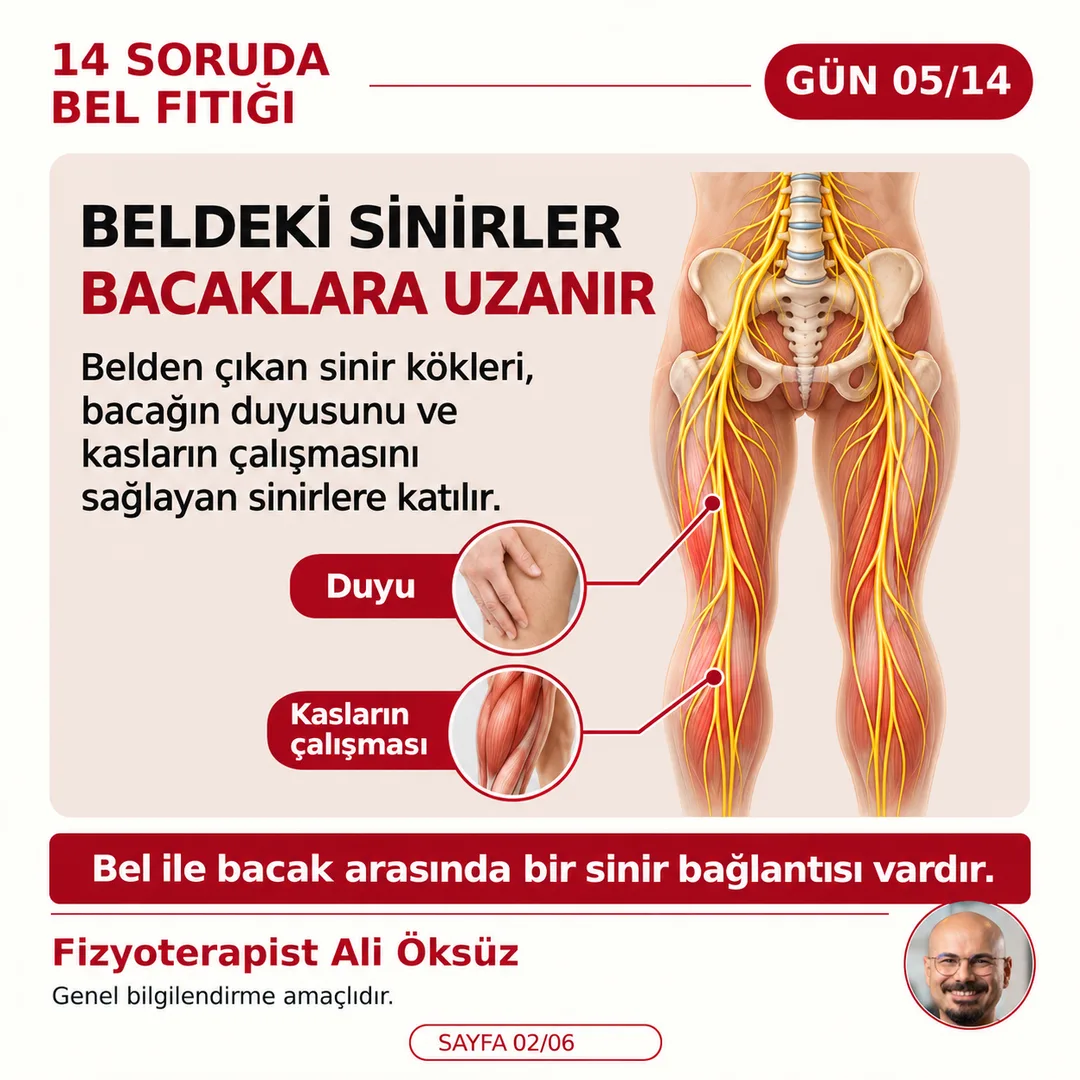
Nerve roots exiting the lumbar spine join the nerves that provide sensation to the leg and control its muscles. That is why a lower back issue can be felt in the leg; see our Day 4 article for details.
How Is the Nerve Root Affected?
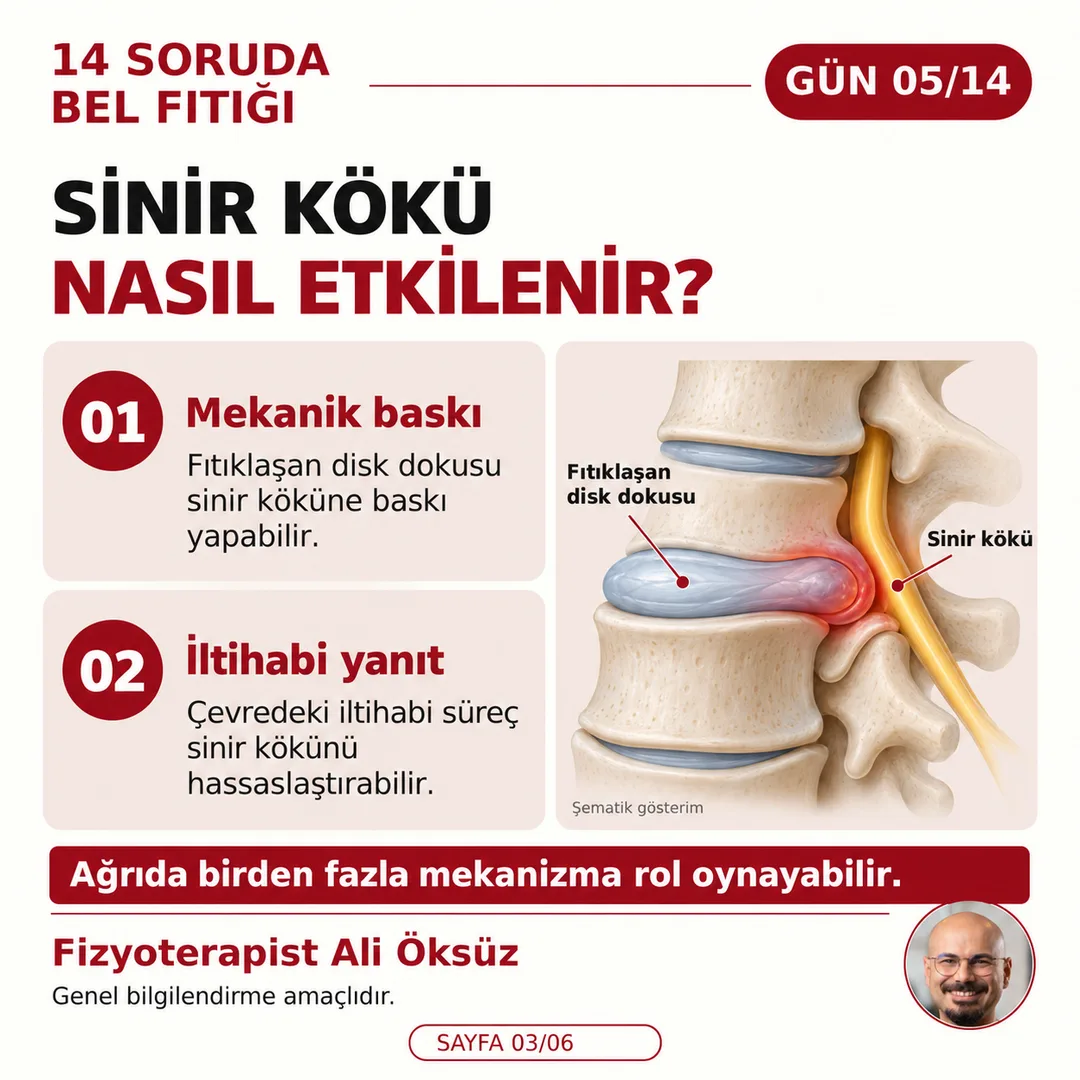
This is today's core topic. Schematically, two main mechanisms stand out:
- Mechanical pressure: Herniated disc tissue can press on the nerve root. Under compression, the nerve root may not transmit sensory and motor signals smoothly, which can be experienced as pain, numbness or muscle weakness.
- Inflammatory response: An inflammatory process developing around the displaced disc tissue can sensitize the nerve root. Even when mechanical compression is not dramatic, pain can arise through this chemical irritation.
Note: More than one mechanism can contribute to pain at the same time.
For this reason, the intensity of pain does not always match the size of the herniation on MRI. To review what the descriptive terms on your MRI report mean, see our Day 3 article.
Pain and Accompanying Symptoms
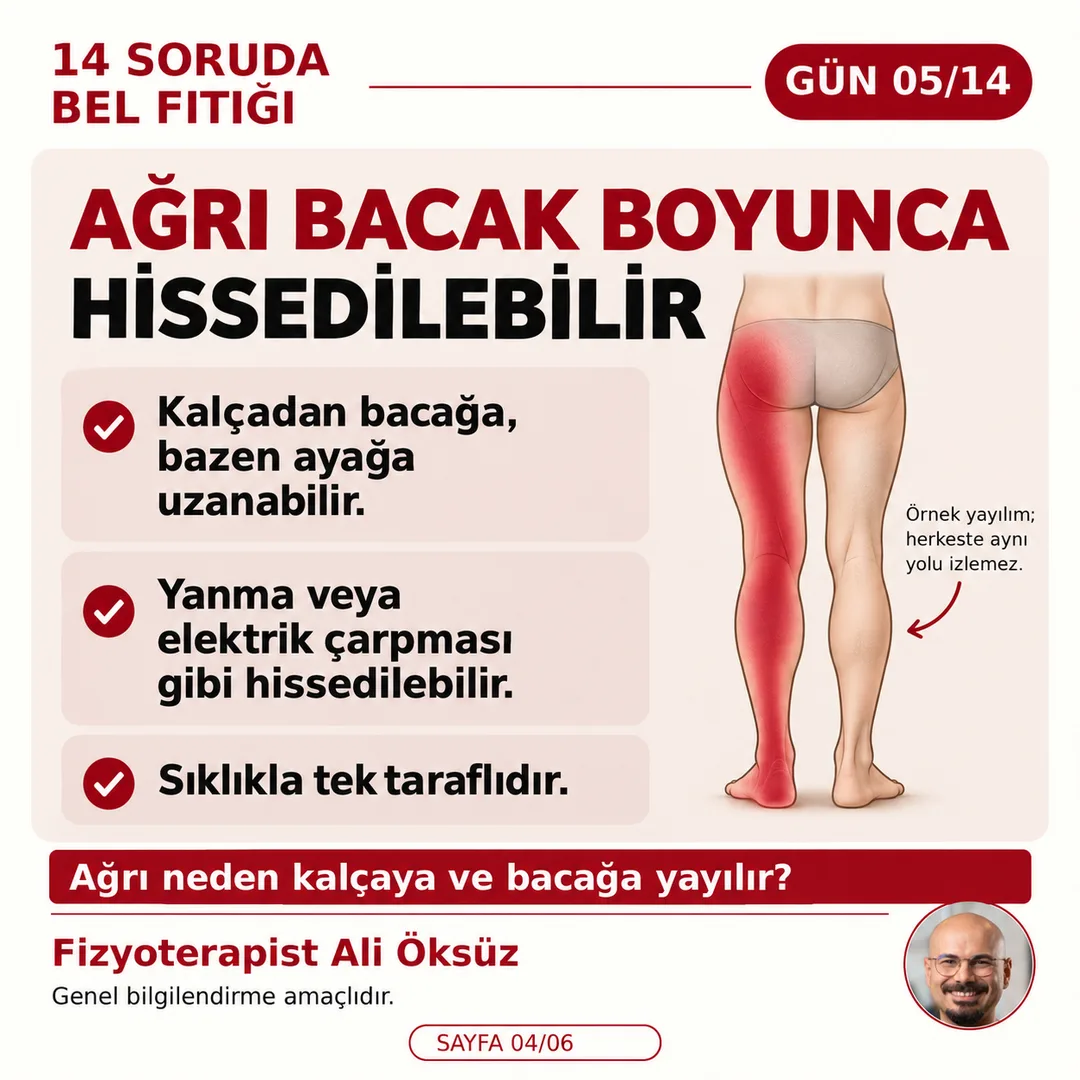
Nerve-root-related pain can extend from the buttock down the leg and sometimes into the foot; it may feel like burning or an electric shock and is frequently one-sided. Its exact path varies from person to person—the diagram in the slides is an example, not a diagnostic map. Numbness, tingling and muscle weakness may accompany the pain, though they do not all have to be present together. For a fuller overview of these symptoms, see our Day 4 post.
The key distinction today is this: numbness—and especially muscle weakness—are findings that require closer medical attention.
Not Every Leg Pain Is a Herniated Disc
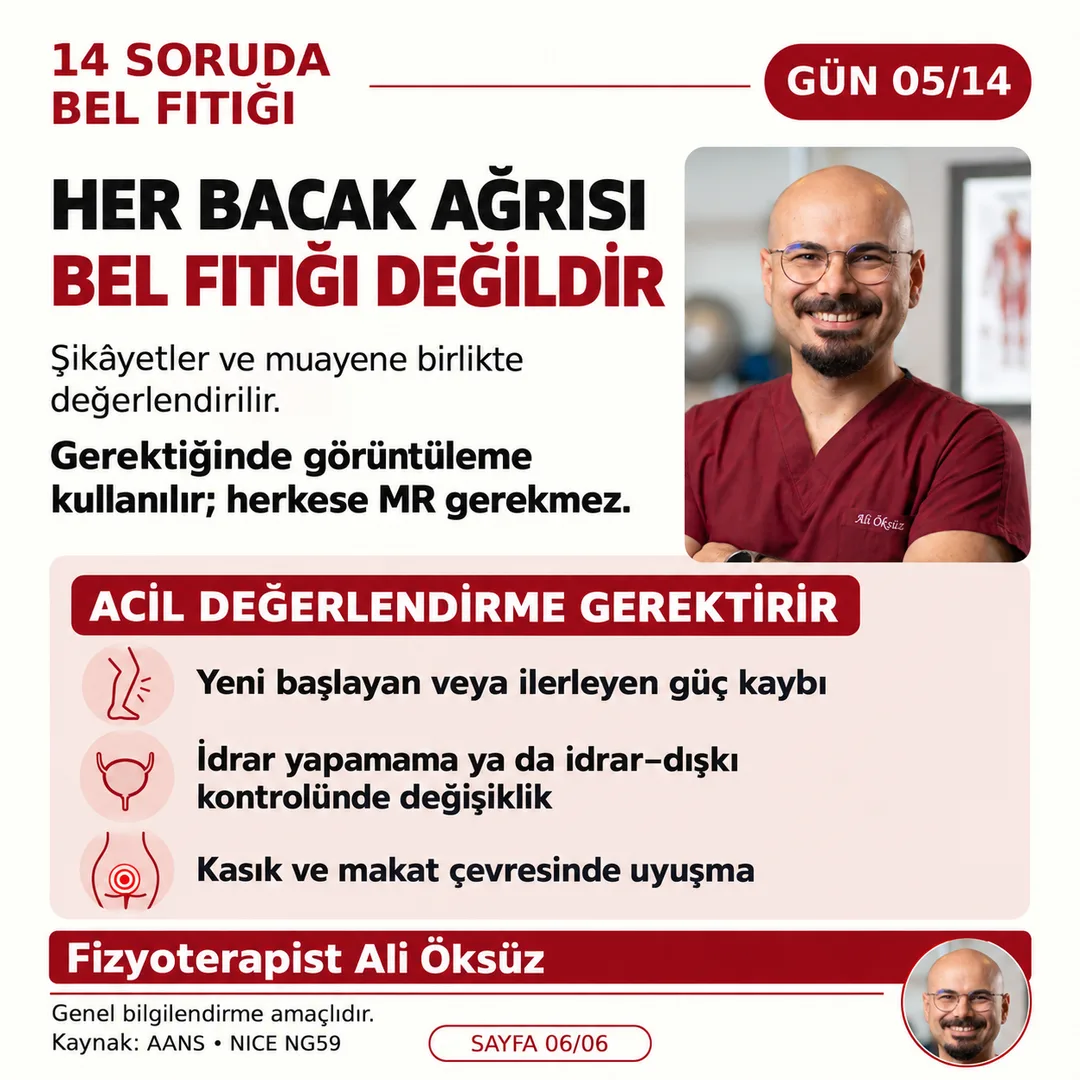
A lumbar disc herniation is not the only cause of leg pain. Symptoms and the physical examination are evaluated together; imaging is ordered when needed, and not everyone requires an MRI. From a kinetic chain perspective, the lower back, hips and daily posture habits are also considered together. A physiotherapist does not make a medical diagnosis; the clinical process always proceeds following a physician's diagnosis and approval.
🚩 Which Symptoms Mean You Should Not Wait?
The following symptoms suggest that neural structures may be more seriously affected. In these situations, seek emergency medical care without delay:
- New or progressive loss of strength: Such as difficulty lifting the foot (foot drop) or the leg giving way.
- Inability to urinate or changes in bladder or bowel control
- Numbness around the groin, buttocks or perianal (saddle) area
When any of these signs are present, a physician's assessment is the immediate priority—do not wait to try exercises or physiotherapy first. This warning list is independent of pain intensity: even someone with mild pain should be evaluated urgently if any of these neurological signs appear.
Even if these emergency signs are absent, a physician's evaluation remains important whenever radiating leg pain, numbness or tingling persists. For the rehabilitation process planned after your physician's approval, see our Herniated Disc Physiotherapy and Low Back Pain Physiotherapy articles, as well as our Manual Therapy and Orthopedic Rehabilitation pages.
Key Takeaways for Today
- A nerve root can be affected by both mechanical pressure and an inflammatory response; pain severity is not always proportional to the size of the herniation.
- Not every leg pain is a herniated disc; symptoms and the clinical examination are evaluated together.
- If you notice new or worsening weakness, difficulty urinating or changes in bladder/bowel control, or numbness in the groin/saddle region, seek emergency medical care immediately.
Frequently Asked Questions (FAQ)
1. How is a nerve root affected? Mechanical pressure and local inflammation are the two primary mechanisms; more than one mechanism can contribute to pain.
2. Does the severity of pain show how large the herniation is? Not always. Because inflammation plays a role alongside mechanical compression, symptom severity and imaging findings do not always go hand in hand.
3. What do numbness and weakness mean? They suggest nerve root involvement; any new or progressive loss of strength requires prompt medical evaluation.
4. Which symptoms require urgent emergency evaluation without waiting? New or progressive loss of strength, inability to urinate or changes in bladder/bowel control, and numbness in the groin or saddle area.
5. Is every leg pain a herniated disc? No. Symptoms and the physical examination are evaluated together; imaging is used when necessary, and not everyone needs an MRI.
📚 Scientific Sources
- American Association of Neurological Surgeons (AANS). Herniated Disc. aans.org
- NICE. Low back pain and sciatica in over 16s: assessment and management (NG59). nice.org.uk/guidance/ng59
Evaluation of Low Back Pain Radiating to the Leg in Antalya Konyaaltı
Following a physician's evaluation for pain, tingling or numbness radiating into your leg, with your physician's approval we can assess your symptoms and movement patterns together at our clinic in Konyaaltı, Antalya.
📍 Ali Öksüz | Fizyoterapist | Özel Sağlık Meslek Hizmet Birimi Toros Mah. 801. Sok. No:4/4 Konyaaltı / Antalya
For information regarding the physiotherapy and rehabilitation consultation process, you can visit our contact and information page.
Legal Disclaimer: This page is for general information; it does not replace a physician's diagnosis, an individual assessment or a definitive cure promise. It has been prepared in accordance with the Health Advertising Regulation.
Related Treatments
The methods described in this article are delivered within the following treatments.
Frequently Asked Questions
The most common questions about this topic. If you can't find your answer, message us directly on WhatsApp.
Two mechanisms stand out: mechanical pressure from displaced disc tissue on the nerve root, and a local inflammatory process that sensitizes the nerve root. More than one mechanism can play a role in pain.
Not always. Because the inflammatory response can play a role alongside mechanical pressure, pain intensity and imaging findings do not always run in parallel.
They are signs suggesting that the nerve root’s signal conduction is affected; not all of them have to occur together. New or progressive loss of strength requires prompt medical evaluation without delay.
New or progressive loss of strength, inability to urinate or changes in bladder/bowel control, and numbness around the groin or perianal (saddle) area require urgent evaluation. In these cases, you should go to emergency medical services immediately.
No. Symptoms and the physical examination are evaluated together; imaging is used when clinically indicated, and not everyone needs an MRI. Diagnosis is made by a physician.
Related Articles
More articles that look at this topic from other angles.
Why Does a Lower Back Problem Cause Leg Pain? Herniated Disc and Leg Pain - Herniated Disc in 14 Questions Day 4
Day 4 of the 'Herniated Disc in 14 Questions' series: why can a lower back problem cause leg pain, tingling, numbness or weakness? Is every pain radiating down the leg a herniated disc? Physiotherapist Ali Öksüz explains.
Read moreWhat Is a Herniated Disc? Is Every Low Back Pain a Hernia? Herniated Disc in 14 Questions - Day 1
Day 1 of the 'Herniated Disc in 14 Questions' series: not every low back pain is a herniated disc. What is a herniated disc, what does an MRI tell us, and what is looked at in the assessment? Physiotherapist Ali Öksüz explains.
Read moreAntalya Lumbar Disc Herniation Treatment and Medical Exercise
Do you have persistent lower back and leg pain in Antalya? Read about clinical treatment for herniated disc, the difference manual therapy makes, and clinical reformer pilates.
Read moreReady to talk about your complaint?
Call or message us on WhatsApp for a personalised clinical physiotherapy programme after your physician's diagnosis. I'm happy to answer your questions.
About the Author
Physiotherapist Ali Oksuz
Physiotherapist providing clinical physiotherapy services in Konyaaltı, Antalya. Applies evidence-based approaches (Mulligan, Maitland, Vodder MLD) in manual therapy, lymphedema rehabilitation, clinical reformer pilates, and orthopedic rehabilitation. The articles convey the physiotherapy process after a physician's diagnosis for informational purposes; it does not replace medical treatment.